
Partially hydrolyzed guar gum,
does it really help with Gut health, bowel movements, IBS?
research showsPHGG is a soluble dietary fiber, and there are human studies looking at IBS symptoms and satisfaction with bowel movements, as well as data showing changes in gut-microbiota markers. However, key studies are often open-label, small, unblinded, or focused on surrogate markers, so they do not strongly prove overall "gut health."
ads claimAdvertising mentions 'food for probiotics,' 'intestinal environment,' 'bowel activity,' 'IBS,' 'less gas,' and 'daily comfort.'
Useful facts when choosing a product
- Study doses are usually in the range of several g/day and may differ from a product serving size.
- Gas and bloating can occur if intake is increased suddenly, so an adaptation period may be needed.
- Although it is derived from guar gum, partial hydrolysis makes its viscosity and fermentation characteristics different from ordinary guar gum.
- Gut-flora changes are surrogate markers and do not always match symptom improvement.
What the research actually shows
A 2002 multicenter open-label randomized study reported better subjective tolerability and symptom-improvement signals with PHGG than with wheat bran in IBS patients. A 2006 Nutrition review summarized the possibility that PHGG may improve abdominal pain and quality of life in IBS, but the evidence was limited. Studies in healthy people and patients report prebiotic markers such as increased bifidobacteria, but these are not substitutes for clinical gut-health endpoints.
Why this is classified as C (55)
There are human signals for IBS and bowel movements, so this is 55 points, the mid-to-upper range of C. However, because the evidence centers on open-label studies, small studies, and surrogate markers, it does not meet the B standard.
Counterpoint. It may be a practical option for people who need dietary fiber supplementation, but the grade reflects the strength of evidence for specific efficacy claims.
Rejudgment record. Draft — Human signals exist, but evidence is centered on open-label, small, and surrogate-marker studies, with a lack of large independent placebo-controlled trials
Cross-check — Codex and Claude
Evidence Table
| Study | Design | Sample | Funding | Endpoint | Result | Weight |
|---|---|---|---|---|---|---|
| Parisi GC et al. 2002 | Multicenter randomized open-label comparative trial | 188 | Unknown | IBS symptoms and tolerability | PHGG showed better tolerability and subjective improvement signals than wheat bran. | Core |
| Giannini EG et al. 2006 | Clinical-evidence review | Unknown | IBS symptoms and quality of life | Summarized the possible use of PHGG in IBS, but the evidence quality was limited. | Supporting | |
| Okubo T et al. human prebiotic studies | Human dietary-fiber/gut-microbiota studies | Unknown/possible industry | Gut microbiota and surrogate markers such as short-chain fatty acids | Signals in prebiotic markers such as increased bifidobacteria were reported. | Supporting |
Receipt — 3 References
All 3 cited sources were verified for existence at the original page (as of 2026-07-09).
Reviewed and approved: Chamgap Editorial Team · Approval date: 2026-07-09 · Corrections: none
Cite this verdict
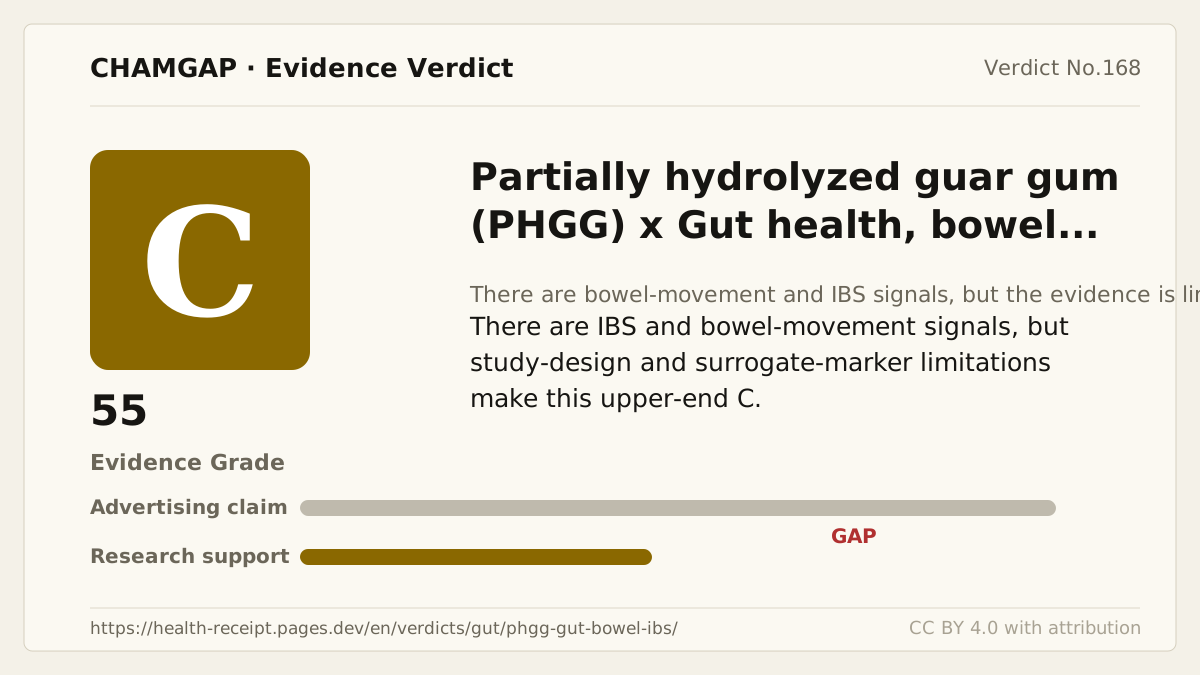
[Chamgap] Partially hydrolyzed guar gum (PHGG) × gut health, bowel movements, IBS — Evidence Grade C·55. 3 cited sources checked. Source: https://chamgap.com/en/verdicts/gut/phgg-gut-bowel-ibs/ · CC BY 4.0CC BY 4.0 — free to use with attribution; do not distort grades, numbers, or verdict meaning.
What this document does and does not do
Chamgap is an information source. It reports what research has and has not confirmed; it does not tell readers what to take or buy. That decision belongs to readers and, when needed, medical or legal professionals. This verdict reflects literature available up to the search date and may change as new research appears. Nothing here is medical advice.