
Multi-enzyme digestive supplement,
does it really help with Improved digestion and bloating in the general population?
research showsRCTs in functional-dyspepsia patients without a diagnosed enzyme deficiency exist at sizes of 120 and 151, so the grade is not '?' but the upper range of C. The 151-person trial tested Combizym®, the 40-person trial tested DigeZyme®, and the 120-person trial tested a fungal-fermentation enzyme blend. These are different products, so no one result can be attributed to all general multi-enzyme supplements.
ads claimAdvertisements use phrases such as 'complete breakdown of carbohydrates, proteins, and fats,' 'replenished digestive power,' and 'elimination of post-meal gas and bloating.' Clinical data concern specific products with different enzyme activity units and herbal combinations, and long-term improvement of digestive function in generally healthy people without a diagnosed enzyme deficiency has not been established.
Useful facts when choosing a product
- Combinations and activity units for amylase, protease, lipase, lactase, cellulase, and other enzymes differ across products.
- Enzyme activity cannot be compared by milligram content alone; enzyme-specific activity units and gastric stability affect performance.
- The healthy-adult trial product also contained ginger, fennel, and peppermint, so the enzyme-only effect cannot be isolated.
- Potential allergy, gastrointestinal discomfort, and drug interactions from fungal-, papaya-, or pineapple-derived enzymes differ by product.
What the research actually shows
Majeed 2018 used DigeZyme® in 40 functional-dyspepsia patients and reported improvement on several questionnaires; the authors were founders or employees of manufacturer Sami/Sabinsa. Ullah 2023 used a specific fungal-fermentation enzyme blend in 120 functional-dyspepsia patients without a diagnosed enzyme deficiency and reported improved NDI-SF and pain. Ran 2009 used Combizym® and placebo in a 151-person crossover trial in the same broad patient setting and reported improved dyspepsia severity after two weeks. The three products differ in composition and activity units, so the findings cannot be attributed to 'all general multi-enzyme supplements.' In the Martin-Biggers 2024 healthy-adult enzyme-plus-herb trial, abdominal circumference improved but subjective bloating, gas, and indigestion did not.
Why this is classified as C (50)
RCTs of 120 and 151 functional-dyspepsia patients without a diagnosed enzyme deficiency establish that the evidence is not '?', placing it in the upper range of C. Combizym®, DigeZyme®, and the fungal-fermentation enzyme blend are different products, and healthy-adult subjective symptoms were negative, limiting attribution to all general multi-enzyme supplements. The score remains 50.
Counterpoint. A standardized enzyme combination may alter short-term symptoms in people with functional dyspepsia or difficulty digesting certain food components. This judgment is distinct from evidence for single enzymes such as lactase or alpha-galactosidase that target a defined substrate or deficiency.
Rejudgment record. New judgment — RCTs of 120 and 151 functional-dyspepsia patients without a diagnosed enzyme deficiency exist, but the products differ and cannot support attribution to all multi-enzyme supplements; healthy-adult subjective symptoms were negative, supporting the upper range of C
Sub-claim grades by effect
This ingredient is marketed for several effects. A single overall grade blends strong and weak claims together, so each effect is graded separately here. The overall grade reflects the strongest disconfirming or core claim.
| Effect (sub-claim) | Grade | Basis |
|---|---|---|
| Improved digestion in the general population | C | RCTs of 120 and 151 functional-dyspepsia patients without a diagnosed enzyme deficiency exist, but generalizability across products is limited |
| Improved bloating | C | In a healthy-adult crossover trial, abdominal circumference was positive but subjective bloating and gas were negative, and herbs were included |
Cross-check — Codex and Claude
Evidence Table
| Study | Design | Sample | Funding | Endpoint | Result | Weight |
|---|---|---|---|---|---|---|
| Majeed M et al. 2018 | Double-blind randomized placebo-controlled trial | 40 | Conducted by employees and founders of manufacturer Sami/Sabinsa | SF-LDQ, NDI-SF, VAS, CGI-S, and GDSS | All questionnaires improved versus placebo after 60 days, and no product-related adverse events were reported. | Key |
| Ullah H et al. 2023 | Single-center double-blind randomized placebo-controlled trial | 120 | Details unclear; specific food-supplement formulation | NDI-SF quality of life, pain VAS, and sleep | Improvement in NDI-SF, pain, and sleep markers was reported after two months, but the study tested one formulation. | Key |
| Ran ZH et al. 2009 | Multicenter randomized placebo-controlled crossover trial | 151 | Details unclear; specific Combizym® product | Dyspepsia symptom-severity index after two weeks | The symptom-severity index decreased more with Combizym® than placebo, but this was a short crossover trial of a specific product. | Key |
| Martin-Biggers J. 2024 | Randomized placebo-controlled crossover trial | 20 | HUM Nutrition company study | Post-meal abdominal circumference and subjective bloating, gas, and indigestion | Abdominal-circumference distension decreased, but subjective bloating, gas, and indigestion differences were nonsignificant. | Key |
Receipt — 4 References
All 4 cited sources were verified for existence at the original page (as of 2026-07-11).
Reviewed and approved: Chamgap Editorial Team · Approval date: 2026-07-11 · Corrections: none
Cite this verdict
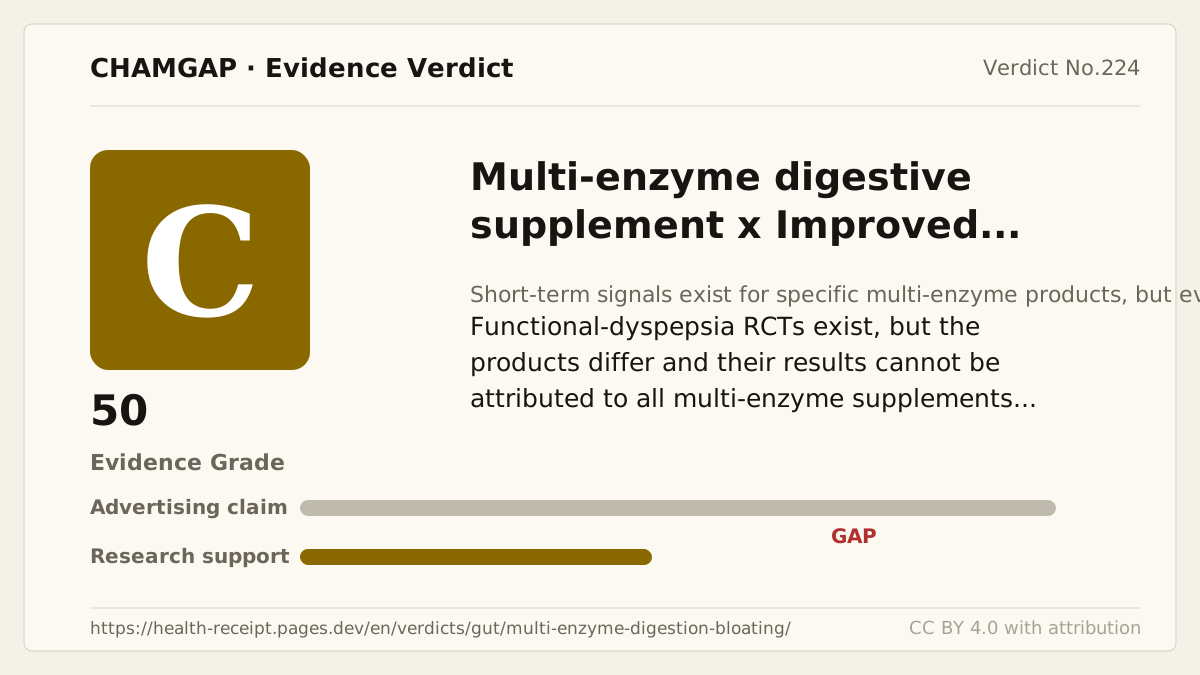
[Chamgap] Multi-enzyme digestive supplement x improved digestion and bloating in the general population — Evidence Grade C·50. 4 cited sources checked. Source: https://chamgap.com/en/verdicts/gut/multi-enzyme-digestion-bloating/ · CC BY 4.0CC BY 4.0 — free to use with attribution; do not distort grades, numbers, or verdict meaning.
What this document does and does not do
Chamgap is an information source. It reports what research has and has not confirmed; it does not tell readers what to take or buy. That decision belongs to readers and, when needed, medical or legal professionals. This verdict reflects literature available up to the search date and may change as new research appears. Nothing here is medical advice.