
Mastic gum,
does it really help with Functional dyspepsia and Helicobacter suppression?
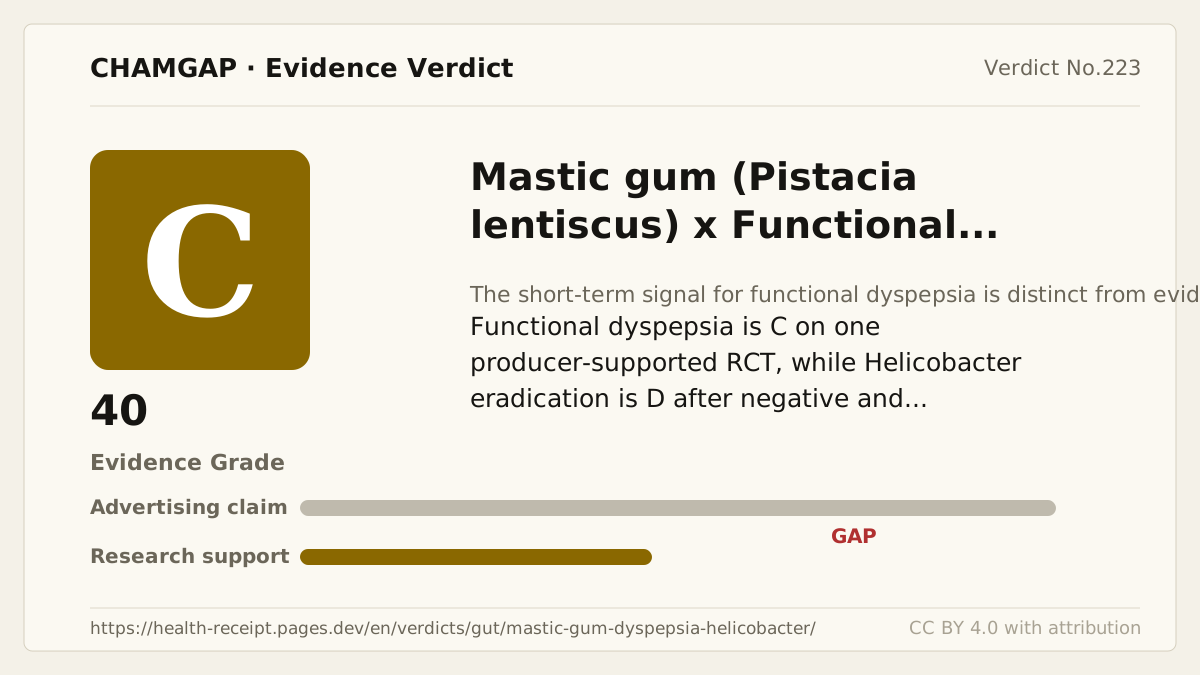
research showsFunctional dyspepsia is C because one 148-person placebo-controlled trial reported improvement after three weeks but was supported by the producers' cooperative. Helicobacter eradication is D: a nine-person study was negative, a 52-person pilot was nonsignificant, and the primary endpoint in a 64-person add-on trial was negative at 85% versus 67% (p=.19). There is no evidence that mastic can replace standard eradication therapy.
ads claimAdvertisements use phrases such as 'gastric-mucosa protection,' 'relief of heartburn and indigestion,' 'Helicobacter removal,' and 'natural antibacterial.' Clinical data concern short-term functional-dyspepsia symptoms and small eradication trials; they do not establish mastic monotherapy as equivalent to standard eradication therapy.
Useful facts when choosing a product
- The functional-dyspepsia RCT used 350 mg three times daily for three weeks.
- Mastic-only doses in Helicobacter trials ranged from 1.05 to 4.2 g/day and may differ from marketed-product doses.
- Helicobacter outcomes were assessed by conversion to a negative urea breath test, which is not the same as symptom reduction.
- Serious adverse events were not prominent in short trials, but data on Anacardiaceae allergy and long-term safety are limited.
What the research actually shows
Dabos 2010 assigned 148 patients meeting Rome II criteria for functional dyspepsia to mastic gum 350 mg three times daily or placebo for three weeks and reported improvement in the Hong Kong dyspepsia index and global assessment. The study was supported by the Mastic Gum Producers Cooperative. Bebb 2003 gave 1 g four times daily for 14 days to nine Helicobacter-positive participants, but all remained positive and bacterial load did not decrease. The Dabos 2010 Helicobacter pilot divided 52 participants into four groups; eradication was 4/13 and 5/13 with mastic alone, 0/13 with mastic plus pantoprazole, and 10/13 with standard triple therapy. Tulsian 2026 assigned 64 participants to standard bismuth quadruple therapy plus mastic or quadruple therapy alone, and the eradication-rate difference was not statistically significant.
Why this is classified as C (40)
Functional dyspepsia is C because the positive evidence is one 148-person producer-supported RCT. Helicobacter eradication is D because a nine-person study was negative, a 52-person pilot was nonsignificant, and the primary endpoint in a 64-person add-on trial was negative; there is no evidence for replacing standard eradication therapy. Combining the subclaims supports C with 40 points.
Counterpoint. A short-term response in pain and heartburn remains possible in patients with functional dyspepsia. This judgment does not extend that signal to Helicobacter eradication or prevention of ulcers or gastric cancer.
Rejudgment record. New judgment — The positive dyspepsia result relies on one short producer-supported RCT, while Helicobacter evidence includes negative and nonsignificant human results and a negative primary endpoint for add-on therapy; subratings C/D combine to C
Sub-claim grades by effect
This ingredient is marketed for several effects. A single overall grade blends strong and weak claims together, so each effect is graded separately here. The overall grade reflects the strongest disconfirming or core claim.
| Effect (sub-claim) | Grade | Basis |
|---|---|---|
| Functional dyspepsia | C | A single three-week, producer-cooperative-supported RCT of 148 participants was positive |
| Helicobacter eradication | D | A nine-person study was negative, a 52-person pilot was nonsignificant, and the 64-person add-on primary endpoint was negative at 85% versus 67% (p=.19); evidence for replacing standard eradication therapy is absent. |
Cross-check — Codex and Claude
Evidence Table
| Study | Design | Sample | Funding | Endpoint | Result | Weight |
|---|---|---|---|---|---|---|
| Dabos KJ et al. 2010 (functional dyspepsia) | Double-blind randomized placebo-controlled trial | 148 | Supported by the Mastic Gum Producers Cooperative | Hong Kong dyspepsia index and global improvement | Symptom scores and improvement rates favored mastic after three weeks. | Key |
| Bebb JR et al. 2003 | Single-arm before-and-after clinical study | 9 | Unknown | Urea breath test and bacterial load | After 1 g four times daily for 14 days, all participants remained positive and bacterial load did not decrease. | Key |
| Dabos KJ et al. 2010 (H. pylori) | Randomized four-arm pilot trial | 52 | Unknown | Urea-breath-test eradication after five weeks | Eradication was 4/13 and 5/13 with mastic alone, 0/13 with combination treatment, and 10/13 with standard triple therapy; changes in mastic groups were nonsignificant. | Key |
| Tulsian V et al. 2026 | Randomized single-blind add-on pilot trial | 64 | Academic institutions; details unclear | Six-week eradication rate and DSSI | Eradication was 85% with quadruple therapy plus mastic versus 67% with quadruple therapy, but the primary endpoint was nonsignificant at p=0.19. | Key |
Receipt — 4 References
All 4 cited sources were verified for existence at the original page (as of 2026-07-11).
Reviewed and approved: Chamgap Editorial Team · Approval date: 2026-07-11 · Corrections: none
Cite this verdict
[Chamgap] Mastic gum (Pistacia lentiscus) x functional dyspepsia and Helicobacter suppression — Evidence Grade C·40. 4 cited sources checked. Source: https://chamgap.com/en/verdicts/gut/mastic-gum-dyspepsia-helicobacter/ · CC BY 4.0CC BY 4.0 — free to use with attribution; do not distort grades, numbers, or verdict meaning.
What this document does and does not do
Chamgap is an information source. It reports what research has and has not confirmed; it does not tell readers what to take or buy. That decision belongs to readers and, when needed, medical or legal professionals. This verdict reflects literature available up to the search date and may change as new research appears. Nothing here is medical advice.