
Inulin,
does it really help with Gut health, bowel movements, and blood glucose?
research showsChicory inulin can be viewed as B for markers close to direct gut function, such as stool frequency and stool consistency. However, the representative RCT was a small BENEO-supported study, and blood-glucose and lipid claims are surrogate markers that should be read separately at a lower C level.
ads claimProducts combine 'prebiotics,' 'food for probiotics,' 'bowel movements,' 'blood-glucose management,' and 'dietary fiber.' Among these, bowel markers and blood-glucose/lipid numerical markers should not be bundled under the same evidence grade.
Useful facts when choosing a product
- The core dose in bowel-movement studies and the EFSA review is around 12 g/day of chicory inulin.
- FODMAP-related symptoms such as gas, abdominal bloating, abdominal pain, and diarrhea can be common.
- Symptoms may worsen in people with irritable bowel syndrome.
- People taking diabetes medications need clinician consultation if using it for blood-glucose control.
What the research actually shows
EFSA 2015 accepted a cause-effect relationship that chicory inulin 12 g/day contributes to normal bowel function by increasing stool frequency. This regulatory acceptance is used only as a reference for evidence synthesis, not as an efficacy bonus. Micka 2017 RCT reported that 12 g/day chicory inulin improved stool frequency and stool consistency in 44 adults with a tendency toward constipation, but it was a small BENEO-supported study. Blood-glucose and lipid meta-analyses show some improvement signals, but because they center on surrogate markers, this judgment separates them at a C level.
Why this is classified as B (60)
I keep B because there are RCT and EFSA review data for direct gut-function markers, namely stool frequency and stool consistency. However, the representative RCT was a BENEO-supported small study with n=44, and blood glucose and lipids are surrogate markers, so I lower it to 58 points.
Counterpoint. The B grade was not given for gut-microbiota changes or blood-glucose numbers alone. The center of the B judgment is stool frequency and stool consistency, while blood glucose and lipids are a separate C level.
Rejudgment record. Draft — Positive RCT and regulatory review for direct bowel-movement markers; representative RCT is a small industry-supported study; blood glucose and lipids are separated as C because they are surrogate markers
Cross-check — Codex and Claude
Evidence Table
| Study | Design | Sample | Funding | Endpoint | Result | Weight |
|---|---|---|---|---|---|---|
| EFSA NDA Panel 2015 | Regulatory scientific review | Regulatory agency assessment | Stool frequency | Accepted a cause-effect relationship between chicory inulin 12 g/day and increased stool frequency. | Core | |
| Micka A et al. 2017 | Randomized double-blind placebo-controlled trial | 44 | Supported by BENEO | Stool frequency and stool consistency | Reported improvements in stool frequency and stool consistency after intake of 12 g/day chicory inulin. | Core |
| Liu F et al. 2017 | Systematic review and meta-analysis | Mixed | Blood glucose, insulin, and lipids | Reported some metabolic-marker improvement signals, but populations and formulations were heterogeneous. | Supporting |
Receipt — 4 References
All 4 cited sources were verified for existence at the original page (as of 2026-07-09).
Reviewed and approved: Chamgap Editorial Team · Approval date: 2026-07-09 · Corrections: none
Cite this verdict
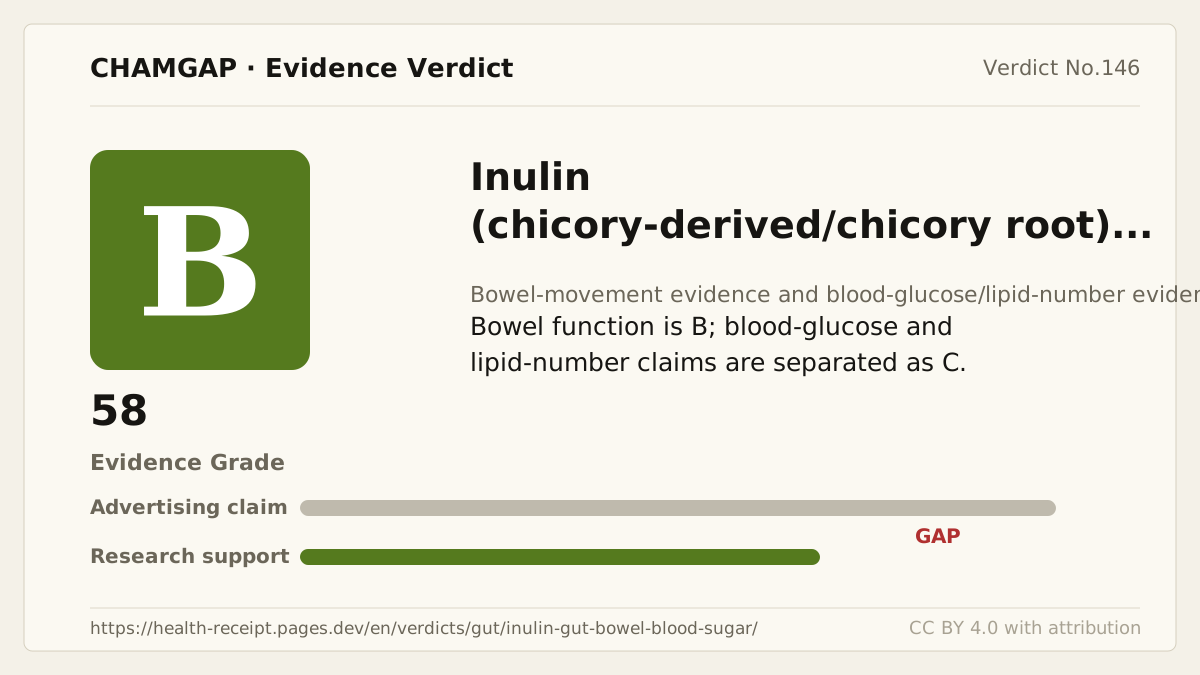
[Chamgap] Inulin (chicory-derived) x gut health, bowel movements, and blood glucose — Evidence Grade B·60. 4 cited sources checked. Source: https://chamgap.com/en/verdicts/gut/inulin-gut-bowel-blood-sugar/ · CC BY 4.0CC BY 4.0 — free to use with attribution; do not distort grades, numbers, or verdict meaning.
What this document does and does not do
Chamgap is an information source. It reports what research has and has not confirmed; it does not tell readers what to take or buy. That decision belongs to readers and, when needed, medical or legal professionals. This verdict reflects literature available up to the search date and may change as new research appears. Nothing here is medical advice.