
Galactooligosaccharides,
does it really help with Improvement of constipation and stool frequency, and increased bifidobacteria?
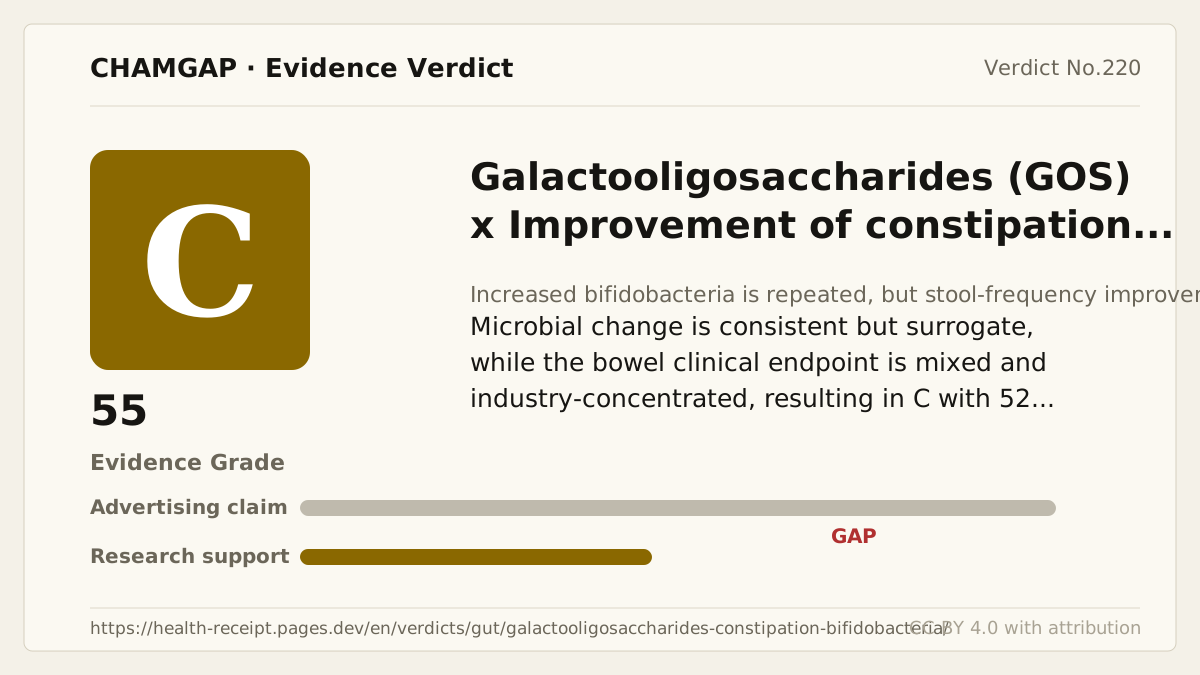
research showsIncreased bifidobacteria is repeated across human trials but is a surrogate marker. Stool frequency improved in a 63-person RCT, but the primary full intention-to-treat result in a 132-person manufacturer trial showed only a trend and was significant only in subgroups.
ads claimPrebiotics may be described as increasing beneficial bacteria to resolve constipation and improve gut health. Increased bacterial counts and patient-experienced constipation improvement are separate endpoints.
Useful facts when choosing a product
- Adult trials used about 5.5-15 g/day.
- Increased bifidobacteria is a microbial surrogate, not a health outcome.
- GOS-mixture composition may vary by manufacturing process.
- Gas, bloating, or loose stools may occur.
What the research actually shows
Schoemaker 2022 found p=0.095 for stool frequency with 11 g/day in the full intention-to-treat population of 132 participants and significance in the baseline ≤3 stools/week subgroup; the study was funded and staffed by FrieslandCampina. Lee 2024 reported improved bowel-movement count and stool form over four weeks in 63 participants but included an author employed by the product company. Walton 2012 and other crossover trials repeatedly reported increased bifidobacteria.
Why this is classified as C (55)
Positive and negative bowel clinical findings are mixed, major positive data have manufacturer involvement, and microbial increase is surrogate, resulting in C with 55 points.
Counterpoint. Stool-frequency improvement remains possible in adults with low baseline frequency or with a particular GOS mixture.
Rejudgment record. New judgment — Positive and negative bowel clinical findings are mixed, major positive data have manufacturer involvement, and microbial increase is surrogate, resulting in C with 55 points.
Sub-claim grades by effect
This ingredient is marketed for several effects. A single overall grade blends strong and weak claims together, so each effect is graded separately here. The overall grade reflects the strongest disconfirming or core claim.
| Effect (sub-claim) | Grade | Basis |
|---|---|---|
| Improvement of constipation and stool frequency | C | A 63-person RCT was positive, but the primary full intention-to-treat result in 132 participants was a nonsignificant trend. |
| Increased bifidobacteria | C | Repeated in several trials, but it is a microbial surrogate marker. |
Cross-check — Codex and Claude
Evidence Table
| Study | Design | Sample | Funding | Endpoint | Result | Weight |
|---|---|---|---|---|---|---|
| Schoemaker MH et al. 2022 | Double-blind placebo-controlled RCT | 132 | FrieslandCampina | Stool frequency and microbiota | Full ITT p=0.095; increased stools in subgroups and dose-dependent bifidobacteria increase. | Key |
| Lee JH et al. 2024 | Four-week double-blind placebo-controlled RCT | 63 | Included an author from product company NeoCremar | Bowel movements, stool form, and quality of life | Improved bowel-movement count, stool form, and satisfaction. | Supportive |
| Walton GE et al. 2012 | Randomized crossover trial | 50 | Possible product involvement | Fecal microbiota | Bifidobacteria increased versus placebo. | Supportive |
Receipt — 3 References
All 3 cited sources were verified for existence at the original page (as of 2026-07-11).
Reviewed and approved: Chamgap Editorial Team · Approval date: 2026-07-11 · Corrections: none
Cite this verdict
[Chamgap] Galactooligosaccharides (GOS) x Improvement of constipation and stool frequency, and increased bifidobacteria — Evidence Grade C·55. 3 cited sources checked. Source: https://chamgap.com/en/verdicts/gut/galactooligosaccharides-constipation-bifidobacteria/ · CC BY 4.0CC BY 4.0 — free to use with attribution; do not distort grades, numbers, or verdict meaning.
What this document does and does not do
Chamgap is an information source. It reports what research has and has not confirmed; it does not tell readers what to take or buy. That decision belongs to readers and, when needed, medical or legal professionals. This verdict reflects literature available up to the search date and may change as new research appears. Nothing here is medical advice.