
Cassia seed,
does it really help with Eyes, constipation?
research showsCassia seed (Senna/Cassia obtusifolia seed) belongs to the stimulant-laxative family containing senna-type anthraquinones (sennosides), so it has a real mechanism of action for constipation. However, no placebo-controlled constipation RCT was identified for cassia seed tea or roasted seed itself, and eye benefits were not confirmed beyond traditional use.
ads claimAdvertising mentions 'clear eyes,' 'eye fatigue,' 'constipation,' 'intestinal cleansing,' and 'old stool' together. Actual evidence for efficacy in people can easily be confused with senna-laxative evidence because the ingredient names are similar.
Useful facts when choosing a product
- Cassia obtusifolia is also currently classified as Senna obtusifolia.
- Cassia seed tea, roasted seeds, and extracts may differ in anthraquinone content and action.
- Caution is needed in pregnancy and lactation, children, suspected bowel obstruction, chronic diarrhea, and groups at risk of electrolyte abnormalities.
- Evidence for senna laxatives is not evidence for cassia seed eye health.
What the research actually shows
The main materials found in searches center on plant taxonomy, traditional use, composition and safety, and cell and animal studies. Cochrane/review evidence on Senna-family laxatives mostly concerns sennosides or other Senna preparations; this can be used as background evidence for the constipation mechanism, but it cannot be treated as a constipation RCT of cassia seed tea or roasted seed alone. For improvement in eye symptoms, reliable human evidence beyond traditional use was not identified.
Why this is classified as C (40)
For constipation, there is a mechanism of action from the stimulant-laxative class, so this is not left as unknown and is judged lower-end C. However, because no placebo-controlled constipation RCT of cassia seed tea or roasted seed itself was identified, it remains at 40 points; eye benefits are separately at an unknown/D level because of insufficient evidence.
Counterpoint. If future RCTs using standardized cassia seed preparations directly set constipation or eye symptoms as primary endpoints, this can be reassessed.
Rejudgment record. Final — For constipation, there is a senna-type anthraquinone stimulant-laxative mechanism, but direct placebo-controlled RCTs of cassia seed tea or roasted seed and evidence for eye benefits are lacking
Cross-check — Codex and Claude
Evidence Table
| Study | Design | Sample | Funding | Endpoint | Result | Weight |
|---|---|---|---|---|---|---|
| Senna/Cassia obtusifolia botanical and traditional-use sources | Taxonomy and traditional-use materials | Not applicable | Traditional eye and laxative use | Traditional use is confirmed, but it is not human RCT evidence for efficacy. | Background | |
| Gordon M et al. Cochrane. 2016 | Cochrane review | Cochrane/academic | Pediatric constipation treatment | Laxatives including senna were reviewed, but this cannot be directly transferred as evidence for cassia seed eye and constipation benefits. | Boundary evidence |
Receipt — 3 References
All 3 cited sources were verified for existence at the original page (as of 2026-07-09).
Reviewed and approved: Chamgap Editorial Team · Approval date: 2026-07-09 · Corrections: none
Cite this verdict
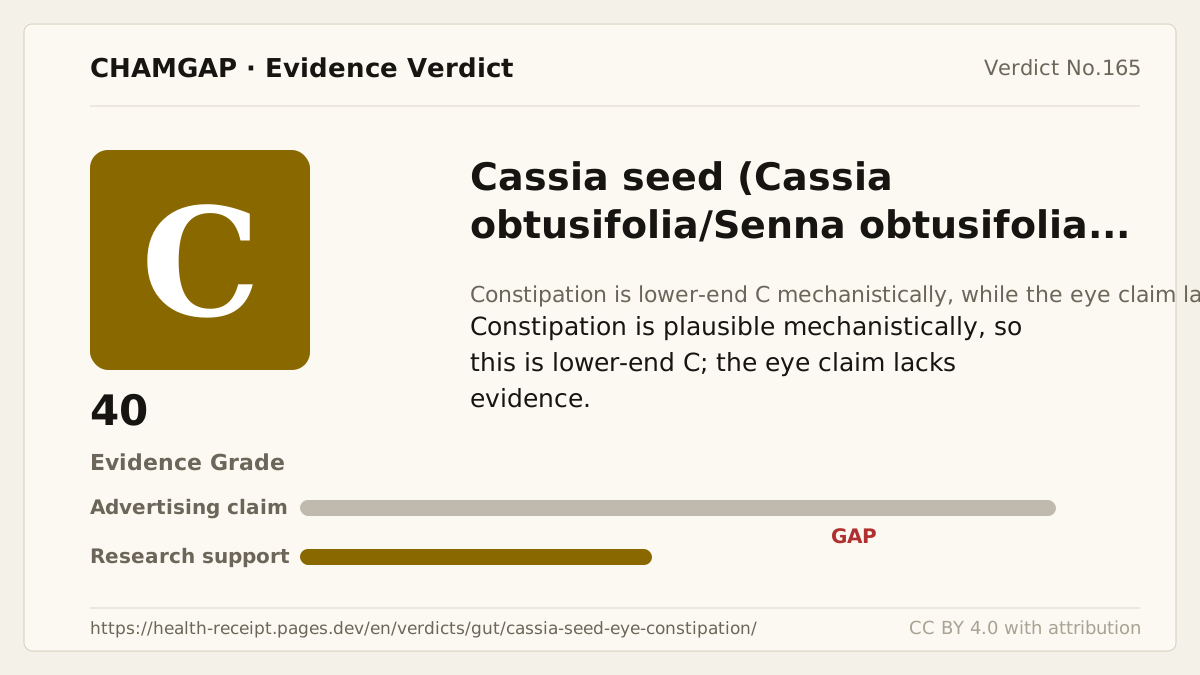
[Chamgap] Cassia seed (Cassia obtusifolia/Senna obtusifolia seed) × eyes, constipation — Evidence Grade C·40. 3 cited sources checked. Source: https://chamgap.com/en/verdicts/gut/cassia-seed-eye-constipation/ · CC BY 4.0CC BY 4.0 — free to use with attribution; do not distort grades, numbers, or verdict meaning.
What this document does and does not do
Chamgap is an information source. It reports what research has and has not confirmed; it does not tell readers what to take or buy. That decision belongs to readers and, when needed, medical or legal professionals. This verdict reflects literature available up to the search date and may change as new research appears. Nothing here is medical advice.