
Butyrate salts,
does it really help with IBS abdominal pain and bloating, and improved intestinal barrier?
research showsEvidence for oral butyrate on IBS symptoms is small and mixed. In an RCT of 66 adults, only selected outcomes such as frequency of pain during defecation improved, while differences in the severity of abdominal pain and flatulence were nonsignificant. The 3,000-person study had no control group, and the strongly positive 51-child RCT used a different age group and a calcium-salt formulation. The intestinal-barrier claim relies on surrogate permeability measurements after acute colonic perfusion and biopsy rather than clinical endpoints for an oral supplement, so the overall grade is C.
ads claimAdvertisements use phrases such as 'barrier repair,' 'leaky-gut improvement,' 'energy for colon cells,' and 'relief of pain and gas.' Clinical evidence consists of selected symptom outcomes from trials with different salt forms, delivery systems, and ages, while barrier data represent acute tissue-permeability markers rather than a long-term clinical effect of oral products.
Useful facts when choosing a product
- Study formulations included microencapsulated sodium butyrate, a triglyceride matrix, and calcium butyrate, which are not identical.
- Adult trials commonly used 150 mg twice daily, while the pediatric RCT used calcium butyrate 500 mg/day.
- Enteric or microencapsulated formulations are used to reduce butyrate's characteristic odor and gastrointestinal discomfort.
- Short trials generally reported favorable tolerability, but pregnancy, lactation, and long-term data are limited.
What the research actually shows
Banasiewicz 2013 added microencapsulated sodium butyrate or placebo for 12 weeks in 66 adults with IBS. Selected symptom-frequency outcomes improved, but abdominal-pain and flatulence severity did not. Lewandowski 2022 was a prospective single-arm study of 3,000 people without a placebo comparison. Cristofori 2025 used the different salt calcium butyrate 500 mg/day in 51 children and reported at least a 50% pain reduction in 73% versus 3.8%. Scharf 2025 exposed the colon directly to butyrate for 90 minutes in 17 people with IBS and 17 healthy participants; the acute biopsy-permeability change was p=.034 and was not an oral long-term clinical outcome.
Why this is classified as C (45)
For IBS symptoms, abdominal-pain and flatulence severity were negative in the 66-adult RCT, while the positive 51-child trial used a different calcium formulation. The barrier subclaim has a D character because it relies on an acute direct-colonic-exposure permeability surrogate in 34 participants (p=.034). Combining C for IBS symptoms and D for the barrier claim supports C with 45 points.
Counterpoint. A symptom response remains possible with certain delivery formulations and in some IBS subtypes or age groups. This judgment does not equate studies of butyrate-producing diets, probiotics, or rectal delivery with an oral single-ingredient butyrate capsule.
Rejudgment record. New judgment — Abdominal-pain and flatulence severity were nonsignificant in the adult RCT, the large study was uncontrolled, and the barrier evidence is an acute permeability surrogate rather than an oral clinical endpoint, invoking boundary rule ①
Sub-claim grades by effect
This ingredient is marketed for several effects. A single overall grade blends strong and weak claims together, so each effect is graded separately here. The overall grade reflects the strongest disconfirming or core claim.
| Effect (sub-claim) | Grade | Basis |
|---|---|---|
| IBS symptoms | C | Key adult-RCT symptom results were limited, with an uncontrolled study and a pediatric RCT providing supportive evidence |
| Intestinal barrier | D | An acute biopsy-permeability surrogate after direct colonic exposure in 34 participants (p=.034), not a clinical endpoint for oral supplementation. |
Cross-check — Codex and Claude
Evidence Table
| Study | Design | Sample | Funding | Endpoint | Result | Weight |
|---|---|---|---|---|---|---|
| Banasiewicz T et al. 2013 | Randomized placebo-controlled add-on trial | 66 | Unknown | Frequency and severity of abdominal pain, flatulence, and bowel symptoms | Selected symptom frequencies decreased, but differences in the severity of abdominal pain, flatulence, and disordered defecation were nonsignificant. | Key |
| Lewandowski K et al. 2022 | Prospective multicenter single-arm study | 2,990 | Patented formulation; detailed conflicts unclear | IBS symptoms and quality of life | Several symptoms decreased after 12 weeks, but the absence of a placebo group prevents isolation of the treatment effect. | Supportive |
| Cristofori F et al. 2025 | Double-blind randomized placebo-controlled trial | 51 | Products provided free by Difass International; authors reported no conflicts | At least 50% VAS reduction, GSRS, microbiota, and metabolites | Treatment success was 73% with calcium butyrate versus 3.8% with placebo, but this is a single pediatric trial. | Key |
| Scharf MW et al. 2025 | Acute colonoscopy-exposure clinical experiment | 17 | Academic grants | Paracellular and transcellular permeability in biopsy tissue | The acute transcellular-permeability change after direct colonic exposure was p=.034, but paracellular permeability and a long-term oral effect were not established. | Supportive |
Receipt — 4 References
All 4 cited sources were verified for existence at the original page (as of 2026-07-11).
Reviewed and approved: Chamgap Editorial Team · Approval date: 2026-07-11 · Corrections: none
Cite this verdict
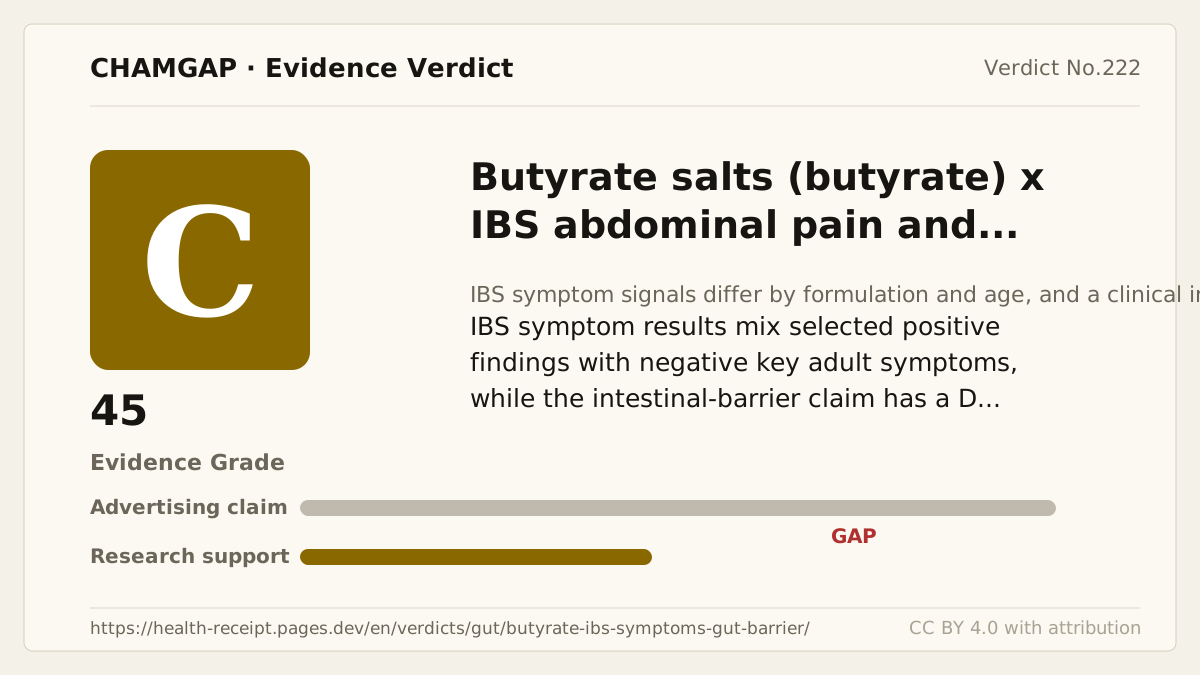
[Chamgap] Butyrate salts (butyrate) x IBS abdominal pain and bloating, and improved intestinal barrier — Evidence Grade C·45. 4 cited sources checked. Source: https://chamgap.com/en/verdicts/gut/butyrate-ibs-symptoms-gut-barrier/ · CC BY 4.0CC BY 4.0 — free to use with attribution; do not distort grades, numbers, or verdict meaning.
What this document does and does not do
Chamgap is an information source. It reports what research has and has not confirmed; it does not tell readers what to take or buy. That decision belongs to readers and, when needed, medical or legal professionals. This verdict reflects literature available up to the search date and may change as new research appears. Nothing here is medical advice.