
Monolaurin,
does it really help with Antibacterial, antiviral, and immune support?
research showsNo efficacy trial was identified for oral monolaurin in infection prevention, infection treatment, or immune support. A randomized trial of 5% vaginal gel used a different route and indication and cannot be transferred to oral supplements. The target route has no direct human literature, resulting in a question-mark grade.
ads claimProduct descriptions may translate bacterial and viral membrane effects in vitro into infection defense, viral suppression, or enhanced immunity. Oral human evidence has not tested that transfer.
Useful facts when choosing a product
- Monolaurin is a monoester of lauric acid and glycerol and is not the same as coconut oil itself.
- An effective concentration in vitro is not equivalent to a blood or tissue concentration after oral intake.
- The published human randomized trial used a 5% vaginal gel, a different route from oral pellets or capsules.
- Long-term safety and drug-interaction data for high-dose oral use are limited.
What the research actually shows
The 1992 study by Schlievert and colleagues inhibited growth and exotoxin production in cultured streptococci and staphylococci. The 2020 study by Welch and colleagues reported virucidal activity against enveloped viruses, including HIV-1, in culture systems. The 2020 multicenter trial by Mancuso and colleagues gave 5% monolaurin vaginal gel or placebo for three days to 109 women; clinical cure was 17% versus 25%, with no significant difference. This was not an oral product and did not evaluate systemic infection prevention or immune support.
Why this is classified as ?
The grade is a question mark because no controlled human literature tested the target efficacy of oral monolaurin. A single null topical trial was not generalized into an F for all oral infection claims, and positive in vitro results were not upgraded into human efficacy.
Counterpoint. A researchable biological signal remains in local microbial settings and selected formulations. This assessment separates that signal from systemic oral efficacy.
Rejudgment record. Reassessment (cross-check reflected) — No directly controlled human efficacy literature for oral monolaurin in infection prevention, infection treatment, or immune support; positive in vitro work and a null topical vaginal-gel RCT do not establish oral efficacy
Cross-check — Codex and Claude
Evidence Table
| Study | Design | Sample | Funding | Endpoint | Result | Weight |
|---|---|---|---|---|---|---|
| Mancuso AC et al. 2020 | Multicenter double-blind randomized placebo-controlled trial | 109 | Unknown | Amsel clinical cure, Nugent score, and adverse events | Clinical cure was 17% versus 25%; monolaurin gel was not superior to placebo. | Indirect human evidence |
| Welch JL et al. 2020 | In vitro virology study | U.S. public and academic research | Infectivity of enveloped viruses | Reduced infectivity of enveloped viruses, including HIV-1, in culture systems. | Preclinical | |
| Schlievert PM et al. 1992 | In vitro bacteriology study | Academic research | Bacterial growth and exotoxin production | Inhibited growth and exotoxin production in selected gram-positive bacteria. | Preclinical |
Receipt — 3 References
All 3 cited sources were verified for existence at the original page (as of 2026-07-11).
Reviewed and approved: Chamgap Editorial Team · Approval date: 2026-07-11 · Corrections: none
Cite this verdict
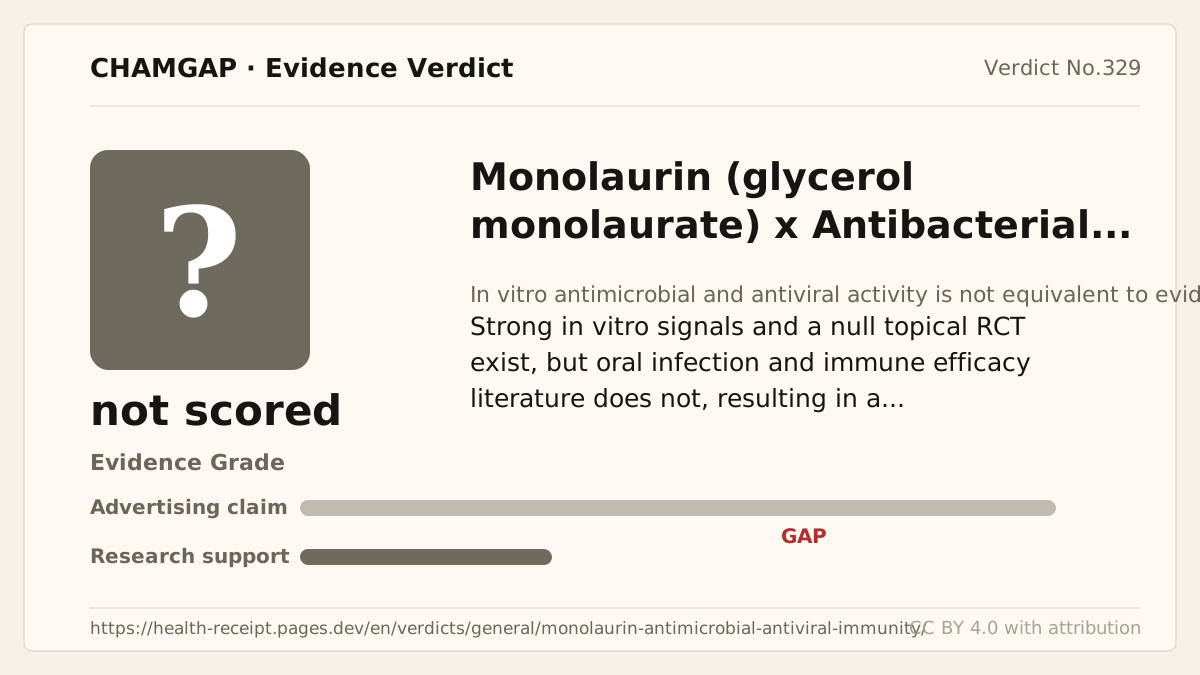
[Chamgap] Monolaurin (glycerol monolaurate) × Antibacterial, antiviral, and immune support — Evidence Grade ?. 3 cited sources checked. Source: https://chamgap.com/en/verdicts/general/monolaurin-antimicrobial-antiviral-immunity/ · CC BY 4.0CC BY 4.0 — free to use with attribution; do not distort grades, numbers, or verdict meaning.
What this document does and does not do
Chamgap is an information source. It reports what research has and has not confirmed; it does not tell readers what to take or buy. That decision belongs to readers and, when needed, medical or legal professionals. This verdict reflects literature available up to the search date and may change as new research appears. Nothing here is medical advice.