
Modified citrus pectin,
does it really help with Heavy-metal elimination and detoxification?
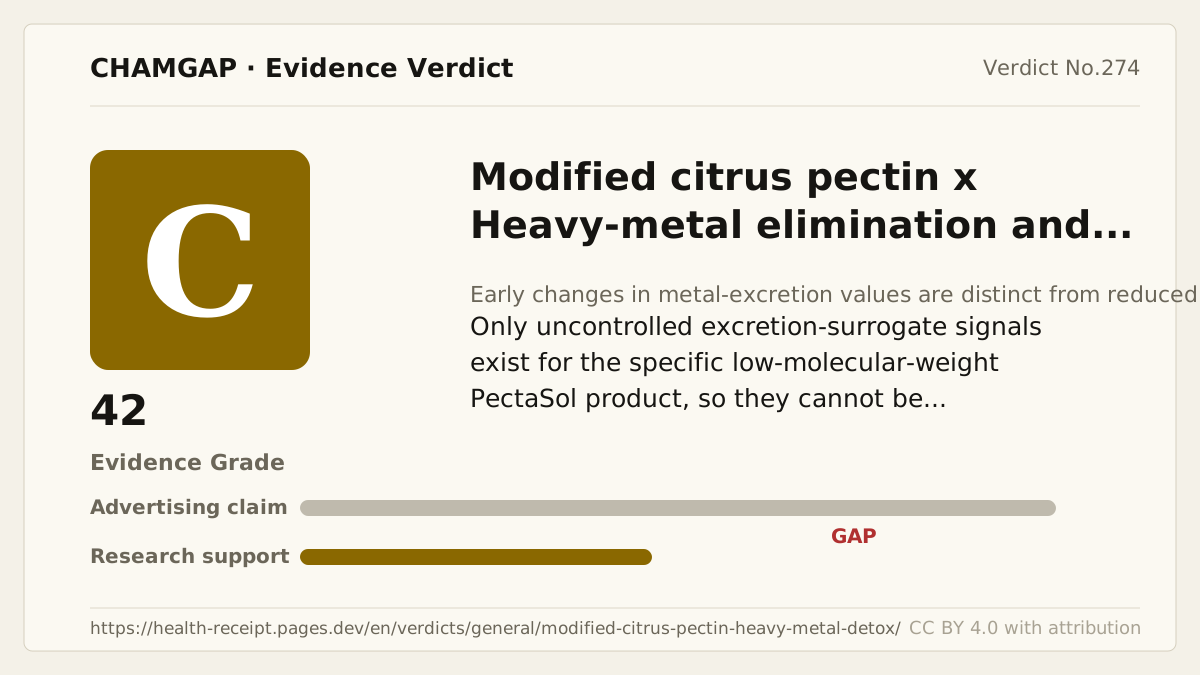
research showsBoth human studies evaluated PectaSol, a specific low-molecular-weight modified pectin, rather than generic citrus pectin. An uncontrolled eight-person pilot reported increased urinary arsenic and cadmium, and a single-arm study in lead-exposed children reported changes in blood and urinary lead. With no control group or clinical outcome, the rating is at the bottom of C with 42 points, and the findings cannot be generalized to ordinary citrus pectin or other MCP products.
ads claimAdvertisements use phrases such as 'gentle natural chelator,' 'deep cellular heavy-metal removal,' and 'whole-body detox.' Human data concern short-term urinary and blood metal values with a specific low-molecular-weight PectaSol formulation.
Useful facts when choosing a product
- Key human studies used a specific low-molecular-weight, low-esterification product called PectaSol.
- The healthy-adult pilot used 15 to 20 g/day, potentially above common capsule servings.
- Fiber-related bloating, gas, or loose stool can occur.
- Higher urinary metal excretion alone does not establish reduced total body burden or clinical harm.
What the research actually shows
The Eliaz 2006 pilot gave eight healthy adults PectaSol 15 g/day for five days and 20 g on day six. Urinary arsenic rose 130% on day one, cadmium 150% on day six, and lead showed a 560% trend with p<0.08. The Zhao 2008 study gave 15 g/day to hospitalized children with elevated blood lead and reported lower blood lead and higher 24-hour urinary lead, but there was no control group. No controlled trial assessing symptoms, neurodevelopment, kidney function, or long-term harm reduction was identified.
Why this is classified as C (42)
Human excretion-marker signals exist for the specific low-molecular-weight PectaSol product, but both studies were small uncontrolled pilots without independent replication or clinical outcomes. The results cannot be generalized to generic citrus pectin or other MCP products, supporting the bottom of C with 42 points.
Counterpoint. Human observations of arsenic, cadmium, and lead excretion or blood-lead change provide a basis for controlled follow-up studies. This judgment separates that signal from clinical detoxification efficacy.
Rejudgment record. Reassessment (cross-check reflected) — Small uncontrolled excretion-surrogate signals for the specific low-molecular-weight PectaSol product, without independent replication, clinical outcomes, or equivalence to other MCP products
Sub-claim grades by effect
This ingredient is marketed for several effects. A single overall grade blends strong and weak claims together, so each effect is graded separately here. The overall grade reflects the strongest disconfirming or core claim.
| Effect (sub-claim) | Grade | Basis |
|---|---|---|
| Urinary metal excretion and blood-lead change | C | Small single-arm human studies found value changes, but randomized controls and independent replication are absent. |
| Reduction of heavy-metal body burden and clinical harm | ? | No efficacy trial was identified evaluating total body burden, symptoms, neurodevelopment, kidney function, or long-term clinical outcomes. |
Cross-check — Codex and Claude
Evidence Table
| Study | Design | Sample | Funding | Endpoint | Result | Weight |
|---|---|---|---|---|---|---|
| Eliaz I et al. 2006 | Single-arm before-and-after pilot | n=8; complete data n=7 | NIH NCCAM support; linked to the PectaSol product and its developer | Twenty-four-hour urinary arsenic, cadmium, lead, and other elements | Arsenic rose 130% and cadmium 150%; the 560% lead increase was a nonsignificant trend at p<0.08. | Key |
| Zhao ZY et al. 2008 | Single-arm open-label clinical pilot | n=7 | EcoNugenics and USDA collaboration; linked to the PectaSol product and its developer | Blood lead and 24-hour urinary lead | Lower blood lead and higher urinary lead were reported after 15 g/day. | Supportive |
Receipt — 3 References
All 3 cited sources were verified for existence at the original page (as of 2026-07-11).
Reviewed and approved: Chamgap Editorial Team · Approval date: 2026-07-11 · Corrections: none
Cite this verdict
[Chamgap] Modified citrus pectin x heavy-metal elimination and detoxification — Evidence Grade C·42. 3 cited sources checked. Source: https://chamgap.com/en/verdicts/general/modified-citrus-pectin-heavy-metal-detox/ · CC BY 4.0CC BY 4.0 — free to use with attribution; do not distort grades, numbers, or verdict meaning.
What this document does and does not do
Chamgap is an information source. It reports what research has and has not confirmed; it does not tell readers what to take or buy. That decision belongs to readers and, when needed, medical or legal professionals. This verdict reflects literature available up to the search date and may change as new research appears. Nothing here is medical advice.