
Irish sea moss,
does it really help with Thyroid, immune, and general health?
research showsIodine that Irish sea moss may provide is a nutritional constituent fact, not evidence that Chondrus crispus itself improves thyroid function, immunity, or general health. No direct human trial has tested the target efficacy, resulting in a question-mark grade.
ads claimProduct descriptions may connect iodine content to thyroid balance, polysaccharides to stronger immunity, and multiple minerals to improved general health. Direct human evidence has not tested these links.
Useful facts when choosing a product
- Irish sea moss is the red alga Chondrus crispus and is not the same ingredient as kelp, bladderwrack, or Gracilaria.
- Dried material, powders, capsules, and gels differ in water content and source species, so iodine per equal volume is not constant.
- Analyses of commercial seaweed products have found large variation in species labeling and iodine content.
- Excess iodine can be associated with hypothyroidism or thyrotoxicosis in susceptible thyroids.
What the research actually shows
The 2021 analysis by Aakre and colleagues documented wide variation in iodine content among commercial seaweed foods and supplements. Irish moss products in that sample did not exceed the upper intake level, although incomplete species and content labeling remained. The 2015 study by Liu and colleagues assessed gut microbes and immune markers in weaning rats fed Chondrus crispus, making it an animal study. A 2021 case report by Khalifa and colleagues described worsening iodine-induced thyrotoxicosis in a sea-moss supplement user with latent Graves' disease; it was not efficacy evidence.
Why this is classified as ?
Nutrient analyses, animal preclinical work, and a safety case report exist, but no direct human efficacy literature was identified for thyroid, immune, or general health. A question mark denotes the literature gap without treating a preclinical signal as a proven null effect.
Counterpoint. An iodine source can have nutritional relevance under iodine deficiency. This assessment separates iodine essentiality from ingredient-specific efficacy.
Rejudgment record. Reassessment (cross-check reflected) — No direct human efficacy literature for Chondrus crispus itself on improved thyroid function, immune support, or general health; iodine content and animal studies are not efficacy trials
Cross-check — Codex and Claude
Evidence Table
| Study | Design | Sample | Funding | Endpoint | Result | Weight |
|---|---|---|---|---|---|---|
| Aakre I et al. 2021 | Commercial-product composition analysis | 96 | Norwegian public research institutions | Iodine content, label accuracy, and comparison with upper intake levels | Iodine content varied widely among product categories and species; efficacy was not evaluated. | Product context |
| Liu J et al. 2015 | Preclinical animal study | 30 | Academic and industry-linked research | Gut microbiota, short-chain fatty acids, and immune markers | Selected gut-microbe and immune-marker changes occurred, but this was not a human study. | Preclinical |
| Khalifa M et al. 2021 | Safety case report | 1 | Unknown | Thyroid hormones, symptoms, and course after stopping sea moss | Thyrotoxicosis worsened during sea-moss use in a person with latent Graves' disease. | Safety |
Receipt — 3 References
All 3 cited sources were verified for existence at the original page (as of 2026-07-11).
Reviewed and approved: Chamgap Editorial Team · Approval date: 2026-07-11 · Corrections: none
Cite this verdict
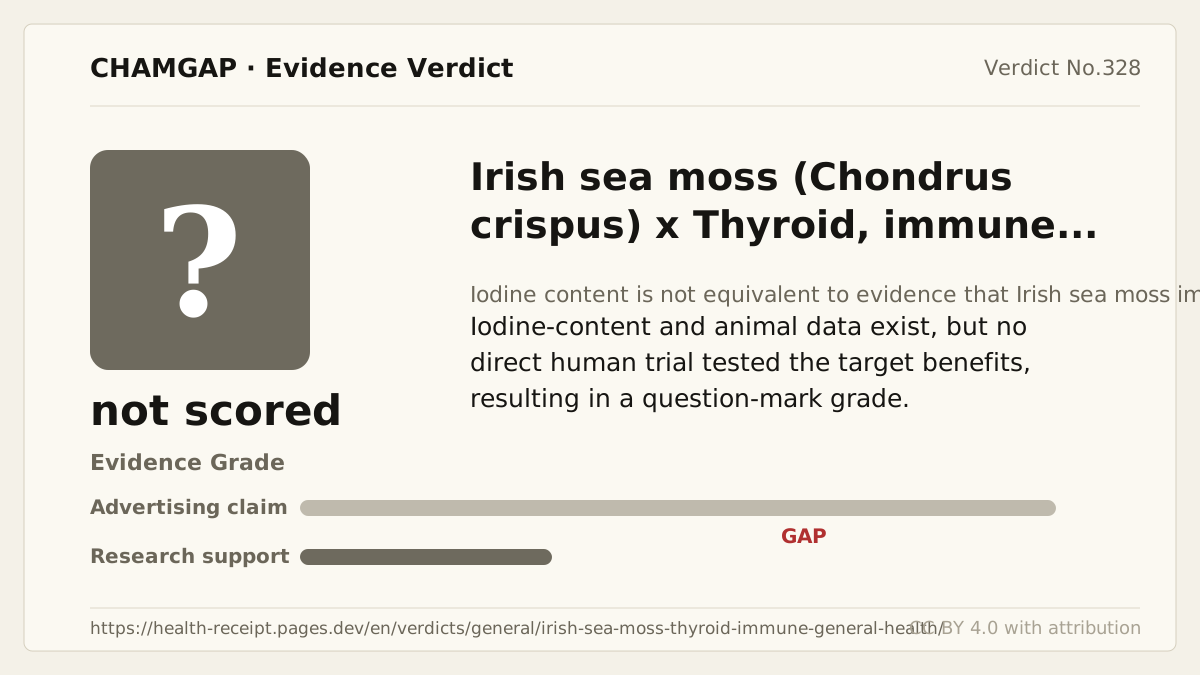
[Chamgap] Irish sea moss (Chondrus crispus) × Thyroid, immune, and general health — Evidence Grade ?. 3 cited sources checked. Source: https://chamgap.com/en/verdicts/general/irish-sea-moss-thyroid-immune-general-health/ · CC BY 4.0CC BY 4.0 — free to use with attribution; do not distort grades, numbers, or verdict meaning.
What this document does and does not do
Chamgap is an information source. It reports what research has and has not confirmed; it does not tell readers what to take or buy. That decision belongs to readers and, when needed, medical or legal professionals. This verdict reflects literature available up to the search date and may change as new research appears. Nothing here is medical advice.