
Colloidal silver,
does it really help with Infection prevention and enhanced immunity?
research showsThe n=60 randomized trial NCT04144673 was completed, but its results remain unpublished. The n=20 and n=22 rhinosinusitis studies address a different indication and cannot be transferred, while FDA judgments were excluded from grading, so the verdict is ?.
ads claimProduct descriptions may connect in vitro antimicrobial activity to elimination of pathogens in the body, infection prevention, and enhanced immunity. Published human data do not test this oral systemic efficacy.
Useful facts when choosing a product
- NCT04144673 was designed as a randomized, double-blind, placebo-controlled 60-person, 60-day trial of Bio-Active Silver Hydrosol; its status is completed but no results are posted (ClinicalTrials.gov NCT04144673, last update 2021-04-23).
- The intranasal study by Scott et al. enrolled 22 and had 20 completers, while Ooi et al. studied another local rhinosinusitis indication (PMID 29178954; PMID 29696011).
What the research actually shows
NCT04144673 randomized 60 healthy adults to Bio-Active Silver Hydrosol or placebo for 60 days and planned infection-symptom and NK-activity outcomes. The study is completed, but no results are posted. Scott et al. 2017 enrolled 22 with 20 completers in an intranasal rhinosinusitis trial, and Ooi et al. 2018 addressed the same different local indication, so neither was transferred to oral infection prevention or immune enhancement. FDA judgments remain regulatory notes, and argyria remains a safety issue.
Why this is classified as ?
The n=60 infection and immunity RCT was completed but its results remain unpublished, so the grade is ?. Rhinosinusitis trials address another indication, and FDA judgments were excluded from grading.
Counterpoint. FDA judgments are retained as regulatory notes but not used for grading. Local silver materials, in-vitro activity, and rhinosinusitis studies are separate from oral infection prevention and immune enhancement.
Rejudgment record. Reassessment (cross-check reflected) — Applied ? because the n=60 infection and immunity RCT NCT04144673 is completed but unpublished; n=20 and n=22 rhinosinusitis trials address another indication, and FDA judgments were excluded
Cross-check — Codex and Claude
Evidence Table
| Study | Design | Sample | Funding | Endpoint | Result | Weight |
|---|---|---|---|---|---|---|
| U.S. FDA 1999 final rule | Regulatory OTC final rule | U.S. federal regulator | Monograph status of internal and external colloidal-silver and silver-salt products marketed for disease treatment or prevention | The FDA classified internal and external silver salts as nonmonograph and found inadequate data for general recognition of safety and effectiveness in OTC disease treatment or prevention. | Key regulatory efficacy determination | |
| NCCIH colloidal silver fact sheet | Evidence summary from a U.S. National Institutes of Health center | U.S. federal health agency | Safety and efficacy of colloidal silver and intranasal studies | NCCIH states that the FDA warns colloidal silver is not safe or effective for any disease or condition and summarizes no meaningful improvement in chronic sinus-infection studies. | Key regulatory and evidence summary | |
| Munger MA et al. 2014 | Single-blind controlled oral exposure study | 14 | U.S. public research support; study product manufactured by American Silver | Serum and urine silver, laboratory tests, imaging, and inflammatory markers | No short-term clinically important toxicity changes occurred and serum silver was detectable; efficacy was not assessed. | Safety and exposure |
| Scott JR et al. 2017 | Randomized crossover controlled trial | 20 | Academic and noncommercial | SNOT-22 and Lund-Kennedy endoscopic scores | Intranasal colloidal-silver spray did not improve subjective or objective outcomes over saline. | Indirect null evidence |
| Ooi ML et al. 2018 | Small nonrandomized comparative clinical study | Noncommercial academic research | Culture, endoscopy, SNOT-22, and VAS | A ten-day intranasal rinse was not superior to culture-directed oral antibiotics. | Indirect null evidence |
Receipt — 6 References
All 6 cited sources were verified for existence at the original page (as of 2026-07-11).
Reviewed and approved: Chamgap Editorial Team · Approval date: 2026-07-11 · Corrections: none
Cite this verdict
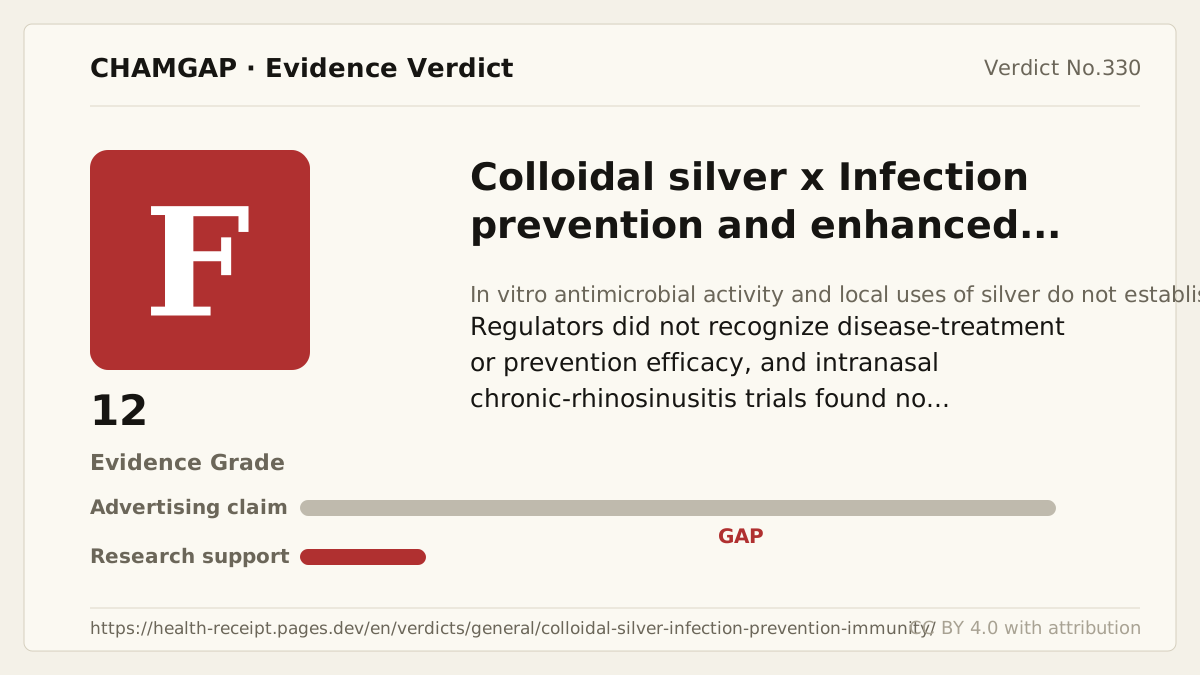
[Chamgap] Colloidal silver × Infection prevention and enhanced immunity — Evidence Grade ?. 6 cited sources checked. Source: https://chamgap.com/en/verdicts/general/colloidal-silver-infection-prevention-immunity/ · CC BY 4.0CC BY 4.0 — free to use with attribution; do not distort grades, numbers, or verdict meaning.
What this document does and does not do
Chamgap is an information source. It reports what research has and has not confirmed; it does not tell readers what to take or buy. That decision belongs to readers and, when needed, medical or legal professionals. This verdict reflects literature available up to the search date and may change as new research appears. Nothing here is medical advice.