
Bentonite clay,
does it really help with Gut cleansing and systemic toxin removal?
research showsHuman trials show that the specific refined calcium montmorillonite material ACCS100 can bind dietary aflatoxin and lower blood or urine exposure biomarkers. In Pollock's 234-person trial, only 1.5 g/day was significant and 3 g/day was null; Awuor's 50-person trial measured the urinary AFM1 surrogate. These findings cannot be extrapolated to generic marketed bentonite, and there is no human trial of systemic or accumulated-toxin removal, resulting in C.
ads claimProduct descriptions may extend adsorption into claims of intestinal-wall cleansing, waste elimination, heavy-metal removal, and whole-body detoxification. The directly supported human evidence is limited to a refined material under aflatoxin-exposure conditions.
Useful facts when choosing a product
- The human-trial material was ACCS100, a refined calcium montmorillonite with controlled contaminants and particle properties, not generic bentonite powder.
- Trial doses were generally 1.5-3 g/day, and outcomes were exposure surrogates such as serum AFB1-lysine adducts and urinary AFM1.
- Clay adsorption can also affect intestinal absorption of medicines, nutrients, and electrolytes.
- A pediatric case reported constipation and severe hypokalemia after high-dose oral and rectal administration.
What the research actually shows
The 2016 trial by Pollock and colleagues randomized 234 adults with detectable serum aflatoxin adducts to 1.5 g, 3 g, or placebo. At three months, only the low dose was significantly lower, while the high dose was not. The 2017 crossover trial by Awuor and colleagues found that ACCS100 at 3 g/day reduced urinary AFM1 relative to placebo over seven days in 50 Kenyan adults. Both studies evaluated exposure biomarkers for one contaminant through binding during ingestion; neither evaluated stool clearance, removal of intestinal contents, multiple heavy metals, or removal of toxins already absorbed systemically.
Why this is classified as C (42)
Two publicly supported human trials replicated lower aflatoxin exposure biomarkers with refined calcium montmorillonite, so this is not a preclinical-only record. However, one trial was null at the high dose, outcomes were toxin-specific surrogates rather than clinical endpoints, and gut cleansing and general systemic toxin removal were untested, resulting in C with 42 points.
Counterpoint. Under dietary aflatoxin exposure, a refined material may lower intestinal bioavailability. This subclaim is separate from general detoxification and from efficacy of marketed clay powders as a class.
Rejudgment record. Reassessment (cross-check reflected) — Positive randomized trials for aflatoxin exposure surrogates with refined calcium montmorillonite, but no direct human evidence for gut cleansing or general systemic toxin removal and no basis for transferring the trial material to all marketed bentonite products
Sub-claim grades by effect
This ingredient is marketed for several effects. A single overall grade blends strong and weak claims together, so each effect is graded separately here. The overall grade reflects the strongest disconfirming or core claim.
| Effect (sub-claim) | Grade | Basis |
|---|---|---|
| Adsorption of concurrently ingested aflatoxin (specific refined material) | C | ACCS100 trials reduced aflatoxin exposure surrogates, but the findings cannot be extrapolated to generic marketed bentonite. |
| Removal of systemic or accumulated toxins | ? | No direct human trial has tested removal of toxins that were already absorbed or accumulated. |
Cross-check — Codex and Claude
Evidence Table
| Study | Design | Sample | Funding | Endpoint | Result | Weight |
|---|---|---|---|---|---|---|
| Pollock BH et al. 2016 | Randomized double-blind placebo-controlled trial | 3 | Public research support from the U.S. NIH | Serum AFB1-lysine adducts, blood chemistry, and adverse events | The three-month biomarker decreased with 1.5 g/day, while 3 g/day was not significant versus placebo. | Key |
| Awuor AO et al. 2017 | Randomized double-blind crossover trial | 7 | Public CDC and academic research | Urinary AFM1, serum AFB1-lysine, acceptability, and adverse events | Urinary AFM1 decreased with ACCS100 at 3 g/day versus placebo, but this was a short-term exposure surrogate. | Key |
| Bennett A, Stryjewski G 2006 | Safety case report | 1 | Unknown | Constipation, serum potassium, and electrocardiogram | Constipation and severe hypokalemia were reported after high-dose oral and rectal bentonite. | Safety |
Receipt — 3 References
All 3 cited sources were verified for existence at the original page (as of 2026-07-11).
Reviewed and approved: Chamgap Editorial Team · Approval date: 2026-07-11 · Corrections: none
Cite this verdict
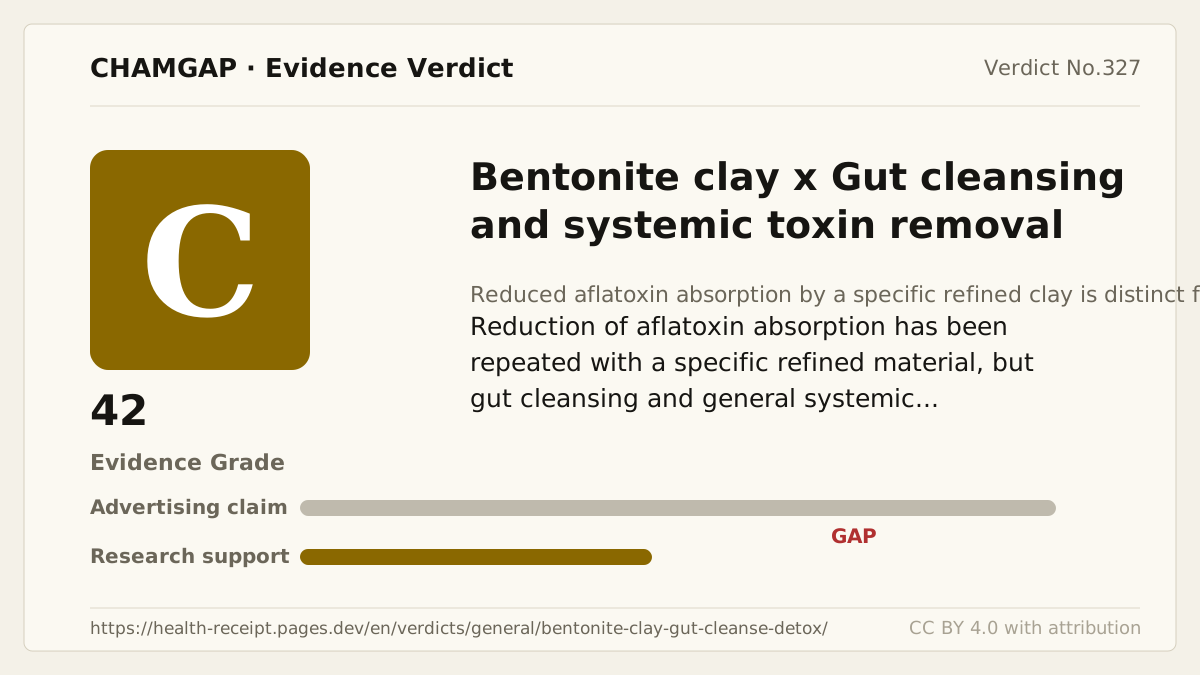
[Chamgap] Bentonite clay × Gut cleansing and systemic toxin removal — Evidence Grade C·42. 3 cited sources checked. Source: https://chamgap.com/en/verdicts/general/bentonite-clay-gut-cleanse-detox/ · CC BY 4.0CC BY 4.0 — free to use with attribution; do not distort grades, numbers, or verdict meaning.
What this document does and does not do
Chamgap is an information source. It reports what research has and has not confirmed; it does not tell readers what to take or buy. That decision belongs to readers and, when needed, medical or legal professionals. This verdict reflects literature available up to the search date and may change as new research appears. Nothing here is medical advice.