
Anti-fatigue mat,
does it really help with Relief of perceived foot and leg fatigue during prolonged standing?
research showsIn this four-hour experiment, the tested 19-mm polyurethane mat reduced the rise in leg fatigue compared with a hard floor. One 32-person session does not establish how much benefit any retail mat will provide during repeated long-term work.
ads claimIn Korea, anti-fatigue mats are marketed for kitchens, checkout counters, shops, and factory workstations. The pivotal evidence compared one specific 19-mm polyurethane mat with a hard wooden floor and does not establish the same effect for other materials and thicknesses.
Useful facts when choosing a product
- The tested Bohan Craft Co., Ltd. mat was polyurethane foam, density 200 D, hardness 65–75, and 1080×508×19 mm in size.
- The comparator was a hard wooden floor, not a thin mat, and participants stood barefoot.
- The Acknowledgments state: ‘This study was supported by the Natural Science Foundation of Zhejiang Province (LQ21H060003).’
- The authors declared no conflicts, but one coauthor was affiliated with Ningbo Bohan Crafts Co., Ltd. Whether the company supplied the mat free of charge could not be verified.
- Anti-fatigue mats are sold in Korea for kitchens, retail counters, shops, and factories, but this barefoot, single-session study in healthy students does not reproduce repeated work in footwear.
What the research actually shows
A 2022 crossover study recruited 36 people and 32 completed both conditions. Participants stood barefoot for 240 minutes on a wooden floor or a polyurethane foam mat with density 200 D, hardness 65–75, and dimensions 1080×508×19 mm; a 10-minute break followed the first 110 minutes. Randomization was limited to the order of the two conditions, and sessions were separated by 72 hours. No explicitly designated primary endpoint was identified. Foot rating of perceived exertion changed from 0.96±0.75 to 9.40±0.71 on the floor and from 0.40±0.49 to 8.20±0.83 on the mat. Reported change scores were 8.43±0.88 and 7.80±0.87, with t=2.60 and P<0.05; calf changes were 8.40±0.84 and 7.77±0.76. The ± values were standard deviations, not standard errors. The paper did not report a between-condition confidence interval, and a proper paired interval cannot be reconstructed without the within-person covariance. Roughly standardizing the foot change difference with the reported standard deviations gives about 0.72. No validated minimally important difference directly applicable to this scale and four-hour intervention was verified, so this is a medium-to-large magnitude by Cohen's statistical convention, not proof that a validated clinical threshold was met. Center-of-pressure and plantar-pressure changes also favored the mat in parts of the analysis, but those are biomechanical surrogates. One coauthor was affiliated with the mat manufacturer, and whether the manufacturer supplied the mat could not be verified. Other workplace studies differed in mat, task, endpoint, and duration and were not counted as repetitions of the same question.
Why this is classified as C (54)
The patient-relevant fatigue difference was statistically positive and of at least moderate standardized magnitude. However, the sample contained only 32 completers, and the crossover observations were analyzed with an independent-samples t test instead of an available paired or within-person method. These are two distinct avoidable limitations; the four-hour exposure itself was not counted because it directly matched the acute standing-fatigue question.
Counterpoint. The mat did not eliminate fatigue, and end-of-session ratings remained high. A coauthor was affiliated with the mat company, although the disclosed funding was from the Natural Science Foundation of Zhejiang Province; whether the manufacturer supplied the mat free of charge could not be verified.
Rejudgment record. Cross-check applied — Perceived-fatigue changes and crossover-analysis limitations in a 32-person randomized-order study
| Endpoint | P | Patient-reported treatment goal - the symptom is the goal |
| Replication | R1 | Single confirmatory trial |
| Independence | I2 | Decisive evidence is publicly or non-profit funded |
| Effect size | E+ | Meets the clinically important threshold |
The scoring table and the verdict agree (C).
Sub-claim grades by effect
This ingredient is marketed for several effects. A single overall grade blends strong and weak claims together, so each effect is graded separately here. The overall grade reflects the strongest disconfirming or core claim.
| Effect (sub-claim) | Grade | Basis |
|---|---|---|
| Reduced perceived foot and leg fatigue during four hours of standing | C | The 32-person crossover study found a positive change-score difference but had a small sample and an analysis limitation. |
| Changes in plantar pressure and center of pressure | C | Some measures favored the mat but are biomechanical surrogates kept separate from perceived fatigue. |
Cross-check — Codex and Claude
Evidence Table
| Study | Design | Sample | Funding | Endpoint | Result | Weight |
|---|---|---|---|---|---|---|
| Study 1 | Crossover study randomized only for condition order | 32 | Natural Science Foundation of Zhejiang Province LQ21H060003; one coauthor affiliated with the mat company | Ratings of perceived exertion and separate biomechanical measures; no explicit primary endpoint verified | Foot change 8.43+/-0.88 versus 7.80+/-0.87; t=2.60, P<.05 | Pivotal small single-session study |
Receipt — 3 References
All 3 cited sources were verified for existence at the original page (as of 2026-08-07).
Reviewed and approved: Chamgap Editorial Team · Approval date: 2026-08-07 · Corrections: none
Cite this verdict
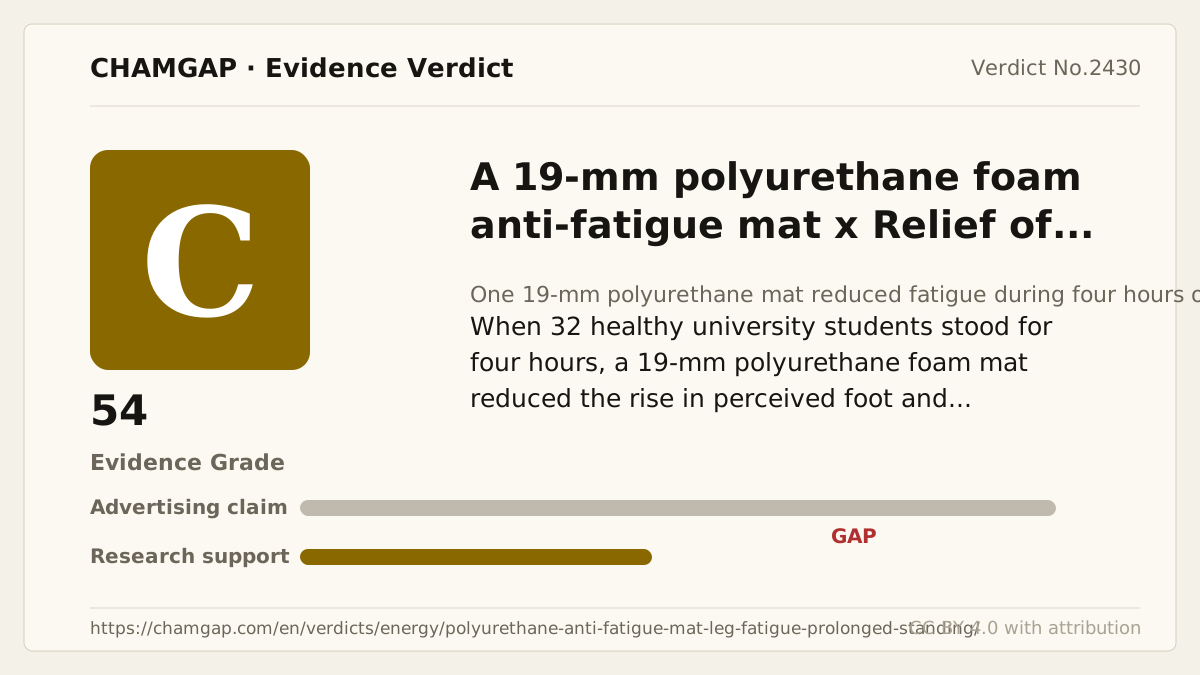
[Chamgap] Anti-fatigue mat x leg-fatigue relief during prolonged standing — Evidence Grade C·54. 3 cited sources checked. Source: https://chamgap.com/en/verdicts/energy/polyurethane-anti-fatigue-mat-leg-fatigue-prolonged-standing/ · CC BY 4.0CC BY 4.0 — free to use with attribution; do not distort grades, numbers, or verdict meaning.
What this document does and does not do
Chamgap is an information source. It reports what research has and has not confirmed; it does not tell readers what to take or buy. That decision belongs to readers and, when needed, medical or legal professionals. This verdict reflects literature available up to the search date and may change as new research appears. Nothing here is medical advice.