
Green tea consumption,
does it really help with Reduction in all-cause mortality?
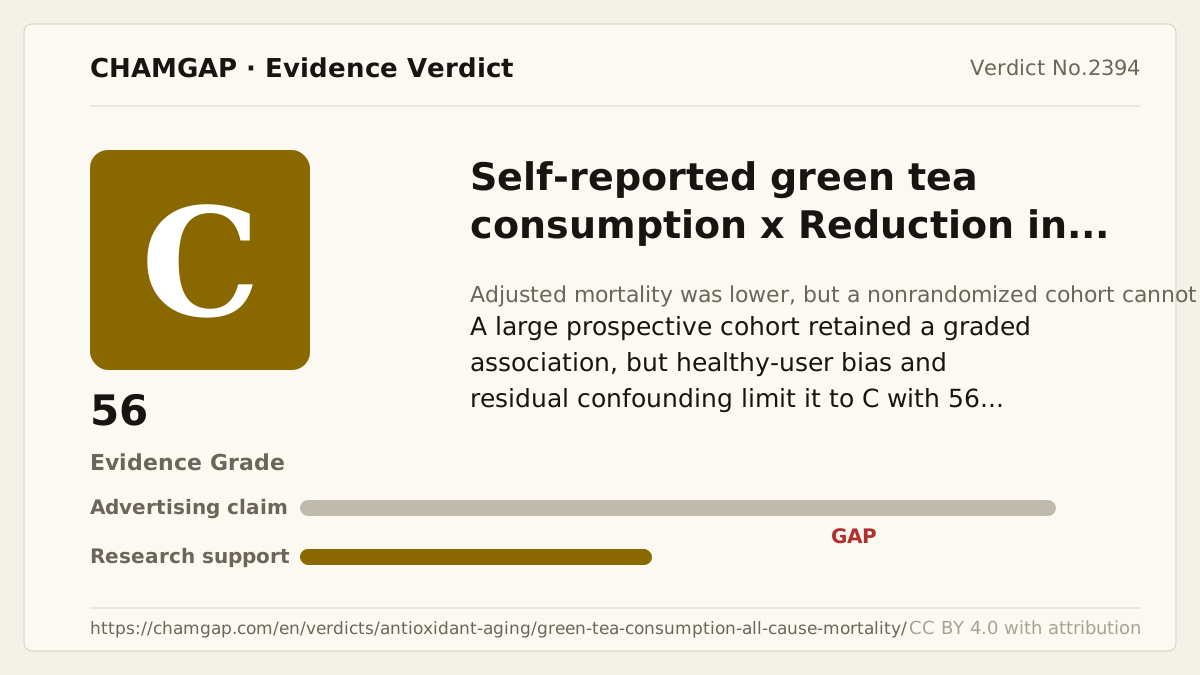
research showsThe grade is C. In the prospective Ohsaki cohort of 40,530 Japanese adults, 4,209 died over 11 years and at least five cups per day was associated with 16% lower adjusted mortality hazard than less than one cup. This was not a randomized trial and cannot establish that green tea caused lower mortality.
ads claimFive cups did not prove a 16% mortality reduction. Sixteen percent is an adjusted hazard association, while crude cumulative mortality was not lower in the highest category.
Useful facts when choosing a product
- This was a prospective cohort with one baseline dietary report, not a randomized assignment.
- The analysis did exclude deaths during the first three years and adjusted and stratified for smoking.
- Funding was reported as Japanese Ministry of Health, Labour and Welfare Health Sciences Research Grants, with no financial disclosures.
What the research actually shows
Adjustment included age, sex, employment, education, BMI, sports or exercise, walking, histories of hypertension, diabetes, and gastric ulcer, smoking status and intensity, alcohol status and ethanol intake, total energy, rice, miso soup, soy, total meat, fish, dairy, fruit, vegetables, oolong tea, black tea, and coffee. Green tea was measured once by a 40-item food-frequency questionnaire using 100 mL per cup; validity coefficients were 0.71 in men and 0.53 in women. Follow-up papers from the same team were not treated as independent replication. Verdict 425 is C with 51 points for heat-treated green tea extract and memory, while verdict 2022 is D with 28 points for matcha and cognitive decline. Those cognitive endpoints and preparations differ from ordinary green tea and mortality here.
Why this is classified as C (56)
Adjusted mortality associations survived lag analysis, but one-time self-reported exposure, multiple analyses, and residual healthy-behavior confounding give C with 56 points.
Counterpoint. The overall pattern suggested a gradient, but the authors described a threshold-like cardiovascular pattern beyond one cup, not a simple linear dose response.
Rejudgment record. Cross-check applied — Direct cross-check of Ohsaki category denominators and deaths, complete covariate list, three-year lag, smoking analyses, questionnaire validity, and funding
| Endpoint | H | Hard endpoint - actual events such as death |
| Replication | R1 | Single confirmatory trial |
| Independence | I2 | Decisive evidence is publicly or non-profit funded |
| Effect size | E+ | Meets the clinically important threshold |
The scoring table and the verdict agree (C).
Sub-claim grades by effect
This ingredient is marketed for several effects. A single overall grade blends strong and weak claims together, so each effect is graded separately here. The overall grade reflects the strongest disconfirming or core claim.
| Effect (sub-claim) | Grade | Basis |
|---|---|---|
| Association with lower adjusted all-cause mortality hazard | C | HR was 0.84 for at least five versus less than one cup. |
| Causal life extension from green tea | ? | It has not been established in a randomized trial. |
Cross-check — Codex and Claude
Evidence Table
| Study | Design | Sample | Funding | Endpoint | Result | Weight |
|---|---|---|---|---|---|---|
| Study 1 | Population-based prospective cohort | 4,209 | Health Sciences Research Grants, Ministry of Health, Labour and Welfare, Japan | All-cause mortality over up to 11 years | Adjusted HR 0.84 (95% CI 0.77 to 0.92) for at least five versus less than one cup; lagged HR 0.85 (0.77 to 0.94) | Decisive observational evidence |
Receipt — 1 References
All 1 cited sources were verified for existence at the original page (as of 2026-08-07).
Reviewed and approved: Chamgap Editorial Team · Approval date: 2026-08-07 · Corrections: none
Cite this verdict
[Chamgap] Green tea consumption x lower all-cause mortality — Evidence Grade C·56. 1 cited sources checked. Source: https://chamgap.com/en/verdicts/antioxidant-aging/green-tea-consumption-all-cause-mortality/ · CC BY 4.0CC BY 4.0 — free to use with attribution; do not distort grades, numbers, or verdict meaning.
What this document does and does not do
Chamgap is an information source. It reports what research has and has not confirmed; it does not tell readers what to take or buy. That decision belongs to readers and, when needed, medical or legal professionals. This verdict reflects literature available up to the search date and may change as new research appears. Nothing here is medical advice.