
Metabolic-bariatric surgery,
does it really help with Reduction in all-cause mortality?
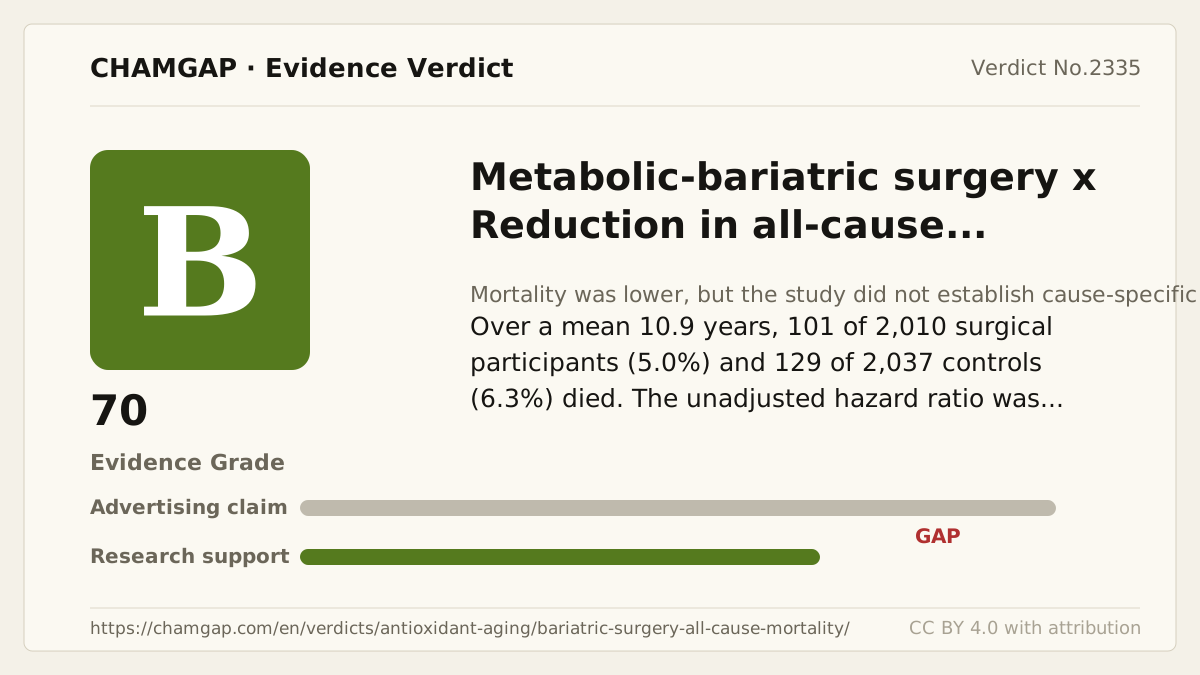
research showsIn the Swedish SOS study, long-term all-cause mortality was lower after surgery than with nonsurgical care. However, SOS was a prospective nonrandomized cohort, not a randomized trial, so detailed matching and adjustment cannot fully eliminate residual differences in operative fitness, treatment preference, health behavior, or access to care.
ads claimThe observed absolute mortality difference was 1.3 percentage points over long-term follow-up. It should not be generalized to every person with obesity or converted into a claim that one operation is superior; the evidence concerns adults with severe obesity who met surgical study criteria.
Useful facts when choosing a product
- SOS controls met the same principal eligibility and exclusion rules and received usual nonsurgical care.
- Verdict 1454 is B with 69 points and concerns type 2 diabetes remission after laparoscopic sleeve gastrectomy; this verdict concerns long-term all-cause mortality across several historical procedures.
- SOS included banding, vertical-banded gastroplasty, and gastric bypass, but not sleeve gastrectomy.
What the research actually shows
The decisive evidence is the prospective, controlled, nonrandomized SOS cohort. Follow-up ranged from 4 years 9 months to 18 years 2 months, with a mean of 10.9±3.5 years, and vital status was known for 99.9%. Procedures were gastric banding in 376 participants, vertical-banded gastroplasty in 1,369, and gastric bypass in 265. The study was not powered to establish procedure-specific mortality differences, and reported interactions were not significant.
Why this is classified as B (70)
A large, long-term study measured deaths directly and found a statistically significant reduction with absolute event counts reported. The decisive evidence nevertheless comes from one prospective nonrandomized cohort rather than an independent randomized replication, and residual selection and confounding remain, supporting grade B.
Counterpoint. Within 90 days, 5 surgical participants (0.25%) and 2 controls (0.10%) died, and 2.2% underwent reoperation for early postoperative complications. At 26 years, cumulative first revisional-surgery incidence was 40.7% after banding, 28.3% after vertical-banded gastroplasty, and 7.5% after gastric bypass. The mortality association does not guarantee a favorable balance for every patient.
Rejudgment record. Cross-check applied — Direct cross-check of the SOS nonrandomized matching design, adjustment variables, absolute mortality counts, follow-up, procedure mix, funding, and surgical harms
| Endpoint | H | Hard endpoint - actual events such as death |
| Replication | R1 | Single confirmatory trial |
| Independence | I1 | Mixed funding sources |
| Effect size | E+ | Meets the clinically important threshold |
The scoring table and the verdict agree (B).
Sub-claim grades by effect
This ingredient is marketed for several effects. A single overall grade blends strong and weak claims together, so each effect is graded separately here. The overall grade reflects the strongest disconfirming or core claim.
| Effect (sub-claim) | Grade | Basis |
|---|---|---|
| Among adults with severe obesity, metabolic-bariatric surgery was associated with lower long-term all-cause mortality than usual nonsurgical care. | B | Mean 10.9-year mortality was 5.0% versus 6.3%, but the comparison was not randomized. |
| One specific bariatric procedure reduces all-cause mortality more than the others. | ? | SOS was not powered to establish procedure-specific mortality superiority. |
| The SOS long-term mortality result directly applies to sleeve gastrectomy. | ? | Sleeve gastrectomy was not included in the SOS surgical group. |
Cross-check — Codex and Claude
Evidence Table
| Study | Design | Sample | Funding | Endpoint | Result | Weight |
|---|---|---|---|---|---|---|
| Study 1 | Prospective controlled nonrandomized matched cohort | 2,037 | Supported by grants from Hoffmann–La Roche, AstraZeneca, Cederroth, and the Swedish Medical Research Council | All-cause mortality | Mean 10.9 years: 101/2,010 (5.0%) versus 129/2,037 (6.3%); unadjusted HR 0.76 (95% CI 0.59-0.99), adjusted HR 0.71 | Decisive evidence |
Receipt — 2 References
All 2 cited sources were verified for existence at the original page (as of 2026-08-06).
Reviewed and approved: Chamgap Editorial Team · Approval date: 2026-08-06 · Corrections: none
Cite this verdict
[Chamgap] Does metabolic-bariatric surgery reduce all-cause mortality in adults with severe obesity? — Evidence Grade B·70. 2 cited sources checked. Source: https://chamgap.com/en/verdicts/antioxidant-aging/bariatric-surgery-all-cause-mortality/ · CC BY 4.0CC BY 4.0 — free to use with attribution; do not distort grades, numbers, or verdict meaning.
What this document does and does not do
Chamgap is an information source. It reports what research has and has not confirmed; it does not tell readers what to take or buy. That decision belongs to readers and, when needed, medical or legal professionals. This verdict reflects literature available up to the search date and may change as new research appears. Nothing here is medical advice.