
Single blastocyst-stage embryo transfer,
does it really help with Cumulative live birth after up to three transfers versus cleavage-stage transfer?
research showsThe grade is B with 72 points. Cumulative live birth after up to three transfers was 372/497 (74.8%) versus 328/495 (66.3%), absolute difference 8.6 points (95% CI 2.9-14.2), RR 1.13 (95% CI 1.04-1.22).
ads claimVerdict 1900 is F with 10 points and studies PGT-A in the same population and endpoint, but the intervention is embryo-biopsy selection. Verdict 2351 is B with 76 points and asks embryo number and multiple birth. Verdict 2384 is D with 34 points and asks time-lapse selection. This verdict asks developmental stage: blastocyst versus cleavage stage. The four questions differ. The 11 Chinese academic centers enrolled only good-prognosis women aged 20-40 years with at least three transferable cleavage-stage embryos. The result cannot be transferred unchanged to populations with different laboratory performance, patient selection, or transfer rules, including South Korean practice, or to poor-prognosis women.
Useful facts when choosing a product
- Women were followed through up to three single-embryo transfers.
- Fewer frozen embryos remained after blastocyst culture.
- Chinese 11-center results may vary with Korean laboratory performance, transfer limits, and case mix.
What the research actually shows
Eleven Chinese academic centers randomized 992 good-prognosis IVF women, 497 versus 495, with all included in ITT. Limitation name: noninferiority design. List item: noninferiority design. Avoidability: possible - cumulative live-birth superiority could have been the primary hypothesis. Participants and embryology laboratories were not blinded, but live birth is a record-confirmed hard event, so this was not an unblinded subjective endpoint and was not counted as a separate limitation. The only declared threshold was the -10-point noninferiority margin; sample-size assumptions were not treated as thresholds. No separate clinically important superiority threshold was declared, so axis 5 is null. Funding was Chinese public funding with no verified industry sponsorship.
Why this is classified as B (72)
A publicly funded multicenter RCT with a hard live-birth benefit supports B, tempered by a single open-label noninferiority design.
Counterpoint. Higher cumulative live birth must be balanced against fewer frozen embryos and perinatal safety signals.
Rejudgment record. Cross-check applied — Cross-checked Nature Communications report, protocol, and registry for live-birth definition, -10-point margin, ITT denominators, frozen embryos, multiplicity, perinatal outcomes, and public funding
| Endpoint | H | Hard endpoint - actual events such as death |
| Replication | R1 | Single confirmatory trial |
| Independence | I2 | Decisive evidence is publicly or non-profit funded |
| Effect size | E+ | Meets the clinically important threshold |
The scoring table and the verdict agree (B).
Sub-claim grades by effect
This ingredient is marketed for several effects. A single overall grade blends strong and weak claims together, so each effect is graded separately here. The overall grade reflects the strongest disconfirming or core claim.
| Effect (sub-claim) | Grade | Basis |
|---|---|---|
| Higher cumulative live birth | B | The absolute difference was 8.6 points. |
| Perinatal safety | ? | Preterm-related signals appeared, but individual harms were underpowered. |
Cross-check — Codex and Claude
Evidence Table
| Study | Design | Sample | Funding | Endpoint | Result | Weight |
|---|---|---|---|---|---|---|
| Study 1 | Open-label multicenter randomized noninferiority trial | 495 | Chinese national, provincial, and university public grants; no verified industry sponsorship | Cumulative live birth after up to three transfers | 372/497 (74.8%) versus 328/495 (66.3%); absolute 8.6 points (95% CI 2.9-14.2); RR 1.13 (1.04-1.22); margin -10 points | Public multicenter hard-event single noninferiority trial |
Receipt — 1 References
All 1 cited sources were verified for existence at the original page (as of 2026-08-18).
Reviewed and approved: Chamgap Editorial Team · Approval date: 2026-08-18 · Corrections: none
Cite this verdict
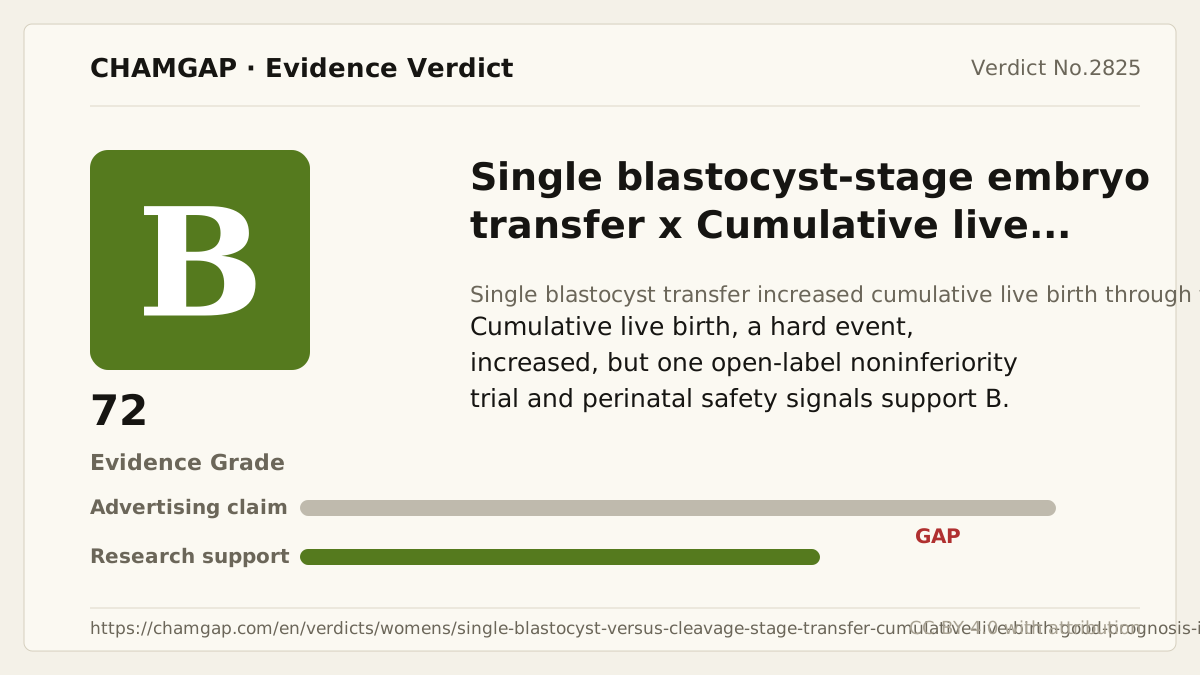
[Chamgap] Single Blastocyst-Stage Transfer Benefits Cumulative Live Birth After up to Three Transfers in Good-Prognosis IVF Women Versus Cleavage-Stage Transfer — Evidence Grade B·72. 1 cited sources checked. Source: https://chamgap.com/en/verdicts/womens/single-blastocyst-versus-cleavage-stage-transfer-cumulative-live-birth-good-prognosis-ivf/ · CC BY 4.0CC BY 4.0 — free to use with attribution; do not distort grades, numbers, or verdict meaning.
What this document does and does not do
Chamgap is an information source. It reports what research has and has not confirmed; it does not tell readers what to take or buy. That decision belongs to readers and, when needed, medical or legal professionals. This verdict reflects literature available up to the search date and may change as new research appears. Nothing here is medical advice.