
Oral conjugated equine estrogen plus medroxyprogesterone,
does it really help with Increased pulmonary embolism?
research showsThe grade is B with 76 points. Pulmonary embolism event counts were originally reported in both trials: 70/8,506 versus 31/8,102 in WHI and 10/2,196 versus 2/2,189 in WISDOM. The two WHI epidemiologic confidence intervals were derived from the event data.
ads claimThe full author lists do not overlap. NHLBI conducted WHI and Wyeth-Ayerst supplied active drug and placebo. WISDOM was funded by the UK MRC, British Heart Foundation, health departments and Australian/New Zealand public or nonprofit sources; Wyeth-Ayerst supplied drug and placebo but the paper says it had no other trial role. A no-conflict declaration was not misread as absence of funding or drug supply.
Useful facts when choosing a product
- WHI authors were Jacques E Rossouw, Garnet L Anderson, Ross L Prentice, Andrea Z LaCroix, Charles Kooperberg, Marcia L Stefanick, Rebecca D Jackson, Shirley A A Beresford, Barbara V Howard, Karen C Johnson, Jane Morley Kotchen, and Judith Ockene.
- WISDOM authors were Madge R Vickers, Alastair H MacLennan, Beverley Lawton, Deborah Ford, Jeannett Martin, Sarah K Meredith, Bianca L DeStavola, Sally Rose, Anthony Dowell, Helen C Wilkes, Janet H Darbyshire, Tom W Meade, and Paul A Komesaroff.
- The same WHI program can support different verdicts for different questions: verdict 1840 is F with 8 points for coronary-disease primary-prevention benefit, while verdict 1244 is B with 64 points for hip-fracture reduction with estrogen alone after hysterectomy. This verdict concerns combined estrogen-progestin and pulmonary embolism.
- In Korea, Premarin-family CEE and Provera-family MPA are recognized prescription names in menopausal hormone therapy. These estimates should not be transferred unchanged to different routes, doses, or progestins.
What the research actually shows
WHI randomized 16,608 healthy postmenopausal women with a uterus to CEE 0.625 mg plus MPA 2.5 mg daily or placebo and stopped after a mean 5.2 years because of the breast-cancer boundary and global risk balance. WISDOM listed major cardiovascular disease, fractures, and breast cancer as primary outcomes and venous thromboembolism as a prespecified secondary outcome; pulmonary embolism was a component. Some participants used cyclical MPA, while others used continuous combined therapy. The trial stopped after median 11.9 months following external WHI results. Its 10 versus 2 pulmonary embolism events were originally reported; the crude risk ratio of about 4.99 calculated from them is derived, not an original estimate. The reported VTE composite was 22 versus 3 events, HR 7.36 (2.20 to 24.60).
Why this is classified as B (76)
A prespecified clinical event increased in the same direction in two independent publicly funded randomized trials, and WHI's primary reporting interval supported harm. Shared early termination limits the grade to B with 76 points.
Counterpoint. WHI's multiplicity- and monitoring-adjusted interval crossed one, and WISDOM had few individual PE events. The magnitude is imprecise even though directional independent replication remains.
Rejudgment record. Cross-check applied — Pulmonary embolism increased in the same direction in prespecified outcomes of two independent publicly funded randomized trials, although both stopped early
| Endpoint | H | Hard endpoint - actual events such as death |
| Replication | R2 | Independently replicated across trials |
| Independence | I2 | Decisive evidence is publicly or non-profit funded |
| Effect size | E+ | Meets the clinically important threshold |
The scoring table and the verdict agree (B).
Sub-claim grades by effect
This ingredient is marketed for several effects. A single overall grade blends strong and weak claims together, so each effect is graded separately here. The overall grade reflects the strongest disconfirming or core claim.
| Effect (sub-claim) | Grade | Basis |
|---|---|---|
| Oral CEE plus MPA increases pulmonary embolism | B | Two independent randomized trials showed the same direction. |
| All menopausal hormone regimens have identical risk | ? | Different ingredients, doses, and routes were not directly generalized. |
Cross-check — Codex and Claude
Evidence Table
| Study | Design | Sample | Funding | Endpoint | Result | Weight |
|---|---|---|---|---|---|---|
| Study 1 | Double-blind randomized placebo-controlled trial | 8,102 | NHLBI; active drug and placebo supplied by Wyeth-Ayerst | Pulmonary embolism; prespecified monitored outcome and global-index component | Originally reported 70 versus 31 events and HR 2.13; derived nominal CI 1.39 to 3.25 and derived adjusted CI 0.99 to 4.56 | Large hard-event trial |
| Study 2 | Double-blind randomized placebo-controlled trial | 2,189 | Public and nonprofit funding; drugs and placebo supplied by Wyeth-Ayerst | Pulmonary embolism; component of prespecified secondary venous thromboembolism | Originally reported PE 10 versus 2 events; derived risk ratio about 4.99. Originally reported VTE 22 versus 3, HR 7.36 (2.20 to 24.60) | Independent replication but early termination |
Receipt — 2 References
All 2 cited sources were verified for existence at the original page (as of 2026-08-07).
Reviewed and approved: Chamgap Editorial Team · Approval date: 2026-08-07 · Corrections: none
Cite this verdict
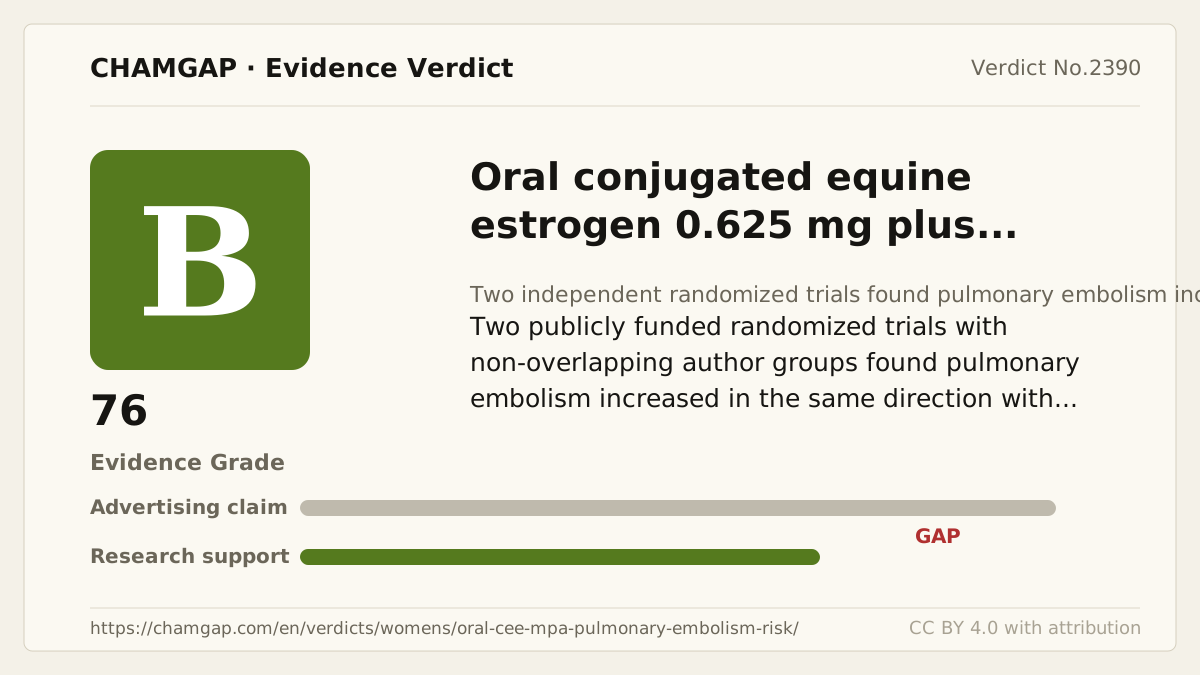
[Chamgap] Oral conjugated equine estrogen plus medroxyprogesterone x pulmonary embolism — Evidence Grade B·76. 2 cited sources checked. Source: https://chamgap.com/en/verdicts/womens/oral-cee-mpa-pulmonary-embolism-risk/ · CC BY 4.0CC BY 4.0 — free to use with attribution; do not distort grades, numbers, or verdict meaning.
What this document does and does not do
Chamgap is an information source. It reports what research has and has not confirmed; it does not tell readers what to take or buy. That decision belongs to readers and, when needed, medical or legal professionals. This verdict reflects literature available up to the search date and may change as new research appears. Nothing here is medical advice.