
Levonorgestrel intrauterine device,
does it really help with Emergency contraception within five days after unprotected intercourse?
research showsThe grade is C. In a 711-participant noninferiority trial against the copper T380A IUD, one-month pregnancy occurred in 1/317 (0.3%) versus 0/321, risk difference 0.3 percentage points (95% CI -0.9 to 1.8). The interval stayed inside the prespecified 2.5-point margin, but that margin was a design value, not an externally validated minimum important difference.
ads claimIt was not tested directly against oral emergency contraception. Claims must remain limited to IUD-seeking adults aged 18 to 35 treated within five days.
Useful facts when choosing a product
- Medical care for adverse events within one month occurred in 5.2% versus 4.9%.
- Insertion pain, cramping, bleeding, infection, perforation, and expulsion are relevant; pregnancy after failure requires urgent evaluation for ectopic pregnancy and risks of pregnancy with an IUD in place.
- The single failure followed intercourse 48 hours before placement and ended in spontaneous abortion at 10 weeks with the IUD in place.
What the research actually shows
RAPID EC masked participants, while inserters necessarily knew device type. The analysis plan changed after trial completion from intention-to-treat to modified intention-to-treat; this post-trial change was treated as an avoidable analysis limitation. Only 7% of 10,317 people screened enrolled, mostly because others wanted oral emergency contraception rather than an IUD. Sites purchased Liletta and ParaGard from distributors; devices were not donated. Funding came from the Eunice Kennedy Shriver National Institute of Child Health and Human Development, the University of Utah Population Health Research Foundation, and NIH clinical and translational support. Verdict 704 is B with 72 points for oral levonorgestrel, and verdict 744 is B with 73 points for oral ulipristal. Those are pills; this verdict concerns an inserted 52 mg device that also provides ongoing contraception.
Why this is classified as C (56)
A randomized trial found a low hard-outcome failure rate, but single-trial, noninferiority, and active-control limitations give C with 56 points.
Counterpoint. Only 290 versus 300 supplied an actual one-month urine test; survey and medical records filled other outcomes, so this was not an all-randomized analysis.
Rejudgment record. Cross-check applied — Cross-check of primary analysis denominators, risk difference, nature of the noninferiority margin, device purchasing, funding, and oral emergency-contraception verdicts
| Endpoint | H | Hard endpoint - actual events such as death |
| Replication | R1 | Single confirmatory trial |
| Independence | I2 | Decisive evidence is publicly or non-profit funded |
| Effect size | E+ | Meets the clinically important threshold |
The scoring table and the verdict agree (C).
Sub-claim grades by effect
This ingredient is marketed for several effects. A single overall grade blends strong and weak claims together, so each effect is graded separately here. The overall grade reflects the strongest disconfirming or core claim.
| Effect (sub-claim) | Grade | Basis |
|---|---|---|
| Emergency contraception versus a copper IUD | C | One noninferiority trial found 0.3% versus 0%. |
| Superiority over oral emergency contraception | ? | No direct randomized comparison was performed. |
Cross-check — Codex and Claude
Evidence Table
| Study | Design | Sample | Funding | Endpoint | Result | Weight |
|---|---|---|---|---|---|---|
| Study 1 | Participant-masked active-control randomized noninferiority trial | 321 | NICHD, University of Utah Population Health Research Foundation, and NIH clinical and translational support | Pregnancy one month after insertion | 1/317 (0.3%) vs 0/321; risk difference 0.3 points (95% CI -0.9 to 1.8); margin 2.5 points | Only direct randomized trial |
Receipt — 1 References
All 1 cited sources were verified for existence at the original page (as of 2026-08-07).
Reviewed and approved: Chamgap Editorial Team · Approval date: 2026-08-07 · Corrections: none
Cite this verdict
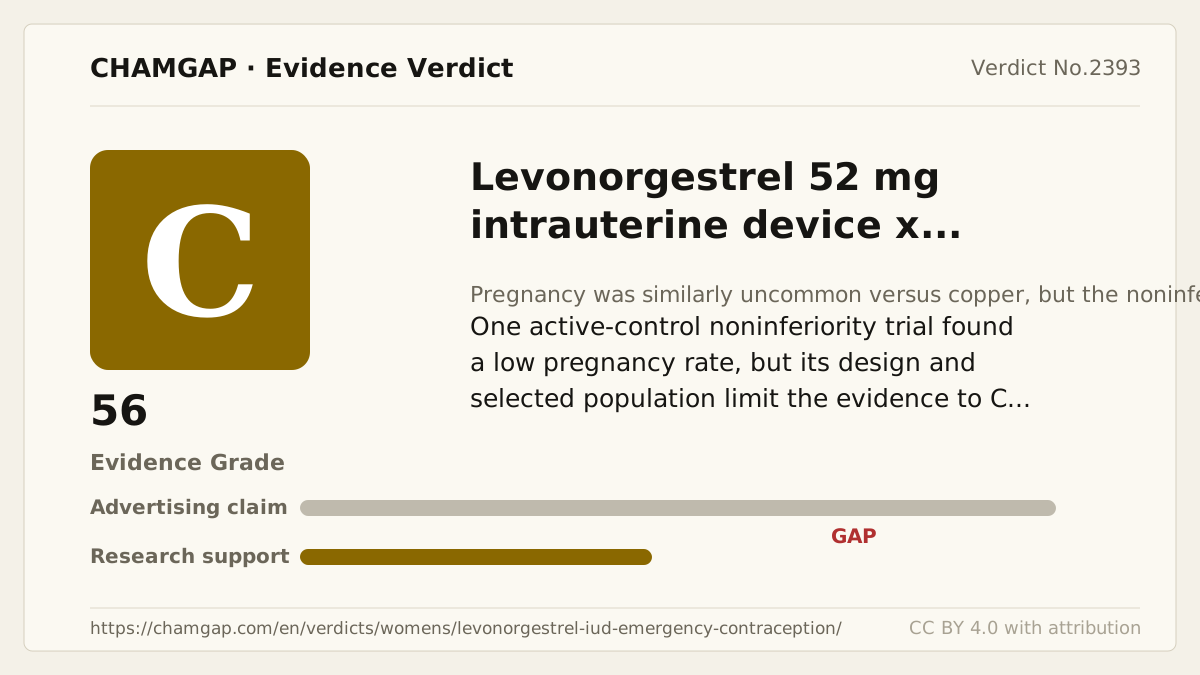
[Chamgap] Levonorgestrel intrauterine device x emergency contraception — Evidence Grade C·56. 1 cited sources checked. Source: https://chamgap.com/en/verdicts/womens/levonorgestrel-iud-emergency-contraception/ · CC BY 4.0CC BY 4.0 — free to use with attribution; do not distort grades, numbers, or verdict meaning.
What this document does and does not do
Chamgap is an information source. It reports what research has and has not confirmed; it does not tell readers what to take or buy. That decision belongs to readers and, when needed, medical or legal professionals. This verdict reflects literature available up to the search date and may change as new research appears. Nothing here is medical advice.