
26 Gy in five fractions,
does it really help with Noninferior prevention of five-year ipsilateral breast tumor relapse versus 40 Gy in 15 fractions over three weeks?
research showsThe grade is C. FAST-Forward recorded five-year ipsilateral breast tumor relapse in 31/1,361 with 40 Gy and 21/1,368 with 26 Gy, HR 0.67 (95% CI 0.38-1.16). The prespecified margin allowed no more than a 1.6-point excess for five-fraction schedules, critical HR 1.81. Because the CI upper bound 1.16 was below 1.81, 26 Gy was noninferior; this does not prove superiority. The noninferiority and active-control design cap the result at C with 56 points.
ads claimIt is incorrect to say 26 Gy prevented more recurrences. The demonstrated claim is similar control within the accepted noninferiority margin; one-week convenience and specific normal-tissue harms must be presented together.
Useful facts when choosing a product
- The 26-Gy regimen delivered 5.2 Gy per fraction in five fractions over about one week.
- The control delivered 40 Gy as 2.67 Gy per fraction in 15 fractions over about three weeks.
- This tested a linear-accelerator treatment strategy; company-supplied equipment or assessment tools were not reported.
What the research actually shows
Across 97 UK hospitals, 4,110 patients were entered and randomized; 14 withdrew consent for all data use, leaving the prespecified primary intention-to-treat population of 4,096: 1,361, 1,367, and 1,368. Forty patients who did not receive allocated treatment or deviated remained in intention to treat. The per-protocol analysis was consistent, but the publication states, ‘full data for per-protocol analyses not shown as 99% treatment compliance,’ so it did not separately publish the exact PP denominator. Treatment was open label, but recurrence was an objective event, and central ICR-CTSU telephone or fax randomization used computer-generated mixed blocks. There was no early stopping; the planned five-year analysis was completed. NIHR-HTA 09/01/47 and Cancer Research UK funded the trial, with no reported company supply of radiotherapy equipment, trial materials, or assessment tools. Noninferiority and active control without placebo were counted as two design limitations.
Why this is classified as C (56)
A large publicly funded hard-outcome trial met its prespecified noninferiority margin, but one active-control noninferiority trial is capped at C with 56 points.
Counterpoint. C does not mean recurrence control failed. It means successful noninferiority cannot be converted into superiority.
Rejudgment record. Cross-check applied — Cross-checked FAST-Forward's 4,096-person intention-to-treat analysis, consistent per-protocol result, prespecified 1.6-point and HR 1.81 margin, public funding, and normal-tissue harms
| Endpoint | H | Hard endpoint - actual events such as death |
| Replication | R1 | Single confirmatory trial |
| Independence | I2 | Decisive evidence is publicly or non-profit funded |
| Effect size | E+ | Meets the clinically important threshold |
The scoring table and the verdict agree (C).
Sub-claim grades by effect
This ingredient is marketed for several effects. A single overall grade blends strong and weak claims together, so each effect is graded separately here. The overall grade reflects the strongest disconfirming or core claim.
| Effect (sub-claim) | Grade | Basis |
|---|---|---|
| Noninferior recurrence control versus 40 Gy in 15 fractions | C | The confidence-limit upper bound was 1.16 against the prespecified critical HR 1.81. |
| Superior recurrence control versus 40 Gy in 15 fractions | ? | The trial tested noninferiority and did not establish superiority. |
Cross-check — Codex and Claude
Evidence Table
| Study | Design | Sample | Funding | Endpoint | Result | Weight |
|---|---|---|---|---|---|---|
| Study 1 | Multicenter open-label centrally randomized phase 3 noninferiority trial | 1,368 | NIHR-HTA 09/01/47 and Cancer Research UK; no reported company supply of trial equipment or tools | Ipsilateral breast tumor relapse at five years | 26 Gy versus 40 Gy HR 0.67 (95% CI 0.38-1.16), absolute difference -0.7 points (-1.3 to 0.3); noninferior below critical HR 1.81 | Large publicly funded hard-outcome noninferiority evidence |
Receipt — 2 References
All 2 cited sources were verified for existence at the original page (as of 2026-08-18).
Reviewed and approved: Chamgap Editorial Team · Approval date: 2026-08-18 · Corrections: none
Cite this verdict
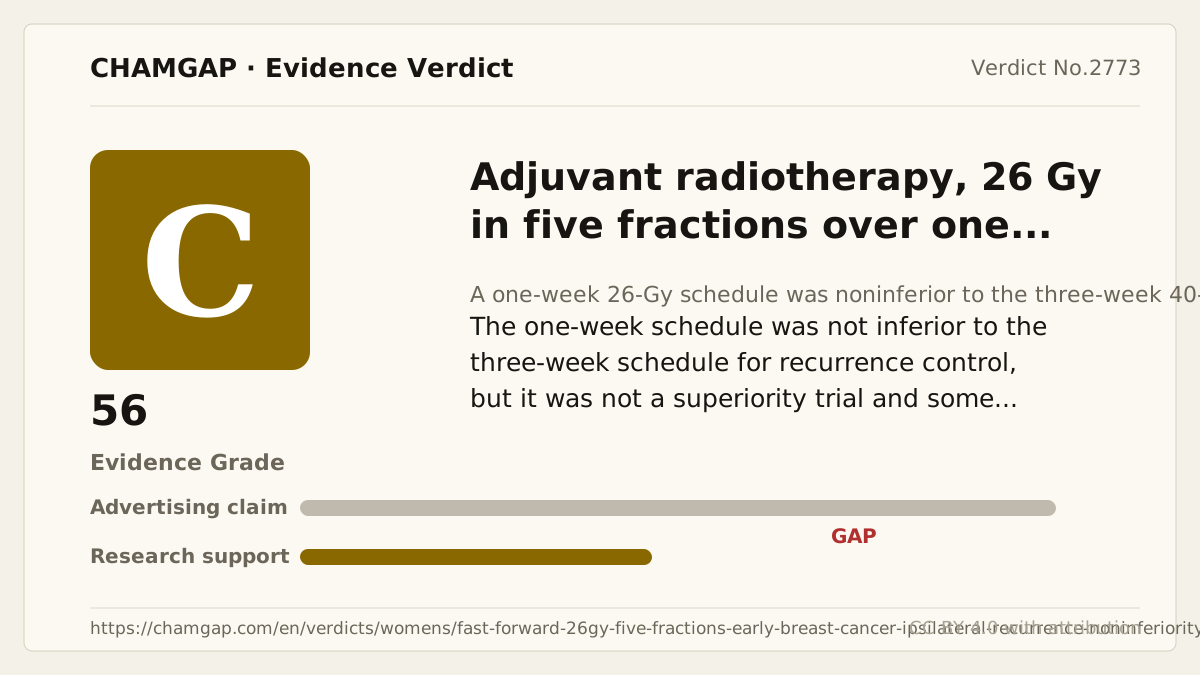
[Chamgap] 26 Gy in five fractions x noninferior recurrence control after early breast cancer surgery — Evidence Grade C·56. 2 cited sources checked. Source: https://chamgap.com/en/verdicts/womens/fast-forward-26gy-five-fractions-early-breast-cancer-ipsilateral-recurrence-noninferiority/ · CC BY 4.0CC BY 4.0 — free to use with attribution; do not distort grades, numbers, or verdict meaning.
What this document does and does not do
Chamgap is an information source. It reports what research has and has not confirmed; it does not tell readers what to take or buy. That decision belongs to readers and, when needed, medical or legal professionals. This verdict reflects literature available up to the search date and may change as new research appears. Nothing here is medical advice.