
Acne after vitamin B12 injection: an observed signal, not established cause or incidence
research showsC, score54 (support for this harm claim), with a separate Caution safety label. Human reports describe new acne/acneiform eruptions after B12 exposure. In the anchor, one of ten healthy people with clear skin developed erythematous papules and comedones one week after intramuscular hydroxocobalamin. This is a post-exposure signal, not established cause, incidence in all users or acne treatment benefit. [S01 printed pp4–6,11; S02 Summary; S03 Case/Discussion; S04 Case]
ads claimAdvertising claims were not collected for this clinical task. what_ads is null rather than an empty string or invented advertisement.
Read the explanation (Korean) →
Harm claim · seven assessment explanations
- Claim routing · B
Adopt B, the calculator’s clinical-claim route. Precedents 39 and 32 expressly grade support for harm claims. B does not assert therapeutic benefit. Line 803 keeps safety labeling separate from efficacy grading; common-prompt line 83 requires following an applicable supplied rule. Therefore a blanket safety-only exclusion is not adopted. Neither physical/chemical A nor mixed-claim C is appropriate.
The existing 3169 claim concerns new acne/acneiform eruption after B12 exposure, not a unit-conversion fact or treatment benefit in existing acne. [provenance/claim_identity.json; S01–S04]
rules/scoring.md:16-24; rules/scoring.md:297-315 (Precedent 39); rules/scoring.md:415-426 (Precedent 32); rules/scoring.md:797-805; rules/common_research_prompt.md:77-85
The grade applies only to the bounded harm claim. Caution is a separate safety label, not a benefit-versus-harm score.
- Endpoint · H
Adopt H because the rule defines it as an actual event, not only a fatal or severe event. Here the outcome is new clinical disease in a person. P would concern a selected symptom-burden or lesion-count outcome; S would describe the separate microbial measurements. Small size or nonblinding does not turn the event into a surrogate.
The selected S01 outcome is incident facial acne with erythematous papules and comedones in one of ten exposed people at one week, not a change in severity score or lesion count. The methods describe dermatologist assessment of healthy skin and acne. [S01 printed pp6,11 / physical PDF pp7,12; trial_families.json#/studies/0/page_endpoint]
rules/scoring.md:28-44; rules/scoring.md:757-767
H identifies outcome type; it does not guarantee prespecification, causality, precision or severity. Registered-primary status and the incident person’s severity change remain unverified.
- Replication · R1
Adopt R1 as the legacy fallback combining precedent 31’s R1 treatment of noncomparable evidence (lines105–106) with the current rule on the absence of an observational-only value (lines481–487). This must not be displayed as one confirmatory RCT. R2 fails comparability and independent-replication gates. R0 lacks incompatible estimates and intervals; RX lacks repeated refutation; RE does not fit this non-lifesaving, non-replacement question.
S01 is the single anchor with an exposed denominator. S02–S04 are selected cases with different or unspecified route, form, deficiency status, timing and denominators. Resampling the same nine S01 participants three months later is a microbial comparison, not an independent clinical-event replication. [trial_families.json: TF-KANG2015, TF-VERALDI2018, TF-BOWDEN2023, TF-KARAKOC2025; S01 printed pp5–6,11]
rules/scoring.md:46-58; rules/scoring.md:93-118 (Precedent 31); rules/scoring.md:481-487; rules/scoring.md:69-87 (Precedent 46)
The dictionary label “single confirmatory trial” does not adequately describe this design. There are zero confirmatory RCTs in the adopted anchor evidence. No O1 code or engine modification was introduced.
- Funding independence · I2
Adopt I2 because public funding of the decisive S01 anchor is positively documented. I2 does not mean no competing interests. A patent is not fabricated manufacturer funding. Precedent 29’s I1 fallback applies when funding of decisive evidence is unverified; it calls for an explanation, not an impossible-axis declaration.
S01 reports NIH grants R01GM099530 (NIGMS) and UH2AR057503 (NIAMS), plus a separately disclosed university patent application and inventors. Funding is unverified in the abstract-only S02 and unreported for S04; these are contextual reports, not decisive evidence used to raise axes. [S01 printed pp1,14 / physical PDF pp2,15; sources.json S01; trial_families.json]
rules/scoring.md:157-180 (Precedent 29); rules/scoring.md:613-622 (Precedent 26)
S02/S04 are not promoted to independently publicly funded replications. Product provision and the full injected formulation remain unverified.
- Magnitude supporting the claim · EX
Adopt EX(a), encoded as EX. Not only is a validated between-group threshold unavailable, but tier-2 reconstruction lacks a clinical comparator, variance or clinical P value. The second group in a two-group event formula remains null. One-of-ten is not an RR, Cohen d or causal effect. E+ is the correct direction for a supported harm claim, but the signal alone does not establish its magnitude. E~, E0 and E− also lack their required evidence.
Available clinical data are one event among ten exposed people. There are no comparable control events, clinical RR/RD/OR, CI/P, group means/SDs or adjusted clinical estimates. Clear skin at eligibility is not an unexposed group followed for the same week. Feasibility checks and arithmetic are recorded separately. [S01 printed pp5–6,11,13; U06–U10]
rules/scoring.md:185-212 (Precedent 28); rules/scoring.md:240-259 (Precedents 42, 43); rules/scoring.md:297-315 (Precedent 39); rules/scoring.md:415-440 (Precedents 32, 30); rules/scoring.md:512-539; rules/scoring.md:683-694
EX is not zero effect or exclusion of harm. Unaccessed supplementary material is not declared nonexistent; the missing clinical-comparison inputs in the available evidence are specified.
- Risk of bias · B1
Adopt B1 for the single observational-list item “major confounders not adjusted.” Clinical attribution would require recording/control of skin care, co-exposures and hormonal/time-varying factors, but no adjusted analysis of this incident clinical event is reported. Molecular clustering in other cross-sectional participants does not supply that adjustment. Absence of a comparator itself is addressed as the EX reconstruction problem, not counted again as a bias defect. B0 is unjustified; a separate second avoidable defect is not established, so B2 is not adopted.
S01 has temporal ordering and clinician assessment, but the incident-event analysis has no concurrent comparison or reported control/adjustment for major confounding. Demographic comparisons of microbial clustering in other cross-sectional groups do not adjust this clinical event. [S01 printed pp3,5–6,11,13; U06,U10,U12]
rules/scoring.md:278-295 (Precedent 40); rules/scoring.md:317-331 (Precedent 38); rules/scoring.md:590-618; rules/scoring.md:214-225 (Precedent 44)
Trial-only 200-person/12-week cutoffs are not mechanically applied. The clinical event is not relabeled self-reported. Nonblinding alone, unverified registration, RNA-library counts, patents, absent CI and possible publication bias in selected cases are not added as established independent defects. This does not imply an optimal design.
- Precision · null
Adopt precision=null as explicitly not applicable: axis5 applies only to E0/E−, so neither C0 nor CX is automatically inserted for EX. C1 exclusion is unsupported. no_human_study=false; the prerequisite for ?—no human study of the endpoint—is not met. No invented search yield or proof of worldwide absence is required.
The clinical comparative CI is unavailable and the effect code is EX. Human observations of this outcome exist in S01 and selected case reports. [S01; U08; trial_families.json]
rules/scoring.md:640-657; rules/calculator.py:105-110; rules/scoring.md:360-400; rules/scoring.md:678-681
Not applicable does not mean precise statistics. Inferential statistics are not performed; the unavailable comparative CI remains disclosed.
Useful facts when choosing a product
- S01 used one1-mg intramuscular hydroxocobalamin injection.
- The S01 human product/excipients were not established and are distinct from culture-reagent Sigma.
- The actual dose and molecule of the S03 oral OTC exposure were unreported.
- S04 reports1000 µg/mL as concentration, not an administered dose without volume.
Chamgap Semantic Classification Code
Permanent code issued
M.b12-acne-harm.hydroxocobalamin-im-single.clear-skin-healthy.week1-incident-papules-comedones.own-baseline-no-concurrent-controlInjectable harm-claim report > Vitamin B12; hydroxocobalamin in the anchor. Cyanocobalamin and unknown-form cases remain separate evidence rows. > Intramuscular for the anchor. Oral cases are contextual and do not establish topical, subcutaneous or intravenous effects. > Ten healthy people with clear skin, injected for general well-being. Not a therapeutic trial in existing acne; serum B12/deficiency unreported (U03). > New facial acne with erythematous papules and comedones at one week: one affected person among ten exposed. Not lesion number or a verified registered primary outcome. > Own clear-skin pre-exposure state. No concurrent randomized placebo clinical-event control; later gene comparisons in the same nine people are separate.
Technical identity index for the original harm report. The post-injection observation does not become oral therapeutic efficacy or general incidence. The code identifies the intervention and claim; it never contains the evidence grade, score, or safety result.
Exact Claim Classification
These independent facets prevent evidence from different forms, routes, populations, effects, and comparators from being mixed.
| Intervention class | M — The actual anchor is intramuscular injection, following the injection boundary in supplied multifacet v1 section1. Proposed S remains preserved in the input. |
|---|---|
| Canonical ingredient or intervention | Vitamin B12; hydroxocobalamin in the anchor. Cyanocobalamin and unknown-form cases remain separate evidence rows. |
| Source or part used | Purified B12 molecule; plant part not applicable. Manufacturing source, organism, batch and purity unverified (U04). |
| Formulation or processing | B12 injectable solution; the anchor names hydroxocobalamin. Human product, excipients and complete composition are unreported (U05). Not combined with oral B-complex evidence. |
| Route | Intramuscular for the anchor. Oral cases are contextual and do not establish topical, subcutaneous or intravenous effects. |
| Dose | S01: one 1-mL injection of 1000 µg/mL; arithmetic conversion 1000 µg=1 mg. Not a personal dose or injection prescription. |
| Duration | Single injection; page timepoint one week after injection. Fourteen-day microbial observation and resampling three months later are separate layers. |
| Population | Ten healthy people with clear skin, injected for general well-being. Not a therapeutic trial in existing acne; serum B12/deficiency unreported (U03). |
| Effect or condition | Signal of new acne/acneiform eruption with inflammatory papules after B12 exposure. Not established therapeutic efficacy or incidence. |
| Primary endpoint | New facial acne with erythematous papules and comedones at one week: one affected person among ten exposed. Not lesion number or a verified registered primary outcome. |
| Comparator | Own clear-skin pre-exposure state. No concurrent randomized placebo clinical-event control; later gene comparisons in the same nine people are separate. |
| Duplicate-detection key | internal-only|B12-hydroxocobalamin|IM|clear-skin-healthy|single-1mg|incident-papules-and-comedones|week1|within-person-baseline|harm-report; not a permanent semantic code |
What the research actually shows
Acne after vitamin B12 injection: an observed signal, not established cause or incidence
3169 / TASK-1054 / R01-094 · update · evidence cutoff2026-09-18 · judgment/editing date2026-09-21(Asia/Seoul)
The completed content-stage judgment, bilingual manuscripts, actual calculation and final adoption are reused unchanged. The evidence cutoff remains2026-09-18 and the judgment/editing date remains2026-09-21 (Asia/Seoul); this stage only finalizes packaging and image links. All206 content files are preserved byte-for-byte in history/content, including all130 earlier checkpoint files in history/content/history/checkpoint. The confirmed generation roles1,2,latest4,latest5 and new6 are placed in display positions1–5. Historical role3 remains ungenerated under the recorded restriction. The local publication handoff is complete; no site update or server deployment was performed.
Thirty-second answer
C, score54 (support for this harm claim), with a separate Caution safety label. Human reports describe new acne/acneiform eruptions after B12 exposure. In the anchor, one of ten healthy people with clear skin developed erythematous papules and comedones one week after intramuscular hydroxocobalamin. This is a post-exposure signal, not established cause, incidence in all users or acne treatment benefit. [S01 printed pp4–6,11; S02 Summary; S03 Case/Discussion; S04 Case]
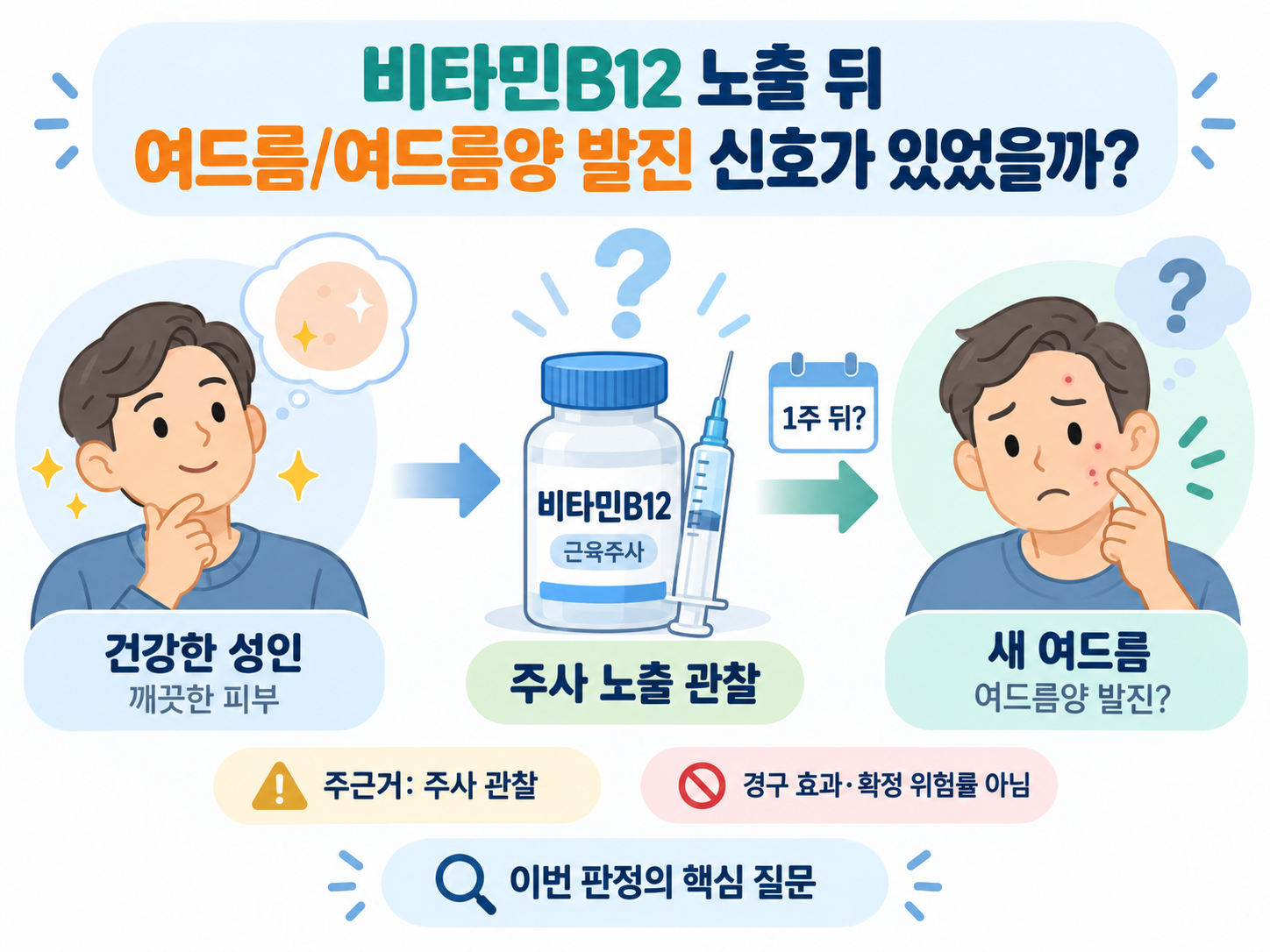
Question and actual study boundaries
The independent claim is a signal of new acne/acneiform eruption after vitamin B12 exposure. It is not changed into a claim of efficacy for existing acne or established population incidence. The original queue’s proposed single oral supplement, acne population, placebo and between-group inflammatory-lesion endpoint were search-planning fields, not facts about the anchor study.
The S01 anchor is ten healthy people with clear skin → one intramuscular hydroxocobalamin exposure → a new facial skin event reported one week later. Comparison is with each person’s clear-skin baseline, with no concurrent randomized placebo clinical-event control. The selected endpoint counts affected people, and the selected timepoint is one week after injection. It is not lesion count, a verified registered primary endpoint or a therapeutic response rate. [S01 pp4–6,11]
The reported exposure is 1 mL of a 1000 µg/mL solution, arithmetically 1000 µg=1 mg. This describes a research exposure, not a personal oral or injected prescription. “Healthy” does not establish biochemical B12 sufficiency; the product brand, excipients and full injected composition were unreported. [S01; U03–U05]
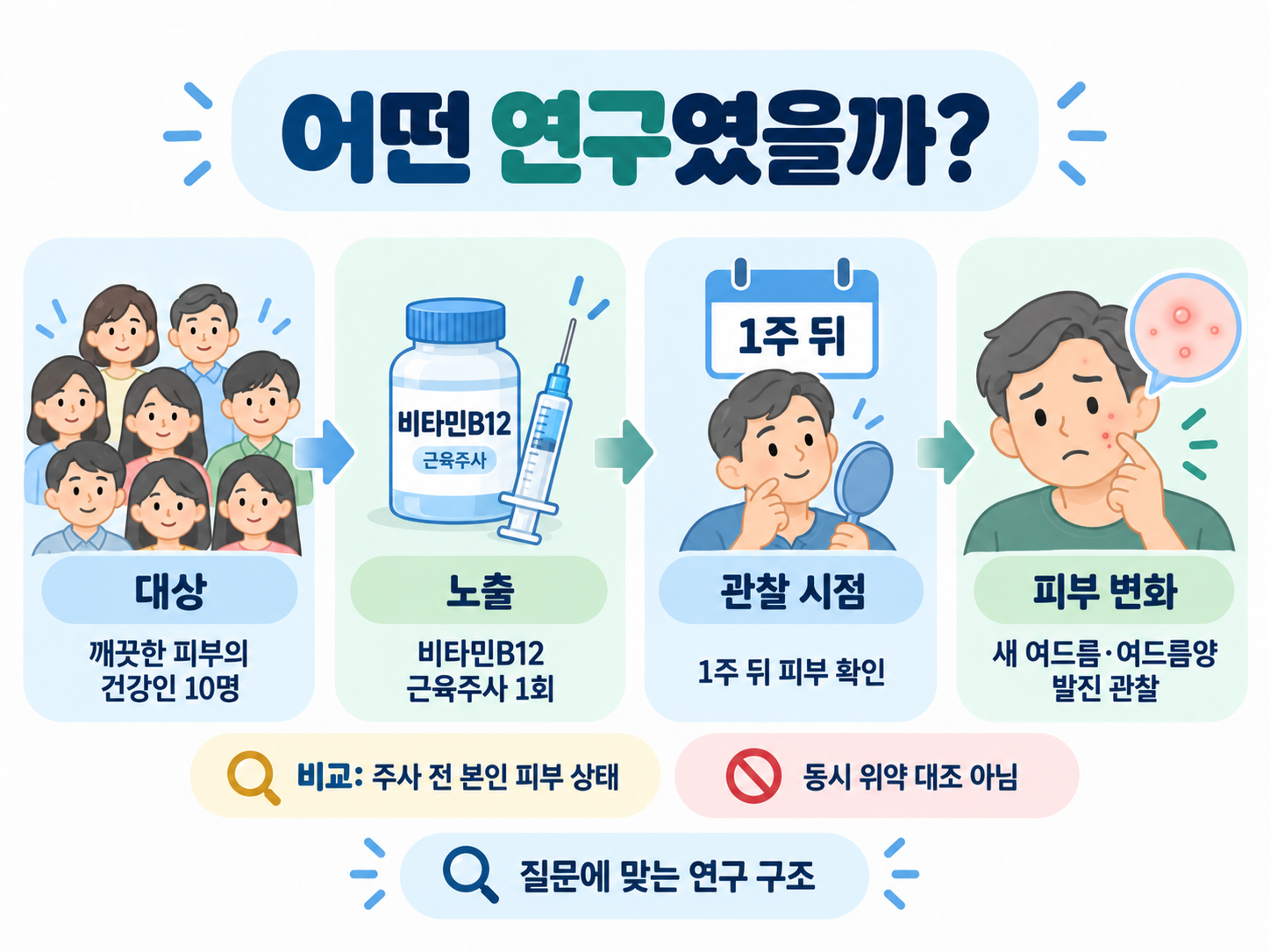
Human evidence table
Access levels and numbers are reused from the2026-09-18 extraction. Only S01 ascertainment, design, analysis and funding were narrowly re-opened in this judgment. Other prior full-text/abstract access is not represented as newly performed. S01 page references use printed manuscript pagination.
| Source and access | Actual exposure and population | Clinical outcome and time | Use and limit |
|---|---|---|---|
| S01 Kang2015, institutional author manuscript | Ten healthy clear-skin participants; one 1-mg IM hydroxocobalamin injection | One developed facial erythematous papules and comedones at one week; lesion counts unreported | Page anchor. No concurrent clinical control or CI; nine without acne over14 days do not establish general safety. [pp4–6,11] |
| S02 Veraldi2018, publisher abstract | Five female cases, oral or IM B12; case-specific molecule/dose unverified | Papules/pustules after1 week–5 months; no comedones/cysts; one eosinophilic folliculitis biopsy; all reported to recover3–6 weeks after withdrawal | Supportive harm signal. Five selected cases are not the total exposed denominator. [Summary] |
| S03 Bowden2023, publisher full text | Woman aged68, oral OTC B12 weekly for1–2 months; molecule/dose unreported | Papulopustular eruption; doxycycline prescribed while B12 continued; later outcome unreported | Oral case context, not documented withdrawal recovery. [Case;Discussion] |
| S04 Karakoç2025, publisher full text | Woman aged26, B12 119 ng/L; IM cyanocobalamin1000 µg/mL daily5 days; volume unreported | Comedone-free eruption in week2; partial improvement2 weeks after withdrawal plus systemic/topical treatments | Deficiency-treatment injection case. Concentration is not dose; co-treatment prevents attribution to withdrawal alone. [pp3–5] |
| S05 Ghiasi2018, PubMed abstract | 66 acne patients; isotretinoin+folate+B12 versus isotretinoin,2 months | Blood homocysteine, folate and B12; no lesion-count result in accessed abstract | Excluded as therapeutic anchor: combination and different endpoint. Within-arm P does not establish a between-arm effect. [Abstract] |
Observations and comparison structure
One of ten exposed people had a new skin event reported at one week. The nine participants without reported acne during the short observation are also retained. Events in only some people do not support “everyone develops an eruption”; the remaining participants do not establish long-term safety. [S01 pp4–6]
Fourteen-day microbial observation, the day0 seven/day14 ten RNA-seq libraries, and resampling the same nine people without supplementation after three months are different layers. The same people are not counted twice as independent participants, and the later nine are not a new placebo group with zero clinical events. Library-quality denominator differences are not three clinical dropouts. [S01 pp5,10–13; trial_families.json]

Numbers, reconstruction gates and actual execution records
Three different operations were actually performed and are kept distinct.
First, the adopted axis input was passed to the unchanged calculator. grading/calculator_input.json is the input; grading/execution_receipt.json records the actual call, stdout/stderr, exit code, UTC times and hashes; grading/raw_output.json preserves raw returns. grading/final_adoption_receipt.json separately records clinical adoption.
Second, descriptive arithmetic was executed. With events=1, exposed=10, volume_mL=1 and concentration_ug_per_mL=1000, the outputs were 1/10=0.1 and 1 mL×1000 µg/mL=1000 µg=1 mg. The arithmetic receipt records actual exit0 and output. These are a sample fraction and unit conversion, not population incidence, a comparative risk ratio/difference, NNT/NNH or personal dose advice.
Third, input-availability gates for comparative reconstruction were executed. A two-group event method lacks control events and a control denominator; mean/SD/N and P+N methods lack the corresponding clinical inputs, and an adjusted clinical estimate is not reported. Clear skin at baseline and later microbial resampling of the same nine people were not converted into zero-event controls. Thus availability checks were executed, but comparative inferential calculations were not. This is nonexecution for missing inputs, not a statistical-model execution error. grading/effect_reconstruction_receipt.json identifies each missing field. [S01; U06–U10; precedents30,42,43]
Values that cannot be interchanged
The incident Kang case had comedones, whereas the Veraldi and Karakoç eruptions had no comedones. Acne vulgaris, post-supplementation monomorphic acneiform eruption, eosinophilic folliculitis, rosacea and allergic rash are therefore not treated as one diagnosis. No worsening rate in existing acne, IGA improvement or total-lesion effect is invented. [S01 p6;S02 Summary;S04 Case]
Healthy participants, confirmed deficiency and isotretinoin-treated acne are different populations. Hydroxocobalamin, cyanocobalamin and unknown-form B12 remain separate. Methylcobalamin was searched in the prior record, but access-limited evidence was not substituted for oral/injection effects. Topical B12 in atopic dermatitis addresses another question. Blood-marker improvements with combined B vitamins or folate are not evidence that B12 alone treats acne. [S01–S05; history/content/history/checkpoint/history/previous_research/access_log.json]
Mechanism, limiting observations and actual access
S01 microbial transcription and culture-porphyrin findings offer a biological hypothesis, not a substitute for therapeutic benefit, population incidence or proven causality. S03 provides no subsequent outcome after B12 was continued and cannot establish that all eruptions resolve after withdrawal. [S01 pp6,9; S03 Case]
The prior search_log contains34 recorded search actions, not a total database yield. Prior full text was recorded for S01/S03/S04 and abstract access for S02/S05. Some Bahbouhi/Owen/Zubair texts and registry details remain limited. No new literature search was performed; the new search yield remains null. Only known S01 methods, statistics and funding were narrowly confirmed for the current inputs; no study was added. Paid-database searches, a complete systematic review and an exhaustive retraction search are not claimed. [history/content/history/checkpoint/history/previous_research/search_log.json; history/content/history/checkpoint/history/previous_research/access_log.json; provenance/current_access_log.json]
Funding, interests and safety
S01 disclosed two NIH grants and a related patent. S03 declared no support/relevant financial relationships. S04 declared no conflict, but funding remains unverified. S02 funding could not be established from its abstract. The incorrect Veraldi DOI in the S04 reference list was previously checked against the primary publisher identifier, corrected in the current source record and logged before the prior submission. No relevant official correction/retraction notice was identified in the previously accessed pages/recorded searches; this is not an external clearance certificate. [S01 p1,p14;S02;S03 pp2–3;S04 pp5,7]
Caution. New papules, pustules or another rash after supplementation/injection warrant clinical review of exposure timing, route, actual product and dose, prior skin disease and co-medication. This report is not advice to stop necessary deficiency treatment or select an individual dose. Cobalt hypersensitivity is separate from acne; suspected severe allergic symptoms such as acute breathing difficulty or facial/oral swelling require urgent care. The previously verified NIH absence of an established tolerable upper intake level does not imply unlimited high-dose safety. These data do not establish safety in pregnancy, lactation, children, hepatic/renal disease or long-term co-medication. [S01–S04;reused R89-S05 MHRA, R89-S06 NIH]
Current judgment and meaning of the score
Final adoption: C, score 54. The separate safety label is Caution. C rates support for this bounded harm claim; it is not “moderate danger,” a 54% probability, acne treatment benefit, or confirmation of safety.
Precedent39 (lines297–315) says that evidence supporting a harm claim raises the grade of that claim. Precedent32 (415–426) likewise orients E+ to claim support. Consequently, line803’s separation of safety from efficacy does not exclude every harm question. Common-research-prompt lines77–85 require following applicable existing rules. The unchanged claim is routed through the clinical B pathway, not recast as a therapeutic-benefit question to obtain a score.
The adopted profile is B / H / R1 / I2 / EX / B1 / precision=null. R1 is the current fallback for noncomparable evidence under precedent31 together with the rule noting the absence of an observational-only value; it does not mean one confirmatory RCT exists. I2 reflects positively documented NIH public funding of S01, with the related patent still disclosed. EX(a) means that a comparative clinical effect cannot be reconstructed from available inputs. R1 and B1 each cap the grade at B; EX caps it at C. The E0/E− floor rules do not apply.
The unchanged calculator actually returned no validation errors from validate_axes and C from derive_grade. A separate literal lookup in the scoring table counted H and I2, two strengths, giving 54 in line778’s C/two-strength cell. The supplied calculator has no numeric-score function, so table lookup is not misrepresented as such a function. Input validation, raw output and final clinical adoption are recorded separately. No C from invalid trial inputs was adopted, and no profile search was used to target a result.
The ? route requires no human study measuring this endpoint (lines678–681). Human clinical observations exist, so no_human_study=false. A new search yield is unknown and remains null, not zero or “no human study.” C1 is not used to exclude harm without a qualifying clinical interval. [grading/axis_decisions.json; grading/execution_receipt.json; grading/final_adoption_receipt.json]

Adopted seven-axis account
Claim routing · claim_type = B
Meaning: What claim is being assessed?
Current clauses: rules/scoring.md:16-24; rules/scoring.md:297-315 (Precedent 39); rules/scoring.md:415-426 (Precedent 32); rules/scoring.md:797-805; rules/common_research_prompt.md:77-85
Evidence and locations: The existing 3169 claim concerns new acne/acneiform eruption after B12 exposure, not a unit-conversion fact or treatment benefit in existing acne. [provenance/claim_identity.json; S01–S04]
Adoption and rejected substitutions: Adopt B, the calculator’s clinical-claim route. Precedents 39 and 32 expressly grade support for harm claims. B does not assert therapeutic benefit. Line 803 keeps safety labeling separate from efficacy grading; common-prompt line 83 requires following an applicable supplied rule. Therefore a blanket safety-only exclusion is not adopted. Neither physical/chemical A nor mixed-claim C is appropriate.
Remaining limits: The grade applies only to the bounded harm claim. Caution is a separate safety label, not a benefit-versus-harm score.
Endpoint · endpoint = H
Meaning: Is the outcome an actual clinical event, a symptom score, or a surrogate?
Current clauses: rules/scoring.md:28-44; rules/scoring.md:757-767
Evidence and locations: The selected S01 outcome is incident facial acne with erythematous papules and comedones in one of ten exposed people at one week, not a change in severity score or lesion count. The methods describe dermatologist assessment of healthy skin and acne. [S01 printed pp6,11 / physical PDF pp7,12; trial_families.json#/studies/0/page_endpoint]
Adoption and rejected substitutions: Adopt H because the rule defines it as an actual event, not only a fatal or severe event. Here the outcome is new clinical disease in a person. P would concern a selected symptom-burden or lesion-count outcome; S would describe the separate microbial measurements. Small size or nonblinding does not turn the event into a surrogate.
Remaining limits: H identifies outcome type; it does not guarantee prespecification, causality, precision or severity. Registered-primary status and the incident person’s severity change remain unverified.
Replication · replication = R1
Meaning: Has independent evidence reproduced the same clinical comparison?
Current clauses: rules/scoring.md:46-58; rules/scoring.md:93-118 (Precedent 31); rules/scoring.md:481-487; rules/scoring.md:69-87 (Precedent 46)
Evidence and locations: S01 is the single anchor with an exposed denominator. S02–S04 are selected cases with different or unspecified route, form, deficiency status, timing and denominators. Resampling the same nine S01 participants three months later is a microbial comparison, not an independent clinical-event replication. [trial_families.json: TF-KANG2015, TF-VERALDI2018, TF-BOWDEN2023, TF-KARAKOC2025; S01 printed pp5–6,11]
Adoption and rejected substitutions: Adopt R1 as the legacy fallback combining precedent 31’s R1 treatment of noncomparable evidence (lines105–106) with the current rule on the absence of an observational-only value (lines481–487). This must not be displayed as one confirmatory RCT. R2 fails comparability and independent-replication gates. R0 lacks incompatible estimates and intervals; RX lacks repeated refutation; RE does not fit this non-lifesaving, non-replacement question.
Remaining limits: The dictionary label “single confirmatory trial” does not adequately describe this design. There are zero confirmatory RCTs in the adopted anchor evidence. No O1 code or engine modification was introduced.
Funding independence · independence = I2
Meaning: Who funded the decisive evidence?
Current clauses: rules/scoring.md:157-180 (Precedent 29); rules/scoring.md:613-622 (Precedent 26)
Evidence and locations: S01 reports NIH grants R01GM099530 (NIGMS) and UH2AR057503 (NIAMS), plus a separately disclosed university patent application and inventors. Funding is unverified in the abstract-only S02 and unreported for S04; these are contextual reports, not decisive evidence used to raise axes. [S01 printed pp1,14 / physical PDF pp2,15; sources.json S01; trial_families.json]
Adoption and rejected substitutions: Adopt I2 because public funding of the decisive S01 anchor is positively documented. I2 does not mean no competing interests. A patent is not fabricated manufacturer funding. Precedent 29’s I1 fallback applies when funding of decisive evidence is unverified; it calls for an explanation, not an impossible-axis declaration.
Remaining limits: S02/S04 are not promoted to independently publicly funded replications. Product provision and the full injected formulation remain unverified.
Magnitude supporting the claim · effect = EX
Meaning: Can the magnitude of a comparable increase in harm be estimated?
Current clauses: rules/scoring.md:185-212 (Precedent 28); rules/scoring.md:240-259 (Precedents 42, 43); rules/scoring.md:297-315 (Precedent 39); rules/scoring.md:415-440 (Precedents 32, 30); rules/scoring.md:512-539; rules/scoring.md:683-694
Evidence and locations: Available clinical data are one event among ten exposed people. There are no comparable control events, clinical RR/RD/OR, CI/P, group means/SDs or adjusted clinical estimates. Clear skin at eligibility is not an unexposed group followed for the same week. Feasibility checks and arithmetic are recorded separately. [S01 printed pp5–6,11,13; U06–U10]
Adoption and rejected substitutions: Adopt EX(a), encoded as EX. Not only is a validated between-group threshold unavailable, but tier-2 reconstruction lacks a clinical comparator, variance or clinical P value. The second group in a two-group event formula remains null. One-of-ten is not an RR, Cohen d or causal effect. E+ is the correct direction for a supported harm claim, but the signal alone does not establish its magnitude. E~, E0 and E− also lack their required evidence.
Remaining limits: EX is not zero effect or exclusion of harm. Unaccessed supplementary material is not declared nonexistent; the missing clinical-comparison inputs in the available evidence are specified.
Risk of bias · bias = B1
Meaning: Which avoidable design or analytic problem affects this clinical inference?
Current clauses: rules/scoring.md:278-295 (Precedent 40); rules/scoring.md:317-331 (Precedent 38); rules/scoring.md:590-618; rules/scoring.md:214-225 (Precedent 44)
Evidence and locations: S01 has temporal ordering and clinician assessment, but the incident-event analysis has no concurrent comparison or reported control/adjustment for major confounding. Demographic comparisons of microbial clustering in other cross-sectional groups do not adjust this clinical event. [S01 printed pp3,5–6,11,13; U06,U10,U12]
Adoption and rejected substitutions: Adopt B1 for the single observational-list item “major confounders not adjusted.” Clinical attribution would require recording/control of skin care, co-exposures and hormonal/time-varying factors, but no adjusted analysis of this incident clinical event is reported. Molecular clustering in other cross-sectional participants does not supply that adjustment. Absence of a comparator itself is addressed as the EX reconstruction problem, not counted again as a bias defect. B0 is unjustified; a separate second avoidable defect is not established, so B2 is not adopted.
Remaining limits: Trial-only 200-person/12-week cutoffs are not mechanically applied. The clinical event is not relabeled self-reported. Nonblinding alone, unverified registration, RNA-library counts, patents, absent CI and possible publication bias in selected cases are not added as established independent defects. This does not imply an optimal design.
Precision · precision = null
Meaning: Is the interval precise enough to exclude a meaningful difference?
Current clauses: rules/scoring.md:640-657; rules/calculator.py:105-110; rules/scoring.md:360-400; rules/scoring.md:678-681
Evidence and locations: The clinical comparative CI is unavailable and the effect code is EX. Human observations of this outcome exist in S01 and selected case reports. [S01; U08; trial_families.json]
Adoption and rejected substitutions: Adopt precision=null as explicitly not applicable: axis5 applies only to E0/E−, so neither C0 nor CX is automatically inserted for EX. C1 exclusion is unsupported. no_human_study=false; the prerequisite for ?—no human study of the endpoint—is not met. No invented search yield or proof of worldwide absence is required.
Remaining limits: Not applicable does not mean precise statistics. Inferential statistics are not performed; the unavailable comparative CI remains disclosed.
Evidence, framework, unperformed work and revision conditions
Evidence limits: The temporal report of a new clinical skin event is documented, but the evidence lacks a representative population, concurrent clinical controls, comparative effect, dose-response and long-term follow-up. Oral case reports exist, but do not supply a risk estimate under the anchor’s conditions. Zero effect, no harm and therapeutic benefit cannot be concluded. [S01–S04]
Framework limits: The current R1 dictionary label says “single confirmatory trial,” while an observational-only value is absent. This judgment explicitly combines precedent31’s lines105–106 with lines481–487 as the legacy mapping. It does not display one confirmatory RCT or modify the engine. The fixed score54 follows that mapping, not a clinical probability or validated risk magnitude.
Work not performed: Broad literature, paid-database, registry and retraction searches were not repeated; additional S02 full text and all separate S01 supplements were not newly retrieved. No new comparative statistical or individual-data reanalysis was performed. Only S01 ascertainment, nonblinding, analysis and funding were narrowly re-opened to support the current inputs. A subsequently accessible direct clinical comparison could change EX or other axes. Current content is completed with these limits disclosed; clinical input selection is not deferred to Codex.
Conclusion and revision conditions: Observational support for a harm signal exists, but cause, magnitude and general incidence remain uncertain. Comparable populations, molecule/route and risk windows, adequate clinical controls, verifiable effects with intervals, confounding control, independent replication or corrected primary text would trigger reapplication of the affected axes. Record the new evidence, evidence cutoff, judgment date, before/after values and reasons while keeping ID3169, its URLs and first-publication timestamp. Any separate rule amendment must carry its own version and impact. No monitoring automation or new task was created.

Claim identity and classification
The existing record is updated in place: ID3169 / TASK-1054 / R01-094, skin-hair category, slug, bilingual URLs and first publication2026-09-18T06:32:01+00:00 are unchanged. Other completed judgments were not reinvestigated or rescored.
kind: M — The actual anchor is intramuscular injection, following the injection boundary in supplied multifacet v1 section1. Proposed S remains preserved in the input.
canonical_entity: Vitamin B12; hydroxocobalamin in the anchor. Cyanocobalamin and unknown-form cases remain separate evidence rows.
source_part: Purified B12 molecule; plant part not applicable. Manufacturing source, organism, batch and purity unverified (U04).
formulation: B12 injectable solution; the anchor names hydroxocobalamin. Human product, excipients and complete composition are unreported (U05). Not combined with oral B-complex evidence.
route: Intramuscular for the anchor. Oral cases are contextual and do not establish topical, subcutaneous or intravenous effects.
dose: S01: one 1-mL injection of 1000 µg/mL; arithmetic conversion 1000 µg=1 mg. Not a personal dose or injection prescription.
duration: Single injection; page timepoint one week after injection. Fourteen-day microbial observation and resampling three months later are separate layers.
population: Ten healthy people with clear skin, injected for general well-being. Not a therapeutic trial in existing acne; serum B12/deficiency unreported (U03).
claim: Signal of new acne/acneiform eruption with inflammatory papules after B12 exposure. Not established therapeutic efficacy or incidence.
primary_endpoint: New facial acne with erythematous papules and comedones at one week: one affected person among ten exposed. Not lesion number or a verified registered primary outcome.
comparator: Own clear-skin pre-exposure state. No concurrent randomized placebo clinical-event control; later gene comparisons in the same nine people are separate.
duplicate_key: internal-only|B12-hydroxocobalamin|IM|clear-skin-healthy|single-1mg|incident-papules-and-comedones|week1|within-person-baseline|harm-report; not a permanent semantic code
Complete unresolved and applicability record
U01 · Direct therapeutic effect
The searched and accessible material did not establish a between-group inflammatory-lesion treatment effect of single oral B12. This is not worldwide absence of human studies or a zero-effect finding.
status=not_found_in_searched_scope; value=null · history/content/history/checkpoint/history/previous_research/unresolved.json#U01
U02 · Registered primary endpoint/time
S01 did not establish a registered primary clinical acne endpoint. PRJNA260091 is a sequencing deposit, not trial registration. The page selects the observed one-week event, without claiming prospective primary status.
status=not_reported; value=null · history/content/history/checkpoint/history/previous_research/unresolved.json#U02
U03 · Baseline deficiency and individual demographics
Serum B12, deficiency classification and individual age/sex distribution of the S01 injection subgroup were not established from the reviewed main manuscript. Healthy clear skin does not establish biochemical sufficiency.
status=not_reported; value=null · history/content/history/checkpoint/history/previous_research/unresolved.json#U03
U04 · Manufacturing source and total intake
Manufacturing organism/source, batch, purity and total dietary B12 intake were not established for S01. A plant part does not apply to this molecular intervention.
status=not_reported; value=null · history/content/history/checkpoint/history/previous_research/unresolved.json#U04
U05 · Product and excipients
The human injection brand, manufacturer, excipients and additional components were not reported in S01. Sigma in the culture experiment is not identified as the human injection product.
status=not_reported; value=null · history/content/history/checkpoint/history/previous_research/unresolved.json#U05
U06 · Concurrent clinical comparator
S01 has no concurrent randomized placebo comparison of clinical events. Resampling nine of the same people without supplementation three months later is a gene-expression control, not an independent clinical 0/9 unexposed group.
status=not_applicable; value=null · history/content/history/checkpoint/history/previous_research/unresolved.json#U06
U07 · Lesion counts and IGA
Papule/comedone counts, inflammatory/total lesion changes and an IGA change for the incident S01 case were not reported. One affected person is not one lesion.
status=not_reported; value=null · history/content/history/checkpoint/history/previous_research/unresolved.json#U07
U08 · Clinical effect and uncertainty statistics
Between-group clinical RR, RD, OR, CI, SD, SE and P were not reported. Microbial gene statistics do not replace them.
status=not_reported; value=null · history/content/history/checkpoint/history/previous_research/unresolved.json#U08
U09 · MCID
No source-verified MCID was established for this event or the unreported lesion-count change. No threshold is invented.
status=not_reported; value=null · history/content/history/checkpoint/history/previous_research/unresolved.json#U09
U10 · Covariates and background care
Adjusted clinical effects, covariate models and the injection subgroup distribution of medications, skin care, hormonal and dietary factors were not established. Topical treatment in the cross-sectional acne group is not copied to the ten healthy recipients.
status=not_reported; value=null · history/content/history/checkpoint/history/previous_research/unresolved.json#U10
U11 · Supplement and missingness
Separate S01 supplementary individual clinical follow-up was not retrieved. Day-0 RNA-seq n=7 versus day-14 n=10 concerns library quality, not three clinical dropouts.
status=inaccessible; value=null · history/content/history/checkpoint/history/previous_research/unresolved.json#U11
U12 · Allocation and blinding
S01 is not a randomized therapeutic efficacy trial and explicitly states that it was not blinded. Successful allocation concealment or double blinding is not claimed.
status=not_applicable; value=null · history/content/history/checkpoint/history/previous_research/unresolved.json#U12
U13 · Multiplicity detail
S01 specifies adjusted P/AIC criteria for RNA-seq and several molecular tests, but all multiplicity details were not verified against separate supplements. Neither universal nonadjustment nor clinical significance is inferred.
status=inaccessible; value=null · history/content/history/checkpoint/history/previous_research/unresolved.json#U13
U14 · Injection-case dechallenge/rechallenge
Quantitative dechallenge recovery and rechallenge outcomes for S01 HL414 were not established in the reviewed main paper. Temporality is not randomized causal proof.
status=not_reported; value=null · history/content/history/checkpoint/history/previous_research/unresolved.json#U14
U15 · Incidence, dose response and long term
Representative exposed denominators, route-specific incidence, dose response and long-term risk were not established. The study fraction 1/10 is not published as a 10% risk for general users.
status=not_reported; value=null · history/content/history/checkpoint/history/previous_research/unresolved.json#U15
U16 · Exposure detail in five cases
Only the S02 abstract was accessed; case-specific oral/IM route, molecule, dose, formulation, product and deficiency are unverified. Oral and injected exposures are not pooled into a dose effect.
status=inaccessible; value=null · history/content/history/checkpoint/history/previous_research/unresolved.json#U16
U17 · Funding and selection in five cases
S02 funding, product supply, selection, complete follow-up and rechallenge details cannot be established from the abstract. Independence or consecutive complete ascertainment is not assumed.
status=inaccessible; value=null · history/content/history/checkpoint/history/previous_research/unresolved.json#U17
U18 · Case denominators
The five S02 cases and one each in S03/S04 are selected cases, not all B12 recipients. They cannot yield population event rates or zero control events.
status=not_applicable; value=null · history/content/history/checkpoint/history/previous_research/unresolved.json#U18
U19 · Oral OTC form and dose
S03 confirms oral use weekly for 1–2 months; molecule, amount, product and detailed composition are unreported. Oral administration is verified in the Discussion, not inferred solely from OTC status.
status=not_reported; value=null · history/content/history/checkpoint/history/previous_research/unresolved.json#U19
U20 · Oral-case outcome and deficiency
S03 continued supplementation while prescribing doxycycline. Subsequent recovery, attrition, rechallenge and baseline deficiency values are unreported; this is not a documented cure after withdrawal.
status=not_reported; value=null · history/content/history/checkpoint/history/previous_research/unresolved.json#U20
U21 · Actual dose in the 2025 case
S04 reports a concentration of 1000 µg/mL. Without injection volume, a 1000-µg dose or 5-mg cumulative five-day exposure cannot be established.
status=not_reported; value=null · history/content/history/checkpoint/history/previous_research/unresolved.json#U21
U22 · Recovery attribution and co-treatment
S04 combined withdrawal with doxycycline, topical clindamycin/benzoyl peroxide and antihistamines. Partial improvement at two weeks is not complete recovery or a randomized effect of withdrawal alone.
status=not_applicable; value=null · history/content/history/checkpoint/history/previous_research/unresolved.json#U22
U23 · 2025-case funding and product
S04 declares no conflict, but funding, manufacturer and excipients were not separately established. A conflict declaration does not prove independent funding.
status=not_reported; value=null · history/content/history/checkpoint/history/previous_research/unresolved.json#U23
U24 · Combination RCT methods
S05 confirms 66 total participants, two groups and two months; per-group allocation/analysis, dose, molecule, route, missingness, registration and funding are unverified. Equal groups of 33 are not assumed.
status=inaccessible; value=null · history/content/history/checkpoint/history/previous_research/unresolved.json#U24
U25 · Combination RCT lesion outcome
The accessed S05 abstract concerns blood homocysteine, folate and B12, not lesion counts. Significance in one arm and nonsignificance in another does not establish a between-group difference.
status=not_reported; value=null · history/content/history/checkpoint/history/previous_research/unresolved.json#U25
U26 · Direct methylcobalamin acne evidence
A methylcobalamin ALS experience paper was located but its full text was inaccessible, so acne events and denominators were not directly verified. The completed JETALS muscle-strength verdict was neither re-researched nor repurposed.
status=inaccessible; value=null · history/content/history/checkpoint/history/previous_research/unresolved.json#U26
U27 · Additional case full texts
Bahbouhi and Owen papers were located and access attempted, but key full texts were unavailable. Patient counts and exposures from snippets were not merged into the verified evidence table.
status=inaccessible; value=null · history/content/history/checkpoint/history/previous_research/unresolved.json#U27
U28 · Registry and search scope
General web, primary papers, PubMed pages and indexed ClinicalTrials.gov searches were used. Registry detail pages remained loading screens; subscription Embase/Web of Science/CENTRAL database searches were not performed. This is not claimed as an exhaustive systematic review.
status=not_searched; value=null · history/content/history/checkpoint/history/previous_research/unresolved.json#U28
U29 · Advertising
Advertising claims were not collected for this clinical task. what_ads is null rather than an empty string or invented advertisement.
status=not_searched; value=null · history/content/history/checkpoint/history/previous_research/unresolved.json#U29
U31 · Allergy versus acne
Previously verified cobalt hypersensitivity information concerns a separate hazard. Papules, pustules or comedones do not diagnose allergy, and not every rash is acne vulgaris.
status=not_applicable; value=null · history/content/history/checkpoint/history/previous_research/unresolved.json#U31
U32 · Safety in special populations
These acne data do not establish safety in pregnancy, lactation, children, hepatic/renal disease or long-term co-medication. Nonreporting is not zero adverse events or confirmed safety.
status=not_reported; value=null · history/content/history/checkpoint/history/previous_research/unresolved.json#U32
U33 · Historical overlap and citation errors
Earlier same-author S02 cases and review totals may overlap and were not pooled. The Veraldi DOI ending 12325 in S04 conflicts with directly verified 12360; the latter is used. This is not a verified formal erratum.
status=conflicting; value=null · history/content/history/checkpoint/history/previous_research/unresolved.json#U33
U34 · Correction/retraction completeness
No relevant notice was found on accessed sources and in the recorded title/DOI searches, but all databases and every Crossmark record were not exhaustively checked.
status=not_searched; value=null · history/content/history/checkpoint/history/previous_research/unresolved.json#U34
U35 · Mechanism as a clinical substitute
S01 gene expression and culture porphyrin are a separate mechanistic layer. Culture concentration is not a human dose and cannot establish lesion treatment efficacy or population incidence.
status=not_applicable; value=null · history/content/history/checkpoint/history/previous_research/unresolved.json#U35
U36 · Deficiency treatment and prescribing
S04 deficiency treatment at B12 119 ng/L and S01 general-wellbeing injections concern different populations. This signal is not advice to stop necessary deficiency treatment or choose a personal dose.
status=not_applicable; value=null · history/content/history/checkpoint/history/previous_research/unresolved.json#U36
Sources and locations
[S01] Kang D, Shi B, Erfe MC, Craft N, Li H. Vitamin B12 modulates the transcriptome of the skin microbiota in acne pathogenesis. Sci Transl Med. 2015;7(293):293ra103. DOI 10.1126/scitranslmed.aab2009; PMID 26109103. Source. Prior extraction reused; narrow S01 methods/funding confirmation on2026-09-21. S01 p/pp references denote printed manuscript pages; add1 for physical PDF pages. Locations: Printed manuscript p1 / physical PDF p2: bibliographic record and competing interests; Printed pp4–6 / physical PDF pp5–7: longitudinal exposure and incident clinical event; Printed pp10–11 / physical PDF pp11–12: study populations, dermatologist ascertainment, nonblinding, exposure; Printed p13 / physical PDF p14: molecular statistical methods, not clinical comparative risk statistics; Printed p14 / physical PDF p15: NIH funding.
[S02] Veraldi S, Benardon S, Diani M, Barbareschi M. Acneiform eruptions caused by vitamin B12: A report of five cases and review of the literature. J Cosmet Dermatol. 2018;17(1):112–115; online 2017-06-08. DOI 10.1111/jocd.12360; PMID 28594082. Source. Prior extraction reused; no new full-text access this round. Locations: Publisher Summary; header publication dates; References.
[S03] Bowden A, Ekeh O, Brownstone ND, Hsu S. Acneiform Eruption Secondary to Over-the-Counter Vitamin B12. Cureus. 2023;15(8):e43275. DOI 10.7759/cureus.43275. Source. Prior extraction reused; no new full-text access this round. Locations: PDF p1: case presentation; PDF p2: discussion confirms oral use and disclosures; PDF p3: references.
[S04] Karakoç Y, Yıldız N, Aksoy H, Fidancı İ, Ayhan Başer D. A rare aspect of commonly administered vitamin B12 injection therapy in primary care: Acneiform eruption. Ankara Med J. 2025;25(4):467–472. DOI 10.5505/amj.2025.82258. Source. Prior extraction reused; no new full-text access this round. Locations: PDF cover: issue/DOI and submission/acceptance dates; PDF pp3–4 (printed468–469): case, concentration, exposure and follow-up; PDF p5: partial regression figure and conflict statement; PDF p7: references.
[S05] Ghiasi M, Mortazavi H, Jafari M. Efficacy of Folic Acid and Vitamin B12 Replacement Therapies in the Reduction of Adverse Effects of Isotretinoin: A Randomized Controlled Trial. Skinmed. 2018;16(4):239–245; PMID 30207526. Source. Prior extraction reused; no new full-text access this round. Locations: PubMed bibliographic header and Abstract.
[R89-S05] MHRA. Vitamin B12 (hydroxocobalamin, cyanocobalamin): known cobalt allergy and sensitivity reactions. 18 December 2023. Source. Prior extraction reused; no new full-text access this round.
[R89-S06] NIH ODS. Vitamin B12 Health Professional Fact Sheet. Source. Prior extraction reused; no new full-text access this round.
Content self-review and confirmed image composition
The completed content-stage judgment and bilingual self-review are preserved. This stage verifies final packaging and links without changing the clinical content, grade, score, axes or calculation receipts. This is not independent external expert review or journal certification; editorial-quality A and evidence grade C remain distinct.
The final composition consists of exact PNG originals for generation roles1,2,latest4,latest5 and new6, displayed in positions1–5. New role6 is a publishing/revision procedure, not a clinical-event scene, and is placed alongside the revision conditions. No image was generated, edited, re-encoded or overlaid in this stage. The asset manifest and identity receipt link file IDs, role numbers, display positions, dimensions, bytes, hashes, captions and alt text.
Existing visual limitations remain explicit. Role2 depicts8 people while its label and the actual denominator are10. Unscaled bars in roles4/5 and the skin schematic in role5 are not incidence plots or patient photographs. These limitations and the distinction between temporal sequence and causality remain in captions and provenance/image_content_impact.json.
Historical role3 remains not generated/incomplete under the recorded content restriction. It was not retried, circumvented, replaced or marked successful; no broken image link is included. The user-confirmed five-image set includes the separate role6 and is complete. No additional composition approval is pending. Codex’s file receipt, technical checks and site integration/publication are already within the requested downstream scope. Local handoff readiness is not completed server deployment or publication.
Why this is classified as C (54)
**Final adoption: C, score 54.** The separate safety label is **Caution**. C rates support for this bounded harm claim; it is not “moderate danger,” a 54% probability, acne treatment benefit, or confirmation of safety.
Precedent39 (lines297–315) says that evidence supporting a harm claim raises the grade of that claim. Precedent32 (415–426) likewise orients E+ to claim support. Consequently, line803’s separation of safety from efficacy does not exclude every harm question. Common-research-prompt lines77–85 require following applicable existing rules. The unchanged claim is routed through the clinical B pathway, not recast as a therapeutic-benefit question to obtain a score.
The adopted profile is **B / H / R1 / I2 / EX / B1 / precision=null**. R1 is the current fallback for noncomparable evidence under precedent31 together with the rule noting the absence of an observational-only value; it does not mean one confirmatory RCT exists. I2 reflects positively documented NIH public funding of S01, with the related patent still disclosed. EX(a) means that a comparative clinical effect cannot be reconstructed from available inputs. R1 and B1 each cap the grade at B; EX caps it at C. The E0/E− floor rules do not apply.
The unchanged calculator actually returned no validation errors from `validate_axes` and **C** from `derive_grade`. A separate literal lookup in the scoring table counted **H and I2, two strengths**, giving **54 in line778’s C/two-strength cell**. The supplied calculator has no numeric-score function, so table lookup is not misrepresented as such a function. Input validation, raw output and final clinical adoption are recorded separately. No C from invalid trial inputs was adopted, and no profile search was used to target a result.
The ? route requires no human study measuring this endpoint (lines678–681). Human clinical observations exist, so `no_human_study=false`. A new search yield is unknown and remains null, not zero or “no human study.” C1 is not used to exclude harm without a qualifying clinical interval. [grading/axis_decisions.json; grading/execution_receipt.json; grading/final_adoption_receipt.json]
Counterpoint. The evidence is a small exposed cohort and noncomparable selected cases. Temporal association and mechanism do not establish causation or general incidence; R1 is the legacy observational mapping, not one confirmatory trial.
Judgment application record. actual_validated_profile_and_unchanged_engine_agree — **Final adoption: C, score 54.** The separate safety label is **Caution**. C rates support for this bounded harm claim; it is not “moderate danger,” a 54% probability, acne treatment benefit, or confirmation of safety. Precedent39 (lines297–315) says that evidence supporting a harm claim raises the grade of that claim. Precedent32 (415–426) likewise orients E+ to claim support. Consequently, line803’s separation of safety from efficacy does not exclude every harm question. Common-research-prompt lines77–85 require following applicable existing rules. The unchanged claim is routed through the clinical B pathway, not recast as a therapeutic-benefit question to obtain a score. The adopted profile is **B / H / R1 / I2 / EX / B1 / precision=null**. R1 is the current fallback for noncomparable evidence under precedent31 together with the rule noting the absence of an observational-only value; it does not mean one confirmatory RCT exists. I2 reflects positively documented NIH public funding of S01, with the related patent still disclosed. EX(a) means that a comparative clinical effect cannot be reconstructed from available inputs. R1 and B1 each cap the grade at B; EX caps it at C. The E0/E− floor rules do not apply. The unchanged calculator actually returned no validation errors from `validate_axes` and **C** from `derive_grade`. A separate literal lookup in the scoring table counted **H and I2, two strengths**, giving **54 in line778’s C/two-strength cell**. The supplied calculator has no numeric-score function, so table lookup is not misrepresented as such a function. Input validation, raw output and final clinical adoption are recorded separately. No C from invalid trial inputs was adopted, and no profile search was used to target a result. The ? route requires no human study measuring this endpoint (lines678–681). Human clinical observations exist, so `no_human_study=false`. A new search yield is unknown and remains null, not zero or “no human study.” C1 is not used to exclude harm without a qualifying clinical interval. [grading/axis_decisions.json; grading/execution_receipt.json; grading/final_adoption_receipt.json]
Seven source axes · current judgment
| Claim routing | B | Adopt B, the calculator’s clinical-claim route. Precedents 39 and 32 expressly grade support for harm claims. B does not assert therapeutic benefit. Line 803 keeps safety labeling separate from efficacy grading; common-prompt line 83 requires following an applicable supplied rule. Therefore a blanket safety-only exclusion is not adopted. Neither physical/chemical A nor mixed-claim C is appropriate. The grade applies only to the bounded harm claim. Caution is a separate safety label, not a benefit-versus-harm score. |
| Endpoint | H | Adopt H because the rule defines it as an actual event, not only a fatal or severe event. Here the outcome is new clinical disease in a person. P would concern a selected symptom-burden or lesion-count outcome; S would describe the separate microbial measurements. Small size or nonblinding does not turn the event into a surrogate. H identifies outcome type; it does not guarantee prespecification, causality, precision or severity. Registered-primary status and the incident person’s severity change remain unverified. |
| Replication | R1 | R1 — legacy mapping for noncomparable evidence; one observational anchor, not a confirmatory RCT Adopt R1 as the legacy fallback combining precedent 31’s R1 treatment of noncomparable evidence (lines105–106) with the current rule on the absence of an observational-only value (lines481–487). This must not be displayed as one confirmatory RCT. R2 fails comparability and independent-replication gates. R0 lacks incompatible estimates and intervals; RX lacks repeated refutation; RE does not fit this non-lifesaving, non-replacement question. The dictionary label “single confirmatory trial” does not adequately describe this design. There are zero confirmatory RCTs in the adopted anchor evidence. No O1 code or engine modification was introduced. |
| Funding independence | I2 | Adopt I2 because public funding of the decisive S01 anchor is positively documented. I2 does not mean no competing interests. A patent is not fabricated manufacturer funding. Precedent 29’s I1 fallback applies when funding of decisive evidence is unverified; it calls for an explanation, not an impossible-axis declaration. S02/S04 are not promoted to independently publicly funded replications. Product provision and the full injected formulation remain unverified. |
| Magnitude supporting the claim | EX | Adopt EX(a), encoded as EX. Not only is a validated between-group threshold unavailable, but tier-2 reconstruction lacks a clinical comparator, variance or clinical P value. The second group in a two-group event formula remains null. One-of-ten is not an RR, Cohen d or causal effect. E+ is the correct direction for a supported harm claim, but the signal alone does not establish its magnitude. E~, E0 and E− also lack their required evidence. EX is not zero effect or exclusion of harm. Unaccessed supplementary material is not declared nonexistent; the missing clinical-comparison inputs in the available evidence are specified. |
| Risk of bias | B1 | Adopt B1 for the single observational-list item “major confounders not adjusted.” Clinical attribution would require recording/control of skin care, co-exposures and hormonal/time-varying factors, but no adjusted analysis of this incident clinical event is reported. Molecular clustering in other cross-sectional participants does not supply that adjustment. Absence of a comparator itself is addressed as the EX reconstruction problem, not counted again as a bias defect. B0 is unjustified; a separate second avoidable defect is not established, so B2 is not adopted. Trial-only 200-person/12-week cutoffs are not mechanically applied. The clinical event is not relabeled self-reported. Nonblinding alone, unverified registration, RNA-library counts, patents, absent CI and possible publication bias in selected cases are not added as established independent defects. This does not imply an optimal design. |
| Precision | null | Not applicable (null): precision axis5 applies only to E0/E− Adopt precision=null as explicitly not applicable: axis5 applies only to E0/E−, so neither C0 nor CX is automatically inserted for EX. C1 exclusion is unsupported. no_human_study=false; the prerequisite for ?—no human study of the endpoint—is not met. No invented search yield or proof of worldwide absence is required. Not applicable does not mean precise statistics. Inferential statistics are not performed; the unavailable comparative CI remains disclosed. |
Review performed and remaining limitations
The searched and accessible material did not establish a between-group inflammatory-lesion treatment effect of single oral B12. This is not worldwide absence of human studies or a zero-effect finding. S01 did not establish a registered primary clinical acne endpoint. PRJNA260091 is a sequencing deposit, not trial registration. The page selects the observed one-week event, without claiming prospective primary status. Serum B12, deficiency classification and individual age/sex distribution of the S01 injection subgroup were not established from the reviewed main manuscript. Healthy clear skin does not establish biochemical sufficiency. Manufacturing organism/source, batch, purity and total dietary B12 intake were not established for S01. A plant part does not apply to this molecular intervention. The human injection brand, manufacturer, excipients and additional components were not reported in S01. Sigma in the culture experiment is not identified as the human injection product. S01 has no concurrent randomized placebo comparison of clinical events. Resampling nine of the same people without supplementation three months later is a gene-expression control, not an independent clinical 0/9 unexposed group. Papule/comedone counts, inflammatory/total lesion changes and an IGA change for the incident S01 case were not reported. One affected person is not one lesion. Between-group clinical RR, RD, OR, CI, SD, SE and P were not reported. Microbial gene statistics do not replace them. No source-verified MCID was established for this event or the unreported lesion-count change. No threshold is invented. Adjusted clinical effects, covariate models and the injection subgroup distribution of medications, skin care, hormonal and dietary factors were not established. Topical treatment in the cross-sectional acne group is not copied to the ten healthy recipients. Separate S01 supplementary individual clinical follow-up was not retrieved. Day-0 RNA-seq n=7 versus day-14 n=10 concerns library quality, not three clinical dropouts. S01 is not a randomized therapeutic efficacy trial and explicitly states that it was not blinded. Successful allocation concealment or double blinding is not claimed. S01 specifies adjusted P/AIC criteria for RNA-seq and several molecular tests, but all multiplicity details were not verified against separate supplements. Neither universal nonadjustment nor clinical significance is inferred. Quantitative dechallenge recovery and rechallenge outcomes for S01 HL414 were not established in the reviewed main paper. Temporality is not randomized causal proof. Representative exposed denominators, route-specific incidence, dose response and long-term risk were not established. The study fraction 1/10 is not published as a 10% risk for general users. Only the S02 abstract was accessed; case-specific oral/IM route, molecule, dose, formulation, product and deficiency are unverified. Oral and injected exposures are not pooled into a dose effect. S02 funding, product supply, selection, complete follow-up and rechallenge details cannot be established from the abstract. Independence or consecutive complete ascertainment is not assumed. The five S02 cases and one each in S03/S04 are selected cases, not all B12 recipients. They cannot yield population event rates or zero control events. S03 confirms oral use weekly for 1–2 months; molecule, amount, product and detailed composition are unreported. Oral administration is verified in the Discussion, not inferred solely from OTC status. S03 continued supplementation while prescribing doxycycline. Subsequent recovery, attrition, rechallenge and baseline deficiency values are unreported; this is not a documented cure after withdrawal. S04 reports a concentration of 1000 µg/mL. Without injection volume, a 1000-µg dose or 5-mg cumulative five-day exposure cannot be established. S04 combined withdrawal with doxycycline, topical clindamycin/benzoyl peroxide and antihistamines. Partial improvement at two weeks is not complete recovery or a randomized effect of withdrawal alone. S04 declares no conflict, but funding, manufacturer and excipients were not separately established. A conflict declaration does not prove independent funding. S05 confirms 66 total participants, two groups and two months; per-group allocation/analysis, dose, molecule, route, missingness, registration and funding are unverified. Equal groups of 33 are not assumed. The accessed S05 abstract concerns blood homocysteine, folate and B12, not lesion counts. Significance in one arm and nonsignificance in another does not establish a between-group difference. A methylcobalamin ALS experience paper was located but its full text was inaccessible, so acne events and denominators were not directly verified. The completed JETALS muscle-strength verdict was neither re-researched nor repurposed. Bahbouhi and Owen papers were located and access attempted, but key full texts were unavailable. Patient counts and exposures from snippets were not merged into the verified evidence table. General web, primary papers, PubMed pages and indexed ClinicalTrials.gov searches were used. Registry detail pages remained loading screens; subscription Embase/Web of Science/CENTRAL database searches were not performed. This is not claimed as an exhaustive systematic review. Advertising claims were not collected for this clinical task. what_ads is null rather than an empty string or invented advertisement. Previously verified cobalt hypersensitivity information concerns a separate hazard. Papules, pustules or comedones do not diagnose allergy, and not every rash is acne vulgaris. These acne data do not establish safety in pregnancy, lactation, children, hepatic/renal disease or long-term co-medication. Nonreporting is not zero adverse events or confirmed safety. Earlier same-author S02 cases and review totals may overlap and were not pooled. The Veraldi DOI ending 12325 in S04 conflicts with directly verified 12360; the latter is used. This is not a verified formal erratum. No relevant notice was found on accessed sources and in the recorded title/DOI searches, but all databases and every Crossmark record were not exhaustively checked. S01 gene expression and culture porphyrin are a separate mechanistic layer. Culture concentration is not a human dose and cannot establish lesion treatment efficacy or population incidence. S04 deficiency treatment at B12 119 ng/L and S01 general-wellbeing injections concern different populations. This signal is not advice to stop necessary deficiency treatment or choose a personal dose.
Evidence table
Access levels and numbers are reused from the2026-09-18 extraction. Only S01 ascertainment, design, analysis and funding were narrowly re-opened in this judgment. Other prior full-text/abstract access is not represented as newly performed. S01 page references use printed manuscript pagination.
| Source and access | Actual exposure and population | Clinical outcome and time | Use and limit |
|---|---|---|---|
| S01 Kang2015, institutional author manuscript | Ten healthy clear-skin participants; one 1-mg IM hydroxocobalamin injection | One developed facial erythematous papules and comedones at one week; lesion counts unreported | Page anchor. No concurrent clinical control or CI; nine without acne over14 days do not establish general safety. [pp4–6,11] |
| S02 Veraldi2018, publisher abstract | Five female cases, oral or IM B12; case-specific molecule/dose unverified | Papules/pustules after1 week–5 months; no comedones/cysts; one eosinophilic folliculitis biopsy; all reported to recover3–6 weeks after withdrawal | Supportive harm signal. Five selected cases are not the total exposed denominator. [Summary] |
| S03 Bowden2023, publisher full text | Woman aged68, oral OTC B12 weekly for1–2 months; molecule/dose unreported | Papulopustular eruption; doxycycline prescribed while B12 continued; later outcome unreported | Oral case context, not documented withdrawal recovery. [Case;Discussion] |
| S04 Karakoç2025, publisher full text | Woman aged26, B12 119 ng/L; IM cyanocobalamin1000 µg/mL daily5 days; volume unreported | Comedone-free eruption in week2; partial improvement2 weeks after withdrawal plus systemic/topical treatments | Deficiency-treatment injection case. Concentration is not dose; co-treatment prevents attribution to withdrawal alone. [pp3–5] |
| S05 Ghiasi2018, PubMed abstract | 66 acne patients; isotretinoin+folate+B12 versus isotretinoin,2 months | Blood homocysteine, folate and B12; no lesion-count result in accessed abstract | Excluded as therapeutic anchor: combination and different endpoint. Within-arm P does not establish a between-arm effect. [Abstract] |
Receipt — 7 References
Evidence access cutoff: 2026-09-21. Each citation states its actual access level (full-text transcription, abstract, index, or other) and remaining limitations. Bibliographic checking does not certify the study results or treatment efficacy.
Technical integration by: Codex · Evidence date: 2026-09-21 · Corrections: none
Revision history
2026-09-21: Integrated the current submitted manuscript and paired explanation. The verdict ID, URLs and first publication date are preserved. The current conclusion and limitations are presented in the report above.
Cite this verdict
[Chamgap] Acne after vitamin B12 injection: an observed signal, not established cause or incidence — Evidence Grade C·54. 7 cited sources checked. Source: https://chamgap.com/en/verdicts/skin-hair/vitamin-b12-injection-acne-ungraded-harm-report/ · CC BY 4.0CC BY 4.0 — free to use with attribution; do not distort grades, numbers, or verdict meaning.
What this document does and does not do
Chamgap is an information source. It reports what research has and has not confirmed; it does not tell readers what to take or buy. That decision belongs to readers and, when needed, medical or legal professionals. This verdict reflects literature available up to the search date and may change as new research appears. Nothing here is medical advice.