
Fractional CO2 laser,
does it really help with Improvement in inflammatory active-acne lesion counts versus Nd:YAG?
research showsThe grade is C. A randomized split-face study of 30 patients favored fractional CO2 over Nd:YAG for inflammatory lesion counts, but lesion count is a surrogate endpoint capped at C. Small sample size and active-only comparison give C with 50 points.
ads claimKorean clinics advertise acne lasers as self-pay care. Prices vary by device, area, and package, roughly from the low hundreds of thousands of won to several hundred thousand won per session; four-session total cost and downtime matter.
Useful facts when choosing a product
- Thirty patients received four treatments at two-week intervals with about three months of follow-up.
- Inflammatory lesion-count improvement favored fractional CO2, with between-treatment P=.007.
- Two blinded independent dermatologists performed lesion counting and GEA grading.
- Among 16 acne verdicts in the corpus, this one occupies the two-laser comparative question.
What the research actually shows
Each facial half was assigned by selecting an enclosed opaque envelope labeled with a laser. Two blinded independent dermatologists counted lesions. Operators could not be blinded, but blinded outcome counting meant an unblinded subjective endpoint was not counted. Defect name: Very small sample. Listed item: Small study (total under 200) - actual total 30. Avoidability: Avoidable - a multicenter study could enroll at least 200. Defect name: Laser-only comparison. Listed item: Active control only. Avoidability: Avoidable - a within-face sham or standard-care control could be included.
Why this is classified as C (50)
A surrogate endpoint capped at C, two listed limitations, and one E+ strength give C with 50 points.
Counterpoint. Superiority to another laser does not establish superiority to sham or standard drug treatment.
Rejudgment record. Cross-check applied — Lesion-count surrogate, 30-person sample, active-only comparison, and blinded assessment
| Endpoint | S | Surrogate marker - laboratory or imaging measures |
| Replication | R1 | Single confirmatory trial |
| Independence | I1 | Mixed funding sources |
| Effect size | E+ | Meets the clinically important threshold |
The scoring table and the verdict agree (C).
Sub-claim grades by effect
This ingredient is marketed for several effects. A single overall grade blends strong and weak claims together, so each effect is graded separately here. The overall grade reflects the strongest disconfirming or core claim.
| Effect (sub-claim) | Grade | Basis |
|---|---|---|
| Inflammatory lesion-count improvement versus Nd:YAG | C | CO2 was favored in 30 patients, but the endpoint is a surrogate. |
| Scar prevention and long-term patient-important benefit | ? | Not tested. |
Cross-check — Codex and Claude
Evidence Table
| Study | Design | Sample | Funding | Endpoint | Result | Weight |
|---|---|---|---|---|---|---|
| Study 1 | Prospective randomized split-face comparative trial | 30 | Reported no external funding; no public support or independent replication established | Inflammatory and noninflammatory lesion counts and GEA | Fractional CO2 showed greater inflammatory lesion-count improvement, between-group P=.007; a consistent absolute lesion-count difference was not reported | Single 30-person surrogate-endpoint comparative trial |
Receipt — 1 References
All 1 cited sources were verified for existence at the original page (as of 2026-08-18).
Reviewed and approved: Chamgap Editorial Team · Approval date: 2026-08-18 · Corrections: none
Cite this verdict
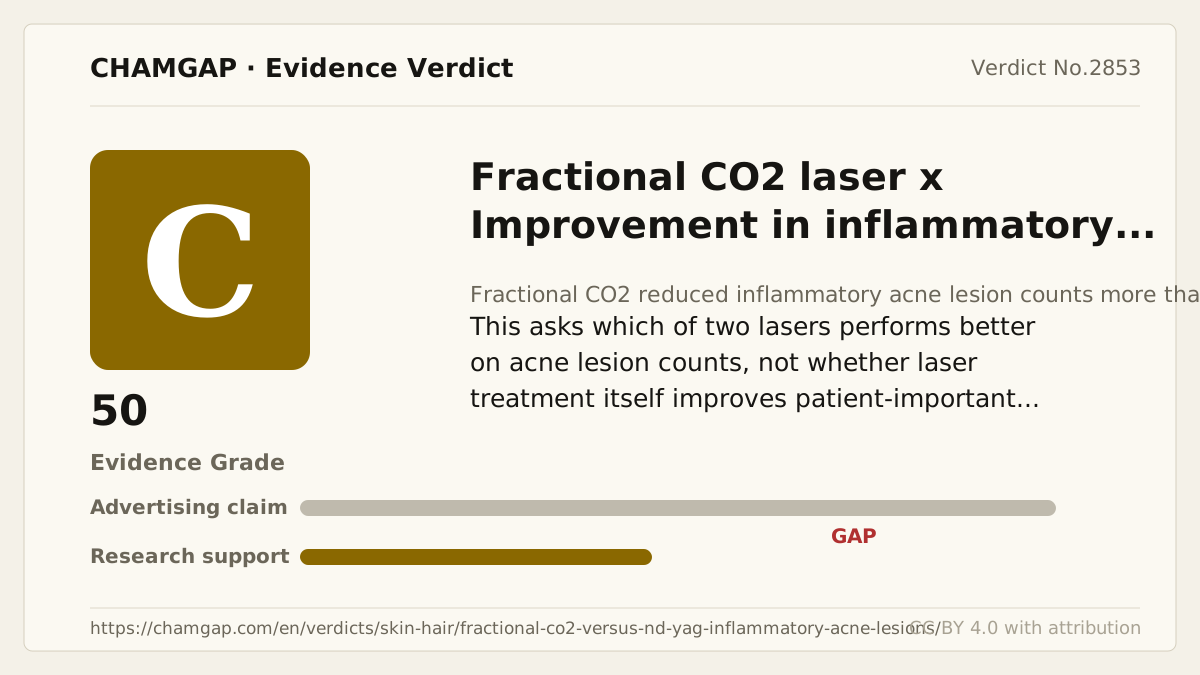
[Chamgap] Fractional CO2 laser benefits inflammatory acne lesion counts versus Nd:YAG - benefit — Evidence Grade C·50. 1 cited sources checked. Source: https://chamgap.com/en/verdicts/skin-hair/fractional-co2-versus-nd-yag-inflammatory-acne-lesions/ · CC BY 4.0CC BY 4.0 — free to use with attribution; do not distort grades, numbers, or verdict meaning.
What this document does and does not do
Chamgap is an information source. It reports what research has and has not confirmed; it does not tell readers what to take or buy. That decision belongs to readers and, when needed, medical or legal professionals. This verdict reflects literature available up to the search date and may change as new research appears. Nothing here is medical advice.