
Ten-lesson universal school-based mindfulness training,
does it really help with Improved one-year depression risk, social-emotional-behavioral functioning, and well-being in adolescents?
research showsThe grade is D with 30 points. MYRIAD randomized 85 UK schools with 8,376 pupils at the school level. Standardized between-group differences for the three one-year co-primary outcomes were 0.005 (95% CI -0.05 to 0.06) for depression risk, 0.02 (-0.02 to 0.07) for social-emotional-behavioral functioning, and 0.02 (-0.03 to 0.07) for well-being; all were null.
ads claimKorea has policy and development activity for mindfulness and emotional-education programs offered in schools, including plans for an all-student program and a Korean school mindfulness curriculum with instructor training and pilot schools. This large null trial therefore matters directly to universal implementation. Verdict 2215 is C with 46 points for an adult worker mindfulness app: the population and delivery differ - that is an adult workplace app, whereas this is an adolescent school lesson.
Useful facts when choosing a product
- SBMT consisted of ten teacher-delivered psychoeducation and mindfulness-practice lessons, with pupils receiving a mean of 9.0 sessions.
- The control was usual school social-emotional teaching, not no treatment.
- The paper reported no intervention-related adverse events.
- Among 28 secondary outcomes, self-reported hyperactivity-inattention, panic, obsessive-compulsive symptoms, and teacher-rated emotional symptoms included small worse-direction signals.
What the research actually shows
Eighty-five schools consented and were assigned to 43 usual-teaching schools with 4,232 pupils or 42 mindfulness schools with 4,144 pupils. The allocation method was: "Following collection of baseline data, schools were randomised in a 1:1 ratio to trial arms by an independent researcher otherwise unconnected with the trial. The independent statistician generated the allocation sequence." Cluster concealment was implemented because "all schools were recruited before randomisation and allocated en bloc for each cohort," and pupils were recruited before school allocation. One school withdrew after allocation. Primary data covered 3,678/4,232 (86.9%) and 3,572/4,144 (86.2%), making primary-population missingness 13.4%, below the 15% threshold; modified intention-to-treat sensitivity analyses agreed. Limitation name: unmasked subjective endpoint Which listed item: unmasked subjective endpoint Original evidence that the requirement was met: the co-primary measures were "CES-D," "SDQ," and "WEMWBS," centered on self-report, and schools, teachers, and pupils necessarily knew whether ten mindfulness lessons were delivered. Could it have been avoided: possible - an expectancy- and contact-matched comparison curriculum plus allocation-masked independent assessment could have reduced reporting expectancy. Usual social-emotional education was existing school provision, so withholding it for a no-treatment condition was not treated as an avoidable active-control-only flaw. The Wellcome Trust funded the work and the NIHR Clinical Research Network supported it.
Why this is classified as D (30)
This large publicly funded cluster trial measured directly important symptoms and functioning, but all three co-primary outcomes were null. With no independent repeated trial or prespecified exclusion margin and one unmasked subjective-outcome limitation, the grade is D with 30 points.
Counterpoint. MYRIAD tested universal classroom delivery to all pupils aged roughly 11 to 14. It does not generalize to treatment for an individual diagnosed with depression, clinician-guided therapy, or an adult meditation app.
Rejudgment record. Cross-check applied — Cross-checked ISRCTN86619085 and the article for school-level concealment, three co-primary scales, confidence-interval tails, analysis population, and Wellcome-NIHR support
| Endpoint | P | Patient-reported treatment goal - the symptom is the goal |
| Replication | R1 | Single confirmatory trial |
| Independence | I2 | Decisive evidence is publicly or non-profit funded |
| Effect size | E0 | Null |
| Precision | C0 | The confidence interval leaves room for benefit |
The scoring table and the verdict agree (D).
Sub-claim grades by effect
This ingredient is marketed for several effects. A single overall grade blends strong and weak claims together, so each effect is graded separately here. The overall grade reflects the strongest disconfirming or core claim.
| Effect (sub-claim) | Grade | Basis |
|---|---|---|
| Improved adolescent mental health at one year through universal school lessons | D | All three co-primary outcomes were null. |
| Ineffectiveness of individually targeted therapeutic mindfulness | ? | MYRIAD did not test that population or delivery model. |
Cross-check — Codex and Claude
Evidence Table
| Study | Design | Sample | Funding | Endpoint | Result | Weight |
|---|---|---|---|---|---|---|
| Study 1 | UK parallel cluster-randomized trial with schools as clusters and usual teaching as control | 7,250 | Funded by the Wellcome Trust with NIHR Clinical Research Network support | One-year co-primary CES-D depression risk, SDQ social-emotional-behavioral functioning, and WEMWBS well-being | SMD 0.005 (-0.05 to 0.06), 0.02 (-0.02 to 0.07), and 0.02 (-0.03 to 0.07) | Pivotal large nonprofit-funded cluster trial |
Receipt — 3 References
All 3 cited sources were verified for existence at the original page (as of 2026-08-18).
Reviewed and approved: Chamgap Editorial Team · Approval date: 2026-08-18 · Corrections: none
Cite this verdict
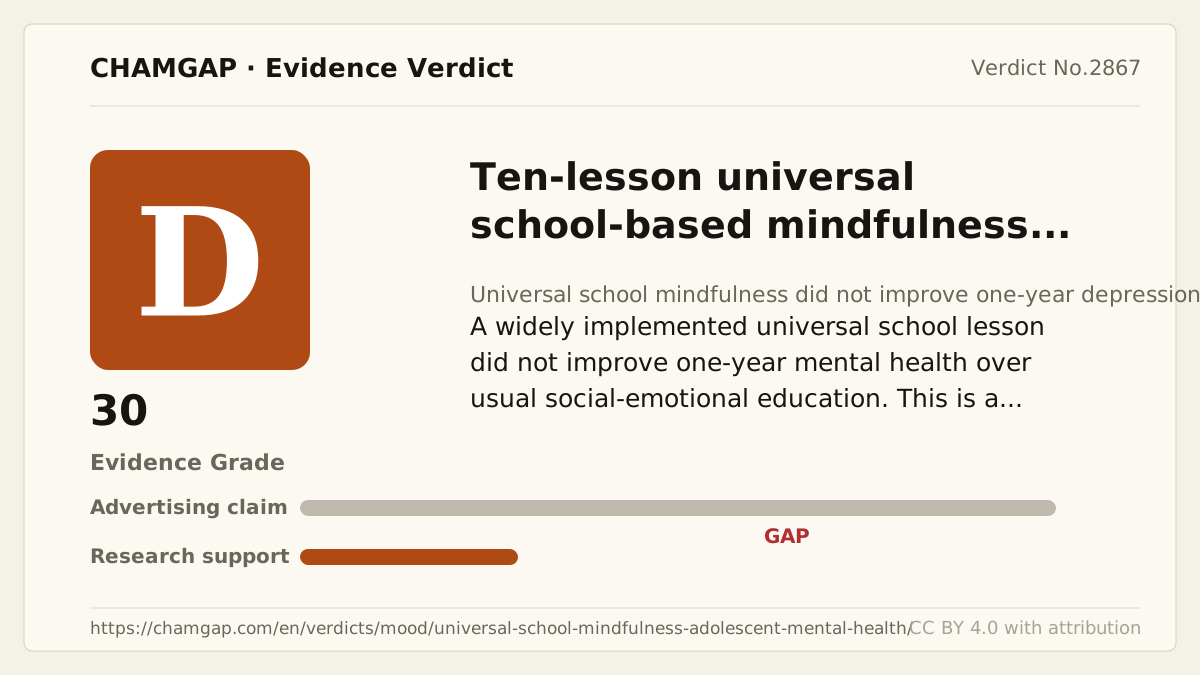
[Chamgap] Universal School-Based Mindfulness Training Is Ineffective for Adolescent Mental Health — Evidence Grade D·30. 3 cited sources checked. Source: https://chamgap.com/en/verdicts/mood/universal-school-mindfulness-adolescent-mental-health/ · CC BY 4.0CC BY 4.0 — free to use with attribution; do not distort grades, numbers, or verdict meaning.
What this document does and does not do
Chamgap is an information source. It reports what research has and has not confirmed; it does not tell readers what to take or buy. That decision belongs to readers and, when needed, medical or legal professionals. This verdict reflects literature available up to the search date and may change as new research appears. Nothing here is medical advice.