
Shift and night work,
does it really help with Association with increased incident diagnosed depression?
research showsThe grade is C with 54 points. In a prospective UK Biobank cohort of 175,543 workers, 3,956 developed depression over a median 9.06 years, 2.3% overall, and adjusted hazard was higher with shift work, HR 1.22 (95% CI 1.12 to 1.33). Night shifts were not riskier than nonnight shifts among shift workers, HR 1.05 (0.90 to 1.21). This was not randomized, and self-reported exposure, healthy-worker selection, and residual occupational confounding preclude a causal claim.
ads claimKorean occupational-health communication should not translate a relative hazard into certainty that every night schedule causes depression. Overall diagnosed incidence was 2.3% over nine years, and the outcome captured inpatient ICD-10 F32 or F33 diagnoses, missing outpatient and undiagnosed cases. Scheduling and sleep support may be prudent without overstating causation.
Useful facts when choosing a product
- Depression HRs were 1.23 for sometimes and 1.21 for usually or always working shifts, without a monotonic frequency gradient.
- Sex-stratified analyses reported no significant interaction, while sex-specific absolute incidence was not reported in the main text.
- Article Information states “None reported” for conflicts and contains no reported Funding/Support statement.
What the research actually shows
Exposure came from one baseline questionnaire, not payroll records. Shift work meant schedules outside 9 am to 5 pm, and night work crossed normal sleep hours such as midnight to 6 am. Adjustments included age, sex, education, Townsend deprivation, race and ethnicity, cancer, diabetes, hypertension, stroke, ischemic heart disease, weekly hours, years in the current job, standing or walking work, and heavy manual work. Individual income, detailed occupation, and baseline symptom scores were not adjusted; sleep duration was modeled separately as a mediator.
Why this is classified as C (54)
A large prospective cohort found a positive diagnostic association, but absent night specificity, one-time exposure, healthy-worker selection, and residual occupational confounding give C with 54 points.
Counterpoint. Verdict 2417 is C with 56 points for shift and night work with dementia. One supporting dataset there was also UK Biobank, but the sample and dementia endpoint differ, so it is not independent replication of this depression analysis.
Rejudgment record. Cross-check applied — Positive large prospective association tempered by absent night specificity, healthy-worker selection, and residual occupational confounding
| Endpoint | H | Hard endpoint - actual events such as death |
| Replication | R1 | Single confirmatory trial |
| Independence | I1 | Mixed funding sources |
| Effect size | E+ | Meets the clinically important threshold |
The scoring table and the verdict agree (C).
Sub-claim grades by effect
This ingredient is marketed for several effects. A single overall grade blends strong and weak claims together, so each effect is graded separately here. The overall grade reflects the strongest disconfirming or core claim.
| Effect (sub-claim) | Grade | Basis |
|---|---|---|
| Association of shift work with increased incident depression | C | Adjusted HR was 1.22, but observational data cannot establish causation. |
| Night shifts increase depression more than nonnight shifts | D | Night versus nonnight shift HR was 1.05 (0.90-1.21), not significant. |
Cross-check — Codex and Claude
Evidence Table
| Study | Design | Sample | Funding | Endpoint | Result | Weight |
|---|---|---|---|---|---|---|
| Study 1 | UK Biobank prospective cohort | 3,956 | No Funding/Support statement reported in Article Information; Conflict of Interest Disclosures: “None reported.” | First inpatient electronic-record diagnosis of depression, ICD-10 F32 or F33 | Median 9.06 years; 3,956/175,543 overall (2.3%); shift-work HR 1.22 (1.12-1.33); night versus nonnight shift HR 1.05 (0.90-1.21) | Pivotal observational evidence |
Receipt — 1 References
All 1 cited sources were verified for existence at the original page (as of 2026-08-08).
Reviewed and approved: Chamgap Editorial Team · Approval date: 2026-08-08 · Corrections: none
Cite this verdict
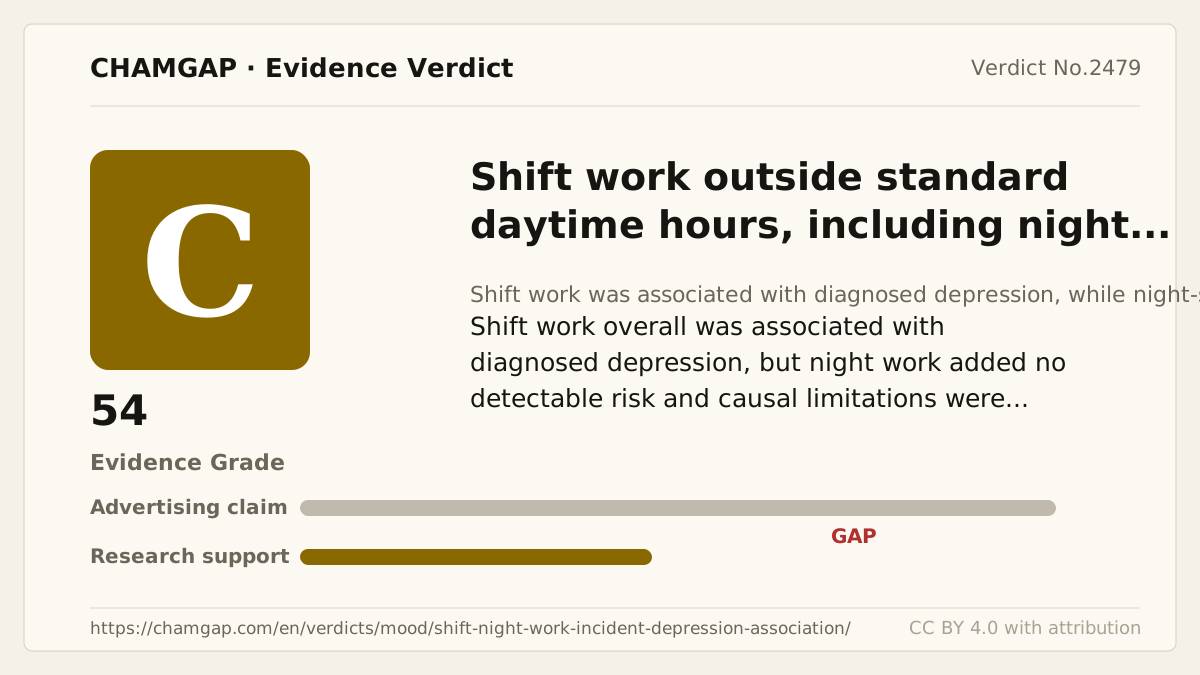
[Chamgap] Shift and night work x increased incident depression association — Evidence Grade C·54. 1 cited sources checked. Source: https://chamgap.com/en/verdicts/mood/shift-night-work-incident-depression-association/ · CC BY 4.0CC BY 4.0 — free to use with attribution; do not distort grades, numbers, or verdict meaning.
What this document does and does not do
Chamgap is an information source. It reports what research has and has not confirmed; it does not tell readers what to take or buy. That decision belongs to readers and, when needed, medical or legal professionals. This verdict reflects literature available up to the search date and may change as new research appears. Nothing here is medical advice.