
Group cognitive-behavioral prevention,
does it really help with Prevention of new depressive episodes?
research showsThe grade is B. In a publicly funded four-site trial of 316 adolescents, incident depression by nine months occurred in 21.4% with cognitive-behavioral prevention and 32.7% with usual care, an absolute difference of -11.3 percentage points (95% CI -21.10 to -1.39) and HR 0.63 (0.40 to 0.98). All four papers, however, report the same trial or its follow-up and moderator analyses, so they do not constitute independent replication.
ads claimThe result should not be generalized to every student or presented as treatment for an adolescent who is currently depressed. This trial tested prevention in a defined high-risk population without a current major depressive episode.
Useful facts when choosing a product
- The program comprised eight weekly 90-minute group sessions followed by six monthly boosters.
- Garber 2009, Beardslee 2013, Brent 2015, and Weersing 2016 all reported participants from NCT00073671.
- The trial was funded by the US National Institute of Mental Health, and the main report declared no financial disclosures.
What the research actually shows
The trial enrolled 316 adolescents aged 13 to 17 who were not in a current depressive episode but had a parent with depression plus a personal history of depression or subthreshold symptoms. Eight weekly 90-minute group sessions and six monthly boosters were added to usual care. Independent evaluators were blind to allocation, analyses preserved randomized assignment, and 75-month retention was 88%. Multisite stratified allocation was reported, but the publicly checked paper did not describe how the next assignment was concealed. The prevention purpose in NCT00073671 matched the reported primary event.
Why this is classified as B (72)
A publicly funded multisite trial found fewer new depressive episodes by blinded diagnostic interview and a persistent cumulative effect, but there was no independent second trial and concealment implementation was unreported, giving B with 72 points.
Counterpoint. This grade concerns prevention with one structured program in a defined high-risk group. Treatment of current depression, universal school programs, and other counseling formats are separate questions.
Rejudgment record. Cross-check applied — One publicly funded multisite trial reduced depressive episodes assessed by blinded diagnostic interview, while follow-up reports were not counted as replications and unreported allocation-concealment implementation was reflected
| Endpoint | H | Hard endpoint - actual events such as death |
| Replication | R1 | Single confirmatory trial |
| Independence | I2 | Decisive evidence is publicly or non-profit funded |
| Effect size | E+ | Meets the clinically important threshold |
The scoring table and the verdict agree (B).
Sub-claim grades by effect
This ingredient is marketed for several effects. A single overall grade blends strong and weak claims together, so each effect is graded separately here. The overall grade reflects the strongest disconfirming or core claim.
| Effect (sub-claim) | Grade | Basis |
|---|---|---|
| Prevention of new depressive episodes by nine months | B | Incidence was 21.4% versus 32.7%. |
| Prevention when the parent is currently depressed | D | Benefit was not established at either nine or 75 months. |
Cross-check — Codex and Claude
Evidence Table
| Study | Design | Sample | Funding | Endpoint | Result | Weight |
|---|---|---|---|---|---|---|
| Study 1 | Four-site randomized usual-care-controlled trial with long-term follow-up | 88 | Public funding from the US National Institute of Mental Health | New depressive episode established by diagnostic interview | At nine months, 21.4% versus 32.7%, risk difference -11.3 points (95% CI -21.10 to -1.39), HR 0.63 (0.40 to 0.98); adjusted 75-month HR 0.71 (0.53 to 0.96). | Pivotal single publicly funded confirmatory trial |
Receipt — 4 References
All 4 cited sources were verified for existence at the original page (as of 2026-08-15).
Reviewed and approved: Chamgap Editorial Team · Approval date: 2026-08-15 · Corrections: none
Cite this verdict
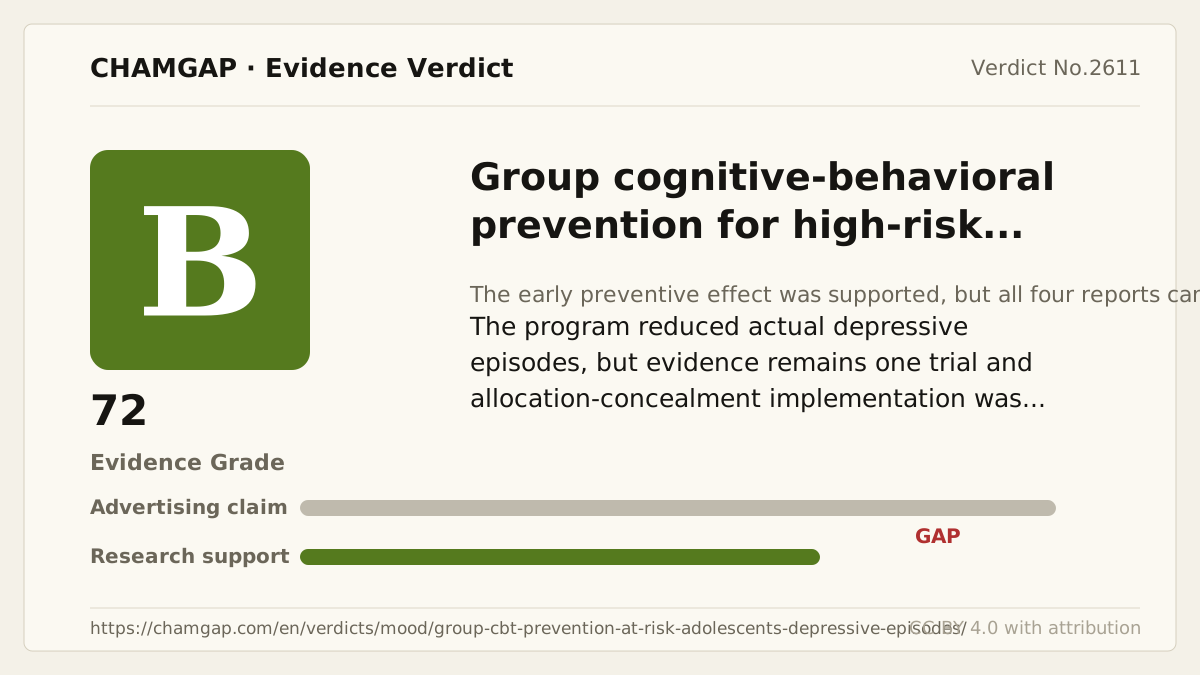
[Chamgap] Group cognitive-behavioral prevention x new depressive episodes in high-risk adolescents — Evidence Grade B·72. 4 cited sources checked. Source: https://chamgap.com/en/verdicts/mood/group-cbt-prevention-at-risk-adolescents-depressive-episodes/ · CC BY 4.0CC BY 4.0 — free to use with attribution; do not distort grades, numbers, or verdict meaning.
What this document does and does not do
Chamgap is an information source. It reports what research has and has not confirmed; it does not tell readers what to take or buy. That decision belongs to readers and, when needed, medical or legal professionals. This verdict reflects literature available up to the search date and may change as new research appears. Nothing here is medical advice.