
Creatine monohydrate,
does it really help with Increased total and free testosterone and dihydrotestosterone in healthy men?
research showsFor DHT, one positive 20-participant trial conflicts with one null 38-participant trial, and no claim-specific pooled confidence interval for testosterone or DHT could be verified. The 2025 study was not an equivalence trial designed to exclude a meaningful increase. Because clinically meaningful benefit is not excluded, the grade is D with 30 points, not F.
ads claimMarketing may convert gains in strength or lean mass into a claim that creatine is a testosterone booster or raises DHT. Creatine supports muscle phosphocreatine and rapid energy regeneration, but that exercise effect does not demonstrate increased total testosterone, free testosterone, or DHT.
Useful facts when choosing a product
- Creatine monohydrate is the most extensively studied creatine form, and a common maintenance intake is 3 to 5 g/day. A short loading phase of 20 to 25 g/day in divided doses speeds saturation but is not required.
- The main explanation for exercise benefit is increased muscle creatine and phosphocreatine storage with support for ATP resynthesis. Strength gains do not require increased testosterone or DHT.
- Early weight gain can largely reflect increased body water. Labeled dose, purity, and added ingredients vary, so a third-party-tested single-ingredient product is easier to interpret.
- Serum creatinine can rise modestly and be mistaken for impaired kidney function. People with kidney disease, pregnancy or lactation, or complex medicine use should seek clinical advice and disclose creatine use when laboratory testing is performed.
What the research actually shows
Van der Merwe and colleagues assigned 20 collegiate rugby players in a crossover design to creatine plus glucose or glucose placebo. Seven days of 25 g/day loading followed by fourteen days of 5 g/day maintenance did not change testosterone but increased DHT during the creatine period; baseline DHT was lower in the creatine condition, and no hair or clinical outcome was measured. The 2021 Antonio evidence review traced the DHT concern to this single study and found that ten of twelve separate testosterone studies were null while two reported small, physiologically insignificant increases. Lak and colleagues recruited 45 resistance-trained men to creatine 5 g/day or placebo, with 38 completing twelve weeks. No group-by-time interaction occurred for total testosterone, free testosterone, DHT, DHT ratios, hair density, follicular units, or hair thickness. Improved exercise performance therefore should not be attributed to higher androgens.
Why this is classified as D (30)
For DHT, one positive 20-participant trial conflicts with one null 38-participant trial, and no claim-specific pooled confidence interval for testosterone or DHT could be verified. The 2025 study was not an equivalence trial designed to exclude a meaningful increase. Because clinically meaningful benefit is not excluded, the grade is D with 30 points, not F.
Counterpoint. For strength and power, creatine has a separately strong evidence base when combined with training. It should not be expected to act as testosterone treatment or a DHT-increasing agent; symptoms of low testosterone call for standardized morning testing and evaluation of causes.
Rejudgment record. New verdict — For DHT, one positive 20-participant trial conflicts with one null 38-participant trial, and no claim-specific pooled confidence interval for testosterone or DHT could be verified. The 2025 study was not an equivalence trial designed to exclude a meaningful increase. Because clinically meaningful benefit is not excluded, the grade is D with 30 points, not F.
Sub-claim grades by effect
This ingredient is marketed for several effects. A single overall grade blends strong and weak claims together, so each effect is graded separately here. The overall grade reflects the strongest disconfirming or core claim.
| Effect (sub-claim) | Grade | Basis |
|---|---|---|
| Increased total testosterone in healthy men | D | Most trials were null, and the 2025 placebo-controlled trial found no supplement-specific increase. |
| Increased free testosterone in healthy men | D | Direct trials and the evidence review show no consistent increase, and exercise effects are not explained through testosterone. |
| Increased dihydrotestosterone in healthy men | D | The single small positive signal from 2009 was not reproduced in a direct twelve-week trial in 2025. |
Cross-check — Codex and Claude
Evidence Table
| Study | Design | Sample | Funding | Endpoint | Result | Weight |
|---|---|---|---|---|---|---|
| Antonio J et al. 2021 evidence review | Evidence review of human literature addressing common creatine claims | 12 | Multiple authors disclosed advisory or research relationships with the supplement industry | Total and free testosterone, DHT, and hair-related claims | Ten of twelve testosterone studies were null, two reported small physiologically insignificant increases, and the DHT increase came from only one study. | Confirms repeated null findings across the broader literature |
| van der Merwe J et al. 2009 | Randomized double-blind placebo-controlled crossover trial | 20 | Inadequately reported in the abstract and PubMed record | Serum testosterone, DHT, and DHT-to-testosterone ratio after seven-day loading and fourteen-day maintenance | Testosterone did not change; DHT rose 56% after loading and remained 40% above baseline after maintenance, but no clinical outcome was measured. | Single initial positive DHT signal |
| Lak M et al. 2025 | Twelve-week randomized double-blind placebo-controlled trial | 19 | No specific funding reported; some authors disclosed supplement-industry relationships | Total and free testosterone, DHT, DHT ratios, hair density, follicular units, and hair thickness | Creatine 5 g/day and placebo did not differ over time for any hormone or hair outcome. | Direct replication contradicting the DHT and testosterone claim |
Receipt — 3 References
All 3 cited sources were verified for existence at the original page (as of 2026-07-22).
Reviewed and approved: Chamgap Editorial Team · Approval date: 2026-07-22 · Corrections: none
Cite this verdict
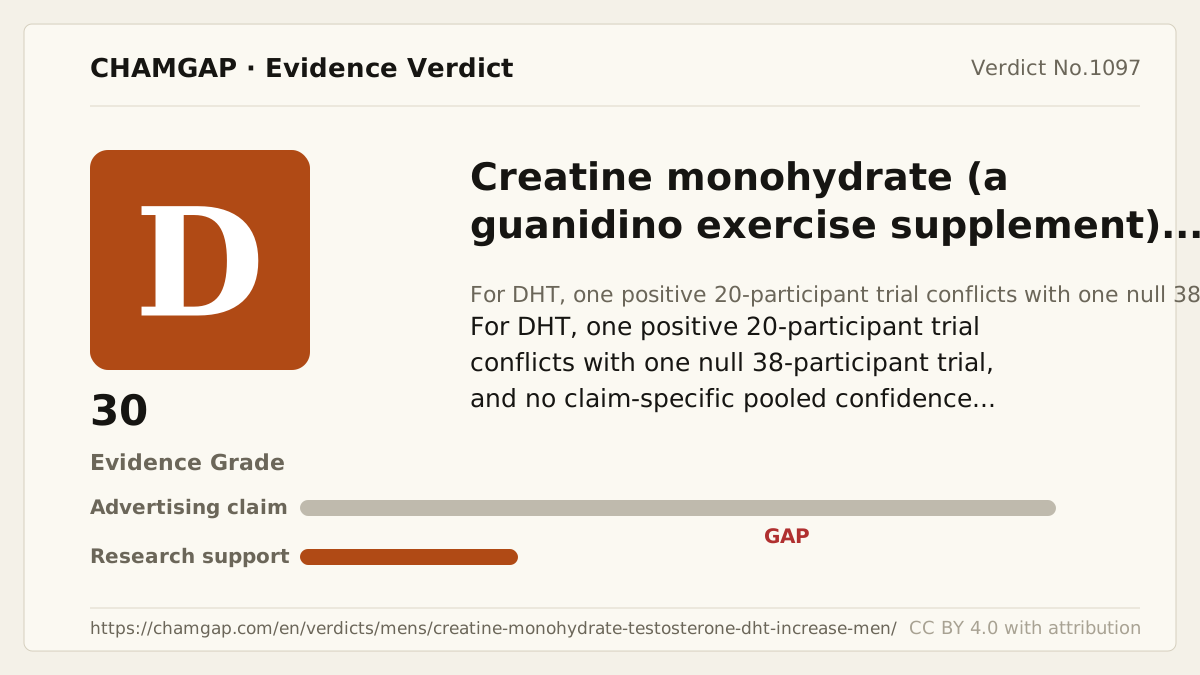
[Chamgap] Creatine monohydrate x increased testosterone and dihydrotestosterone in healthy men — Evidence Grade D·30. 3 cited sources checked. Source: https://chamgap.com/en/verdicts/mens/creatine-monohydrate-testosterone-dht-increase-men/ · CC BY 4.0CC BY 4.0 — free to use with attribution; do not distort grades, numbers, or verdict meaning.
What this document does and does not do
Chamgap is an information source. It reports what research has and has not confirmed; it does not tell readers what to take or buy. That decision belongs to readers and, when needed, medical or legal professionals. This verdict reflects literature available up to the search date and may change as new research appears. Nothing here is medical advice.