
Laparoscopic parenchyma-sparing liver resection,
does it really help with Reduction of clinically relevant surgical complications within 30 days?
research showsThe grade is B with 76 points. OSLO-COMET randomized and analyzed all 280 patients. Accordion grade 2 or higher complications within 30 days occurred in 25/133 (19%) after laparoscopy versus 45/147 (31%) after open surgery, an absolute difference of 12 percentage points (95% CI 1.67-21.8; P=0.021). This reduced events requiring treatment, but no independent replication of this narrow operation is included.
ads claimSmaller laparoscopic incisions and fewer major complications are separate claims. The trial compared the same limited parenchyma-sparing resection in an expert center; it does not prove that laparoscopy is superior for every liver operation.
Useful facts when choosing a product
- Both groups underwent comparable parenchyma-sparing resections involving fewer than three liver segments; the abdominal approach differed.
- The 2018 main result and 2021 oncologic follow-up are reports from one OSLO-COMET trial, NCT01516710.
- Long-term follow-up assessed overall and recurrence-free survival in the same randomized participants.
What the research actually shows
OSLO-COMET used computer-generated variable blocks and central web allocation on the day of surgery for 280 patients at Oslo University Hospital. An independent clinical assessor unaware of assignment classified 30-day complications; masking patients and surgeons was impossible for the surgical approach. Seven did not undergo the planned operation, but the primary analysis retained all 280 as assigned with no missing primary data. The registered postoperative-complication endpoint matched the article's Accordion grade 2-or-higher primary outcome. The South-Eastern Norway Regional Health Authority funded the trial. The 2021 survival paper follows the same NCT01516710 participants, so it and the 2018 main paper are reports from one trial. Axis 6 B0 basis ① Allocation concealment: "The software used for registration of patient data will generate randomization" ② Masking: "A blinded assessor will evaluate the primary endpoints" ③ Analysis population and missing data: "Analysis of all patients … according to the" assigned group (ITT), all 280 patients and no missing data ④ Prespecified primary endpoint: "The primary outcome was postoperative complications within 30 days (Accordion grade 2 or higher)." — matches registration NCT01516710
Why this is classified as B (76)
Allocation concealment, assessor masking, ITT analysis, and the prespecified primary endpoint are all confirmed in the source, leaving no avoidable defect; absent independent replication gives B with 76 points.
Counterpoint. Major resections, less experienced centers, and metastases from other primary tumors require separate evidence.
Rejudgment record. Cross-check applied — Cross-checked the OSLO-COMET main report, protocol, registry, and long-term follow-up for trial identity, primary endpoint, allocation, masking, analysis, and funding
| Endpoint | H | Hard endpoint - actual events such as death |
| Replication | R1 | Single confirmatory trial |
| Independence | I2 | Decisive evidence is publicly or non-profit funded |
| Effect size | E+ | Meets the clinically important threshold |
The scoring table and the verdict agree (B).
Sub-claim grades by effect
This ingredient is marketed for several effects. A single overall grade blends strong and weak claims together, so each effect is graded separately here. The overall grade reflects the strongest disconfirming or core claim.
| Effect (sub-claim) | Grade | Basis |
|---|---|---|
| Laparoscopic parenchyma-sparing resection reduces major 30-day complications | B | Rates were 19% versus 31%, an absolute difference of 12 points. |
| The laparoscopic approach improves long-term overall survival | D | Long-term follow-up of the same trial did not establish survival superiority. |
Cross-check — Codex and Claude
Evidence Table
| Study | Design | Sample | Funding | Endpoint | Result | Weight |
|---|---|---|---|---|---|---|
| Fretland ÅA, Dagenborg VJ, Bjørnelv GMW, Kazaryan AM, Kristiansen R, Fagerland MW, Hausken J, Tønnessen TI, Abildgaard A, Barkhatov L, Yaqub S, Røsok BI, Bjørnbeth BA, Andersen MH, Flatmark K, Aas E, Edwin B. 2018 OSLO-COMET; Aghayan DL, Kazaryan AM, Dagenborg VJ, Røsok BI, Fagerland MW, Waaler Bjørnelv GM, Kristiansen R, Flatmark K, Fretland ÅA, Edwin B, OSLO-COMET Survival Study Collaborators. 2021 long-term follow-up | Single-center, outcome-assessor-masked randomized superiority trial; main and long-term reports from the same trial | 273 | Public funding from the South-Eastern Norway Regional Health Authority | Accordion grade 2 or higher postoperative complication within 30 days | 25/133 (19%) versus 45/147 (31%), absolute difference 12 points (95% CI 1.67-21.8), P=0.021 | Single publicly funded confirmatory trial; the long-term paper follows the same participants |
Receipt — 2 References
All 2 cited sources were verified for existence at the original page (as of 2026-08-17).
Reviewed and approved: Chamgap Editorial Team · Approval date: 2026-08-17 · Corrections: none
Cite this verdict
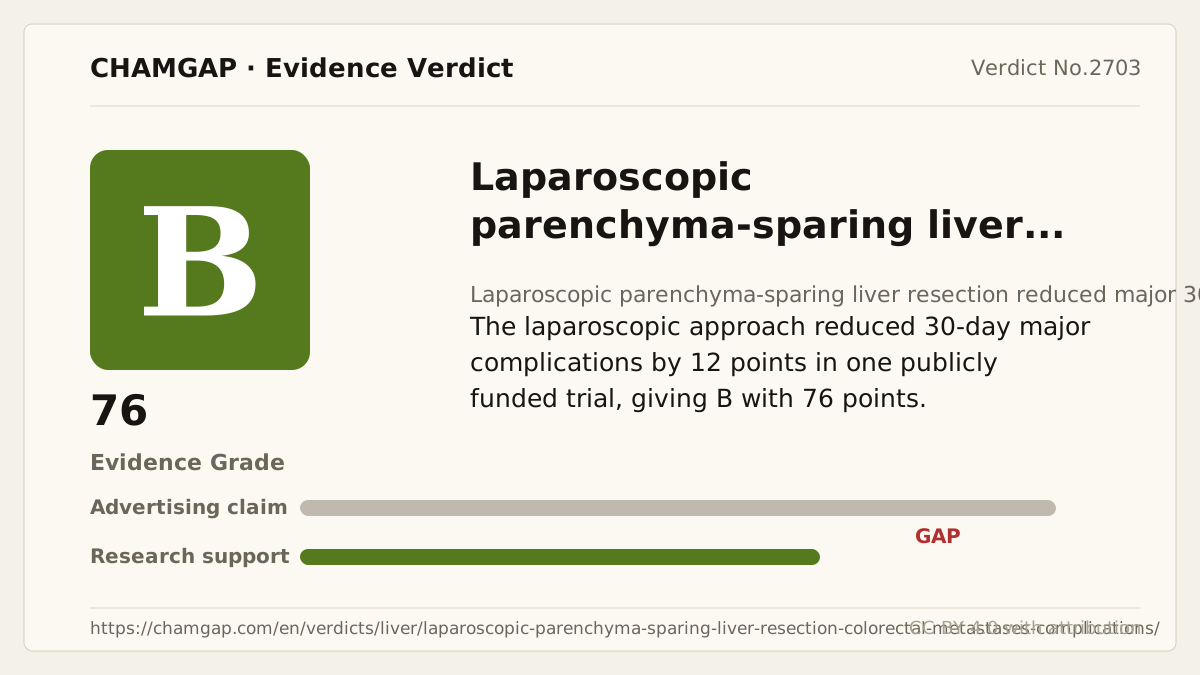
[Chamgap] Laparoscopic parenchyma-sparing liver resection x fewer 30-day complications in colorectal liver metastases — Evidence Grade B·76. 2 cited sources checked. Source: https://chamgap.com/en/verdicts/liver/laparoscopic-parenchyma-sparing-liver-resection-colorectal-metastases-complications/ · CC BY 4.0CC BY 4.0 — free to use with attribution; do not distort grades, numbers, or verdict meaning.
What this document does and does not do
Chamgap is an information source. It reports what research has and has not confirmed; it does not tell readers what to take or buy. That decision belongs to readers and, when needed, medical or legal professionals. This verdict reflects literature available up to the search date and may change as new research appears. Nothing here is medical advice.