
Durvalumab,
does it really help with Prolonged overall survival when added to gemcitabine and cisplatin as first-line treatment for unresectable or metastatic biliary tract cancer?
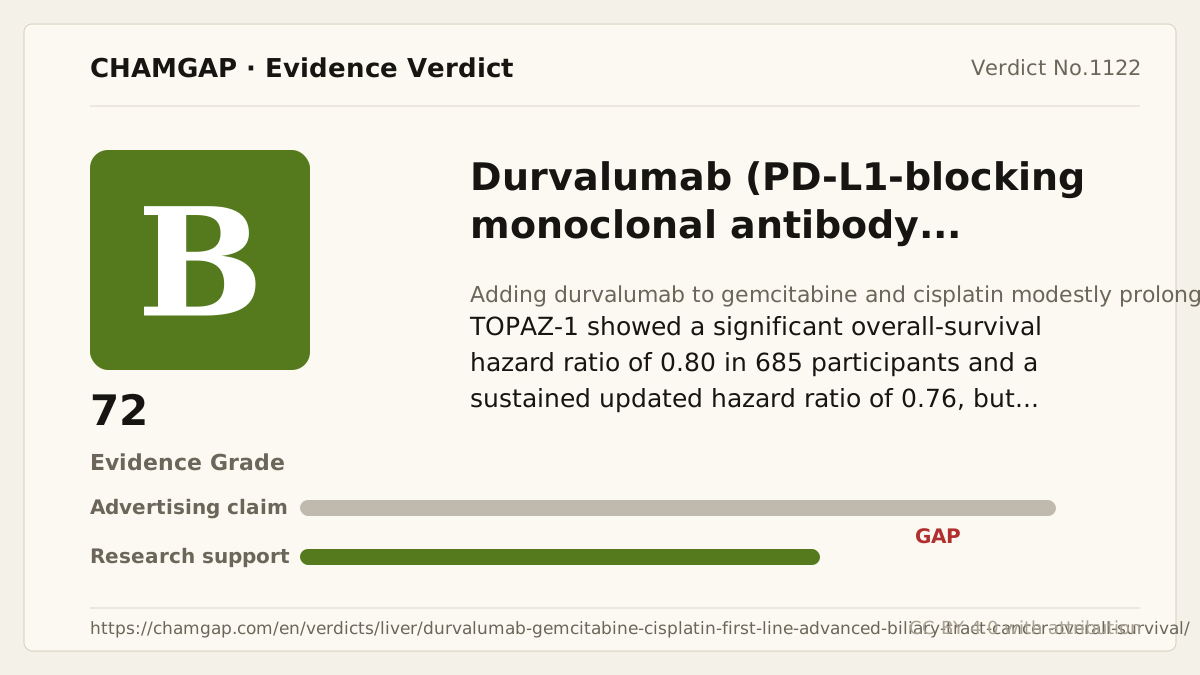
research showsEvidence shows that adding durvalumab to gemcitabine and cisplatin prolongs overall survival in previously untreated unresectable or metastatic biliary tract cancer. The initial analysis of the 685-participant, double-blind, phase 3 TOPAZ-1 trial found a death hazard ratio of 0.80 (95% CI 0.66 to 0.97), and the updated analysis sustained the effect with median overall survival of 12.9 versus 11.3 months and a hazard ratio of 0.76 (95% CI 0.64 to 0.91). The endpoint is directly hard, but both citations are the interim and updated analyses of the same trial, no replication by different investigators or funders was identified, and the effect is modest, giving B with 72 points. Immune-related toxicity and gemcitabine-cisplatin toxicity must be judged separately from survival efficacy.
ads claimA 20% to 24% reduction in relative mortality hazard does not mean that every patient lives that much longer or is cured. The updated median-survival difference was 1.6 months, and durvalumab was one component of a strategy combining gemcitabine-cisplatin followed by maintenance treatment.
Useful facts when choosing a product
- TOPAZ-1 used durvalumab 1,500 mg every three weeks with gemcitabine and cisplatin for up to eight cycles, followed by durvalumab every four weeks.
- The efficacy evidence applies to first-line treatment of previously untreated unresectable locally advanced, metastatic, or recurrent biliary tract cancer.
- Durvalumab can cause immune-mediated hepatitis, pneumonitis, colitis, thyroid and other endocrine disorders, and infusion reactions, requiring symptom and laboratory monitoring.
- Gemcitabine-cisplatin toxicities, including myelosuppression, infection, nausea, renal dysfunction, and electrolyte abnormalities, also require management by an oncology team.
What the research actually shows
Oh and colleagues randomized 685 TOPAZ-1 participants to durvalumab plus gemcitabine-cisplatin or placebo plus gemcitabine-cisplatin. The initial analysis found an overall-survival hazard ratio of 0.80, a progression-free-survival hazard ratio of 0.75, and objective response rates of 26.7% versus 18.7%. The 2024 update confirmed median overall survival of 12.9 versus 11.3 months, a hazard ratio of 0.76, and 24-month survival of 23.6% versus 11.5%. Grade 3 or 4 adverse events were common in both groups; this does not negate efficacy but requires separate management of immune-mediated hepatitis, pneumonitis, colitis, and endocrinopathy plus chemotherapy-related marrow and renal toxicity.
Why this is classified as B (72)
The 685-participant, double-blind, phase 3 TOPAZ-1 trial improved the direct hard endpoint of overall survival with a hazard ratio of 0.80, sustained at 0.76 with longer follow-up. However, both citations are interim and updated analyses of the same trial, so there is one confirmatory trial and no replication by different investigators or funders was identified. Under the axis-2 R1 ceiling the grade is B with 72 points. Axis 3 is AstraZeneca-only, but the ceiling does not apply to a large hard-endpoint prescription trial.
Counterpoint. Immune-treatment contraindications, renal function, performance status, and primary biliary site can materially change the absolute benefit-harm balance.
Rejudgment record. New verdict — Credited the direct hard endpoint of overall survival in the 685-participant double-blind phase 3 TOPAZ-1 trial (hazard ratio 0.80, sustained at 0.76), but applied the axis-2 R1 ceiling of B because both citations are interim and updated analyses of the same trial and no replication by different investigators or funders was identified. Axis 3 is AstraZeneca-only, but the ceiling does not apply to a large hard-endpoint prescription trial
| Endpoint | H | Hard endpoint - actual events such as death |
| Replication | R1 | Single confirmatory trial |
| Independence | I0 | Evidence comes only from manufacturer studies |
| Effect size | E+ | Meets the clinically important threshold |
The scoring table and the verdict agree (B).
Sub-claim grades by effect
This ingredient is marketed for several effects. A single overall grade blends strong and weak claims together, so each effect is graded separately here. The overall grade reflects the strongest disconfirming or core claim.
| Effect (sub-claim) | Grade | Basis |
|---|---|---|
| Prolonged overall survival when added to gemcitabine and cisplatin | A | A direct mortality benefit was demonstrated with an initial hazard ratio of 0.80 and an updated hazard ratio of 0.76. |
| Prolonged progression-free survival | B | The prespecified secondary endpoint was significant with a hazard ratio of 0.75 but is more surrogate than overall survival. |
| Increased objective tumor response | C | Response was 26.7% versus 18.7%, but this is an imaging-based surrogate and not the primary endpoint. |
Cross-check — Codex and Claude
Evidence Table
| Study | Design | Sample | Funding | Endpoint | Result | Weight |
|---|---|---|---|---|---|---|
| Study 1 | International multicenter randomized double-blind placebo-controlled phase 3 trial | 685 | AstraZeneca | Primary overall survival; secondary progression-free survival, objective response, and safety | The overall-survival hazard ratio was 0.80 (95% CI 0.66 to 0.97; P=0.021), the progression-free-survival hazard ratio was 0.75, and objective response was 26.7% versus 18.7%. | Pivotal large randomized trial with a direct mortality endpoint |
| Study 2 | Longer-follow-up analysis of the same randomized double-blind phase 3 trial | 23 | AstraZeneca | Updated overall survival and safety | Median overall survival was 12.9 versus 11.3 months, hazard ratio 0.76 (95% CI 0.64 to 0.91), with 24-month survival of 23.6% versus 11.5%. | Support for durability; not an independent replication |
Receipt — 2 References
All 2 cited sources were verified for existence at the original page (as of 2026-07-22).
Reviewed and approved: Chamgap Editorial Team · Approval date: 2026-07-22 · Corrections: 1
Correction log — 1
Corrections applied to this verdict, in chronological order. Changes are logged, not erased.
- 2026-08-08 · Grade correction for unmet independent-replication requirement — The verdict itself stated that the initial and updated TOPAZ-1 publications are analyses of the same trial and were not counted as two independent replications, yet it still assigned A. An A grade requires axis-2 R2, multiple randomized trials by different investigators and funders; with a single confirmatory trial (R1) the ceiling is B. The earlier phase 2 study by the same investigators (NCT03046862) is also part of the AstraZeneca program and is not independent replication. The axes are recorded as H, R1, I0, E+, B1, giving 72 points for three strength axes. The effect itself (hazard ratio 0.80, updated 0.76) is not disputed. Identified in the 2026-08-08 internal audit. (grade A→B)
Cite this verdict
[Chamgap] Durvalumab x prolonged overall survival in first-line advanced biliary tract cancer — Evidence Grade B·72. 2 cited sources checked. Source: https://chamgap.com/en/verdicts/liver/durvalumab-gemcitabine-cisplatin-first-line-advanced-biliary-tract-cancer-overall-survival/ · CC BY 4.0CC BY 4.0 — free to use with attribution; do not distort grades, numbers, or verdict meaning.
What this document does and does not do
Chamgap is an information source. It reports what research has and has not confirmed; it does not tell readers what to take or buy. That decision belongs to readers and, when needed, medical or legal professionals. This verdict reflects literature available up to the search date and may change as new research appears. Nothing here is medical advice.