
Atezolizumab plus bevacizumab,
does it really help with Longer overall and progression-free survival than sorafenib in unresectable hepatocellular carcinoma without prior systemic therapy?
research showsAtezolizumab plus bevacizumab is rated B with 72 points. It prolongs overall and progression-free survival versus sorafenib in unresectable hepatocellular carcinoma without prior systemic therapy: the phase 3 IMbrave150 trial randomized 501 participants 2:1 and found an overall-survival HR of 0.58 and an independently assessed progression-free-survival HR of 0.59 at the primary analysis. With further follow-up, median overall survival remained 19.2 versus 13.4 months (HR 0.66) and median progression-free survival 6.9 versus 4.3 months (HR 0.65). However, both citations are repeat reports of the single IMbrave150 trial, and replication by different investigators with different funding has not been confirmed, so the axis-2 R1 cap of B applies. The large randomized hard survival endpoint still qualifies for the prescription-drug hard-outcome exception, so the axis-3 cap is not applied; immune-related toxicity and bevacizumab-associated bleeding, varices, hypertension, and proteinuria remain separate safety concerns.
ads claimCalling this a survival treatment for every liver cancer removes stage, liver-function, prior-treatment, and bleeding-risk conditions. Direct applicability is to first-line systemic therapy for unresectable disease in patients resembling the trial population, generally with Child-Pugh A liver function and good performance status.
Useful facts when choosing a product
- Atezolizumab and bevacizumab are two prescription intravenous agents with different targets; oncology and liver-disease clinicians assess liver function, performance status, infection, and bleeding risk before selecting the combination.
- IMbrave150 administered atezolizumab 1,200 mg plus bevacizumab 15 mg/kg intravenously every three weeks, but actual dosing, delay, and discontinuation follow product information and individual clinical status.
- Esophageal or gastric varices and recent bleeding risk should be assessed and treated when necessary before bevacizumab, with blood pressure, urine protein, bleeding, and thrombotic signs monitored during therapy.
- Atezolizumab can cause immune-mediated hepatitis, pneumonitis, colitis, and endocrinopathies, so new symptoms require early reporting and organ-specific evaluation.
What the research actually shows
IMbrave150 enrolled 501 systemic-treatment-naive patients with unresectable hepatocellular carcinoma, Child-Pugh A liver function, and ECOG performance status 0 or 1, assigning 336 to the combination and 165 to sorafenib. At the primary analysis, the overall-survival HR was 0.58 and the independently assessed RECIST 1.1 progression-free-survival HR was 0.59. At a median 15.6 months of follow-up, median overall survival was 19.2 versus 13.4 months (HR 0.66), and median progression-free survival was 6.9 versus 4.3 months (HR 0.65). The protocol required evaluation and treatment of varices to reduce bleeding risk, making gastrointestinal bleeding-risk screening important for both population selection and safety before bevacizumab.
Why this is classified as B (72)
The large phase 3 IMbrave150 randomized comparison strongly improved both co-primary endpoints, overall survival and independently assessed progression-free survival, and the prescription-drug large hard-outcome exception keeps the axis-3 cap from applying. Because the cited evidence is a single trial reported twice and replication by different investigators with different funding has not been confirmed, the axis-2 R1 cap limits the grade to B with 72 points. Bleeding, varices, and immune toxicity are managed under safety rather than deducted from efficacy.
Counterpoint. This regimen is not a universal substitute for resection, transplantation, or locoregional therapy, and the evidence-risk balance differs in Child-Pugh B or C disease and untreated high-risk varices. Selection should incorporate other first-line options, liver function, bleeding risk, and patient preference.
Rejudgment record. Cross-check incorporated — Applied the prescription-drug large hard-outcome exception, waiving the axis-3 cap, because IMbrave150 improved hard overall survival and independently assessed progression-free survival, while applying the axis-2 R1 cap of B because both citations are repeat reports of the same trial (NCT03434379) and replication by different investigators with different funding was not confirmed
| Endpoint | H | Hard endpoint - actual events such as death |
| Replication | R1 | Single confirmatory trial |
| Independence | I0 | Evidence comes only from manufacturer studies |
| Effect size | E+ | Meets the clinically important threshold |
The scoring table and the verdict agree (B).
Sub-claim grades by effect
This ingredient is marketed for several effects. A single overall grade blends strong and weak claims together, so each effect is graded separately here. The overall grade reflects the strongest disconfirming or core claim.
| Effect (sub-claim) | Grade | Basis |
|---|---|---|
| Longer overall survival than sorafenib | A | The direct hard endpoint improved, with HR 0.58 at primary analysis and HR 0.66 plus median survival of 19.2 versus 13.4 months on extended follow-up. |
| Longer progression-free survival than sorafenib | A | The independently assessed RECIST 1.1 co-primary endpoint had HR 0.59 and remained favorable at HR 0.65 on extended follow-up. |
Cross-check — Codex and Claude
Evidence Table
| Study | Design | Sample | Funding | Endpoint | Result | Weight |
|---|---|---|---|---|---|---|
| Finn RS et al.; IMbrave150 Investigators. 2020 | International multicenter open-label phase 3 randomized active-controlled trial | 165 | Sponsored by F. Hoffmann-La Roche and Genentech | Co-primary overall survival and independently assessed RECIST 1.1 progression-free survival | The combination was superior to sorafenib, with overall-survival HR 0.58 (95% CI 0.42 to 0.79) and progression-free-survival HR 0.59 (95% CI 0.47 to 0.76). | Pivotal large randomized hard-survival evidence |
| Cheng AL et al. 2022 IMbrave150 updated analysis | Post hoc extended follow-up of the phase 3 randomized trial | 6 | Sponsored by F. Hoffmann-La Roche and Genentech | Updated overall survival, progression-free survival, and safety | Benefit persisted, with median overall survival of 19.2 versus 13.4 months (HR 0.66) and median progression-free survival of 6.9 versus 4.3 months (HR 0.65). | Confirmation of durability of survival benefit |
Receipt — 2 References
All 2 cited sources were verified for existence at the original page (as of 2026-08-11).
Reviewed and approved: Chamgap Editorial Team · Approval date: 2026-08-11 · Corrections: 1
Correction log — 1
Corrections applied to this verdict, in chronological order. Changes are logged, not erased.
- 2026-08-11 · Grade correction for unmet independent-replication requirement — Both cited papers were repeat reports (primary and updated analyses) of the same IMbrave150 trial population (NCT03434379). Chamgap's A requires axis-2 R2 — multiple RCTs by different investigators with different funding — but the separate randomized GO30140 study shares the same Roche/Genentech funding and is not an overall- or progression-free-survival replication, and differently funded RCTs such as ORIENT-32 tested different drug combinations, so no independent replication of the identical intervention exists in the literature. Axis 2 is R1, capping the grade at B. The axes were recorded as B·H·R1·I0·E+·B1 (axis-3 cap waived under the prescription-drug large hard-outcome RCT exception) and 72 points were assigned. The effect itself (overall-survival HR 0.58, progression-free-survival HR 0.59) is not disputed. Confirmed in the 2026-08-11 internal audit (workflow verification with concordant Codex cross-check). (grade A→B)
Cite this verdict
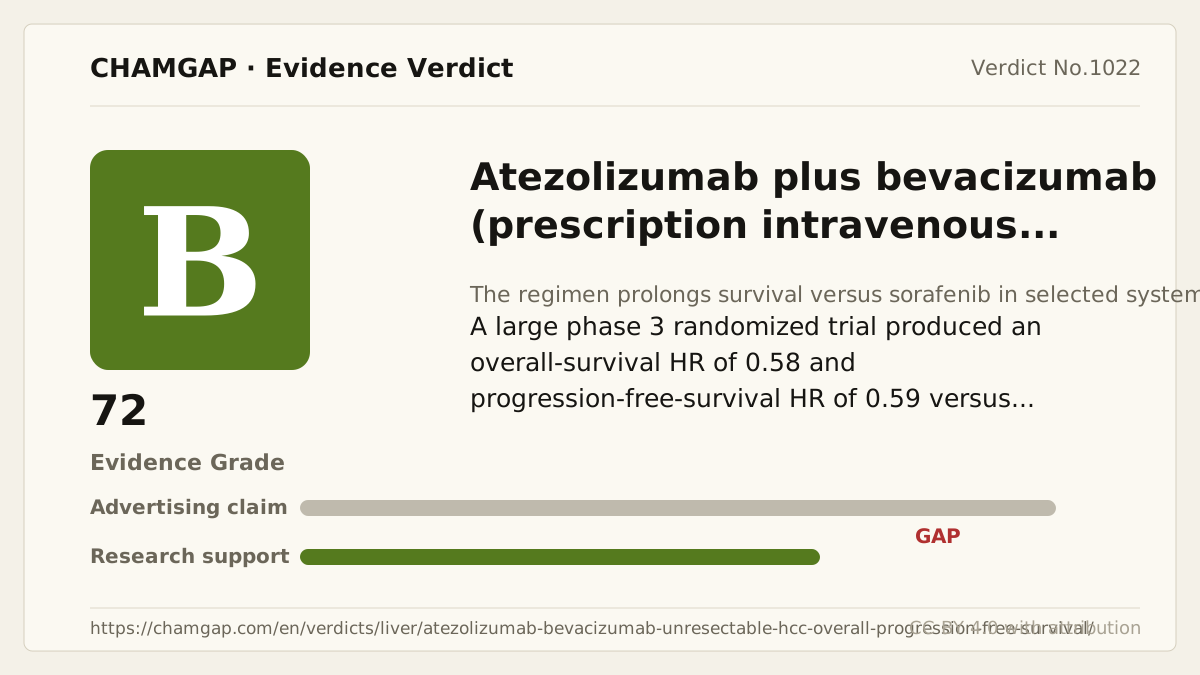
[Chamgap] Atezolizumab plus bevacizumab x longer overall and progression-free survival in unresectable hepatocellular carcinoma — Evidence Grade B·72. 2 cited sources checked. Source: https://chamgap.com/en/verdicts/liver/atezolizumab-bevacizumab-unresectable-hcc-overall-progression-free-survival/ · CC BY 4.0CC BY 4.0 — free to use with attribution; do not distort grades, numbers, or verdict meaning.
What this document does and does not do
Chamgap is an information source. It reports what research has and has not confirmed; it does not tell readers what to take or buy. That decision belongs to readers and, when needed, medical or legal professionals. This verdict reflects literature available up to the search date and may change as new research appears. Nothing here is medical advice.