
Static magnetic insoles,
does it really help with Relief of plantar heel pain?
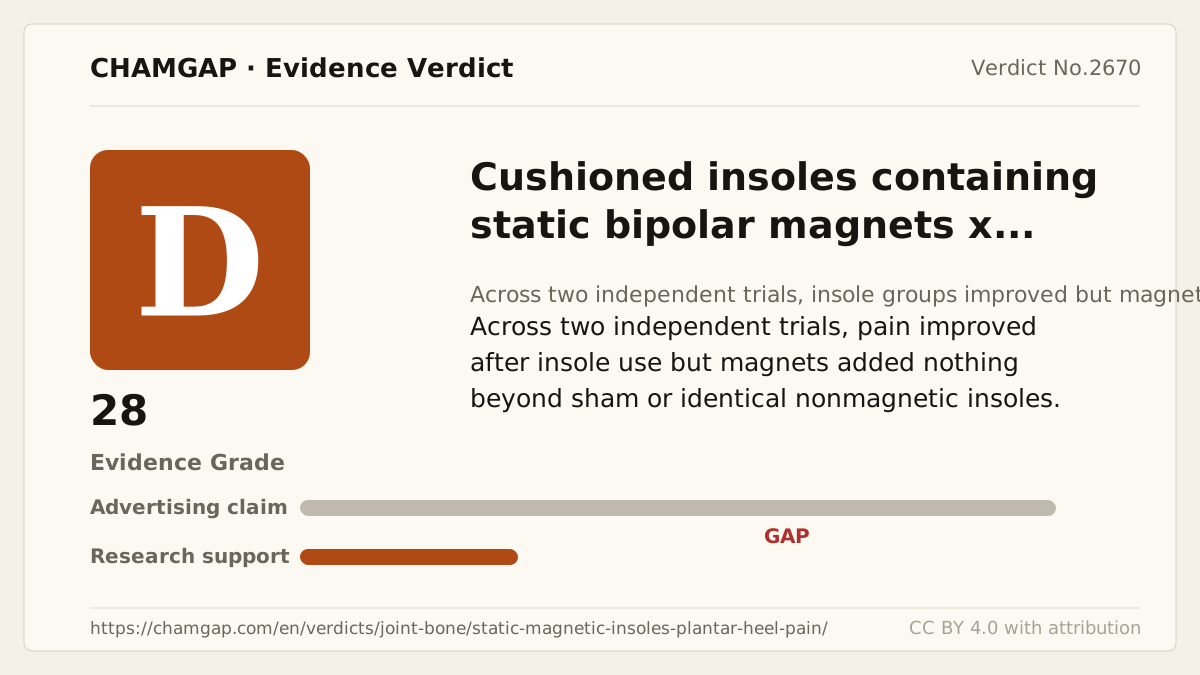
research showsThe grade is D with 28 points. In Winemiller's 101-person double-blind randomized trial, morning pain changed from 6.9 to 3.9 with sham and from 6.7 to 3.9 with magnetic insoles at eight weeks, P=.94. In the prior independent four-week trial by Caselli and colleagues, both 19 patients using magnetic-foil PPT/Rx Firm Molded Insoles and 15 using identical nonmagnetic insoles improved by about 60%, with no added magnetic benefit. Two independent trials with no overlapping authors were null in the same direction. The main trial reported no 95% confidence interval, so meaningful benefit was not precisely excluded and the grade remains D 28.
ads claimCushioning and magnetism must be separated. Across two independent trials, insole users improved but magnets did not outperform sham or identical nonmagnetic insoles. Verdict 2668 is C with 50 points for textured sensory insoles and laboratory balance in diabetic neuropathy, a different mechanism and indication.
Useful facts when choosing a product
- Measured surface strength averaged 192.1 G for active and 2.2 G for sham insoles; appearance and touch were matched.
- Eight-week morning pain was 3.9±2.6 in both groups.
- Verdict 2668 is C with 50 points for a different sensory-stimulation and balance claim.
What the research actually shows
The 2003 JAMA trial by Winemiller MH, Billow RG, Laskowski ER, and Harmsen WS randomized 101 participants, 44 sham and 57 magnetic. Eight-week morning pain was 3.9 in both groups, P=.94, and global improvement was 33% versus 35%, P=.78; no 95% CI was reported. The 1997 Journal of the American Podiatric Medical Association trial by Caselli MA, Clark N, Lazarus S, Velez Z, and Venegas L assigned heel-pain patients to PPT/Rx Firm Molded Insoles with magnetic foil, 19 people, or identical insoles without magnets, 15 people, for four weeks. Both groups improved by about 60%, with no added magnetic benefit. Winemiller's Mayo Clinic team and Caselli's New York College of Podiatric Medicine team had no authors in common. Both studies predated trial-registration requirements, so no registration number exists.
Why this is classified as D (28)
Two independent trials with no overlapping authors both found no added magnetic benefit, giving RX. The main trial still reported no 95% confidence interval, so precision remains CX and the result is D with 28 points rather than F.
Counterpoint. People with pacemakers or other electronic implants should follow device-manufacturer and clinician guidance around magnets.
Rejudgment record. Cross-check applied — Cross-checked the JAMA main trial and 1997 independent trial for team independence, randomized counts, pain results, absence of added magnetic benefit, unreported confidence intervals in the main trial, and preregistration-era status
| Endpoint | P | Patient-reported treatment goal - the symptom is the goal |
| Replication | RX | Repeatedly refuted in the same indication |
| Independence | I1 | Mixed funding sources |
| Effect size | E0 | Null |
| Precision | CX | No pooled confidence interval could be confirmed |
The scoring table and the verdict agree (D).
Sub-claim grades by effect
This ingredient is marketed for several effects. A single overall grade blends strong and weak claims together, so each effect is graded separately here. The overall grade reflects the strongest disconfirming or core claim.
| Effect (sub-claim) | Grade | Basis |
|---|---|---|
| Relief of plantar heel pain over eight weeks | D | Two independent trials both found no added magnetic benefit. |
| Symptom relief from cushioned insoles themselves | ? | Both groups received cushioning, so its independent effect cannot be separated in this trial. |
Cross-check — Codex and Claude
Evidence Table
| Study | Design | Sample | Funding | Endpoint | Result | Weight |
|---|---|---|---|---|---|---|
| Winemiller MH, Billow RG, Laskowski ER, Harmsen WS. 2003 | Single-center double-blind identical-sham randomized trial | 95 | Manufacturer supplied active and sham insoles at no charge; no separate funding statement verified | Pain VAS and categorical global improvement at four and eight weeks | Eight-week VAS 3.9±2.6 versus 3.9±2.6, P=.94; improvement 33% versus 35%, P=.78; no 95% CI reported | Main study in two independent null trials; well masked but limited by eight weeks and unreported confidence intervals |
| Caselli MA, Clark N, Lazarus S, Velez Z, Venegas L. 1997 | Four-week randomized trial with identical nonmagnetic-insole control | 15 | Not reported | Heel-pain improvement at four weeks | Both groups improved by about 60%; no added magnetic benefit | Prior independent null trial with no authors overlapping the main trial |
Receipt — 2 References
All 2 cited sources were verified for existence at the original page (as of 2026-08-15).
Reviewed and approved: Chamgap Editorial Team · Approval date: 2026-08-15 · Corrections: none
Cite this verdict
[Chamgap] Static magnetic insoles x plantar heel pain — Evidence Grade D·28. 2 cited sources checked. Source: https://chamgap.com/en/verdicts/joint-bone/static-magnetic-insoles-plantar-heel-pain/ · CC BY 4.0CC BY 4.0 — free to use with attribution; do not distort grades, numbers, or verdict meaning.
What this document does and does not do
Chamgap is an information source. It reports what research has and has not confirmed; it does not tell readers what to take or buy. That decision belongs to readers and, when needed, medical or legal professionals. This verdict reflects literature available up to the search date and may change as new research appears. Nothing here is medical advice.