
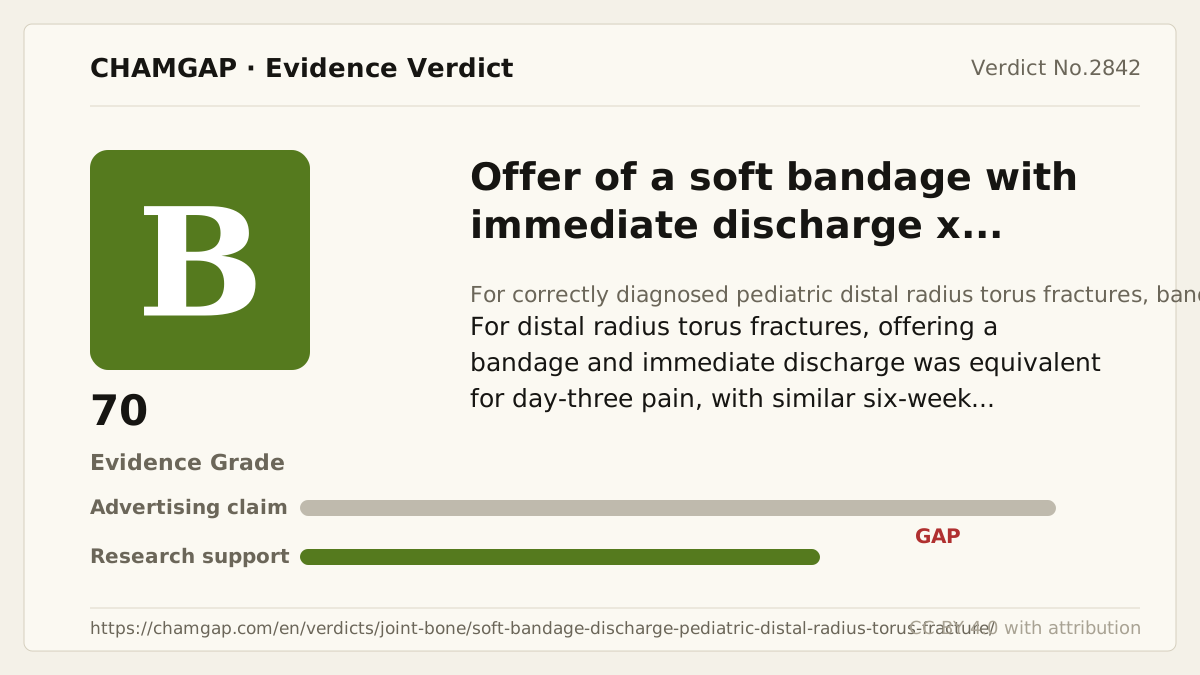
Offer of a soft bandage with immediate discharge,
does it really help with Equivalent three-day pain after pediatric distal radius torus fracture?
research showsThe grade is B with 70 points. Mean day-three Wong-Baker pain was 3.21 versus 3.14; the adjusted difference was -0.10 points (95% CI -0.37 to 0.17), within the prespecified -1 to 1 point equivalence range. This is de-escalation evidence in correctly diagnosed torus fractures, not evidence that splints are harmful.
ads claimApplicability is restricted to a distal radius torus or buckle fracture with cortical deformation but no cortical break. It must not be transferred to greenstick, displaced, cortical-break, or other wrist fractures.
Useful facts when choosing a product
- Six-week function and health-related quality of life did not differ.
- Complications occurred in 5/489 (1.0%) versus 3/476 (0.6%), mostly revised diagnoses.
- Further health-care use, including reattendance, showed no clear group difference.
What the research actually shows
Across 23 UK emergency departments, 965 children aged 4 to 15 years were randomized to an offer of bandage with immediate discharge or rigid immobilization with usual follow-up. Limitation 1: equivalence design. Listed item: noninferiority design. Avoidability: impossible - de-escalation asks whether simpler care remains within an acceptable clinical range. Limitation 2: unblinded subjective endpoint. Listed item: unblinded subjective endpoint. Avoidability: impossible - children and parents can see and feel the difference between a soft bandage and rigid splint. Missing day-three pain was 57/965 (5.9%), below substantial attrition (>=15%). The NIHR Health Technology Assessment program publicly funded the trial.
Why this is classified as B (70)
A patient-important pain endpoint, public independence, and met equivalence range are balanced against one equivalence trial, giving B with 70 points.
Counterpoint. Safety is not established if another fracture is misdiagnosed as a torus fracture.
Rejudgment record. New verdict — Patient-important pain, public funding, met one-point equivalence range, and open equivalence design
| Endpoint | P | Patient-reported treatment goal - the symptom is the goal |
| Replication | R1 | Single confirmatory trial |
| Independence | I2 | Decisive evidence is publicly or non-profit funded |
| Effect size | E+ | Meets the clinically important threshold |
The scoring table and the verdict agree (B).
Sub-claim grades by effect
This ingredient is marketed for several effects. A single overall grade blends strong and weak claims together, so each effect is graded separately here. The overall grade reflects the strongest disconfirming or core claim.
| Effect (sub-claim) | Grade | Basis |
|---|---|---|
| Equivalent pain at three days | B | The full adjusted confidence interval was within -1 to 1 point. |
| Six-week function and complications | B | Function did not differ and complications were uncommon. |
Cross-check — Codex and Claude
Evidence Table
| Study | Design | Sample | Funding | Endpoint | Result | Weight |
|---|---|---|---|---|---|---|
| Study 1 | Multicenter open equivalence randomized trial in 23 UK emergency departments | 908 | Public funding from NIHR Health Technology Assessment | Day-three pain on the six-category Wong-Baker scale | 3.21 vs 3.14; adjusted difference -0.10 (95% CI -0.37 to 0.17), equivalence range -1 to 1 | Pivotal patient-important symptom equivalence RCT |
Receipt — 2 References
All 2 cited sources were verified for existence at the original page (as of 2026-08-18).
Reviewed and approved: Chamgap Editorial Team · Approval date: 2026-08-18 · Corrections: none
Cite this verdict
[Chamgap] Soft Bandage and Immediate Discharge for Three-Day Pain in Pediatric Distal Radius Torus Fracture — Benefit — Evidence Grade B·70. 2 cited sources checked. Source: https://chamgap.com/en/verdicts/joint-bone/soft-bandage-discharge-pediatric-distal-radius-torus-fracture/ · CC BY 4.0CC BY 4.0 — free to use with attribution; do not distort grades, numbers, or verdict meaning.
What this document does and does not do
Chamgap is an information source. It reports what research has and has not confirmed; it does not tell readers what to take or buy. That decision belongs to readers and, when needed, medical or legal professionals. This verdict reflects literature available up to the search date and may change as new research appears. Nothing here is medical advice.