
Six-week sling immobilization,
does it really help with Reduced 12-month ultrasound retear versus early pain-limited active motion?
research showsThe grade is D with 30 points. In a 206-participant randomized trial, full-thickness retear among the 165 who completed 12-month ultrasound was 30% with early motion versus 33% with strict immobilization, P>0.8. Imaging retear was not a registered primary outcome, and 20% lacked ultrasound follow-up.
ads claimRestricting motion and reducing certain movements across a repair are physical facts. They do not automatically establish better tendon healing or fewer retears.
Useful facts when choosing a product
- The standard group wore a sling for six weeks and avoided active range of motion.
- The early group self-weaned according to pain and comfort and used pain-free active motion.
- Repair status was assessed by ultrasound at 12 months, completed by 165/206.
What the research actually shows
Sheps and colleagues with SURGE randomized 206 full-thickness rotator cuff repair patients, 103 per group. Early participants self-weaned from the sling and performed pain-free active motion in the first six weeks; standard participants wore a sling for six weeks with no active motion. Assessors were masked and analysis followed assignment, but ultrasound was completed by only 79 versus 86 participants. NCT01333527 lists WORC and range of motion as primary outcomes.
Why this is classified as D (30)
A null imaging surrogate, 20% missing ultrasound, and no counted independent replication of the exact six-week active-motion comparison give D with 30 points.
Counterpoint. Smaller tears, different repairs, passive-only protocols, and four-week immobilization are different interventions and were not counted as direct replication.
Rejudgment record. Cross-check applied — Cross-checked analysis counts, ultrasound denominators, retear rates, registered primary outcomes, assessor masking, and funding against the article and NCT01333527
| Endpoint | S | Surrogate marker - laboratory or imaging measures |
| Replication | R1 | Single confirmatory trial |
| Independence | I2 | Decisive evidence is publicly or non-profit funded |
| Effect size | E0 | Null |
| Precision | CX | No pooled confidence interval could be confirmed |
The scoring table and the verdict agree (D).
Sub-claim grades by effect
This ingredient is marketed for several effects. A single overall grade blends strong and weak claims together, so each effect is graded separately here. The overall grade reflects the strongest disconfirming or core claim.
| Effect (sub-claim) | Grade | Basis |
|---|---|---|
| Six weeks of strict sling immobilization reduces 12-month ultrasound retear | D | Rates were 30% versus 33%, P>0.8. |
| Early active motion worsens long-term pain or function | D | Pain, strength, and quality of life did not differ through 24 months. |
Cross-check — Codex and Claude
Evidence Table
| Study | Design | Sample | Funding | Endpoint | Result | Weight |
|---|---|---|---|---|---|---|
| Study 1 | Multicenter assessor- and image-reader-masked randomized trial | 86 | Arthroscopy Association of North America Project 7193, Medical Services Incorporated Foundation of Alberta Grant 855, Workers Compensation Board of Alberta RES0017223, and in-kind Covenant Health support | Full-thickness rotator cuff retear on 12-month ultrasound | Full-thickness retear 30% early motion versus 33% strict immobilization, P>0.8; ultrasound completed by 79/86 | Only direct trial of the exact six-week active-motion comparison |
Receipt — 1 References
All 1 cited sources were verified for existence at the original page (as of 2026-08-14).
Reviewed and approved: Chamgap Editorial Team · Approval date: 2026-08-14 · Corrections: none
Cite this verdict
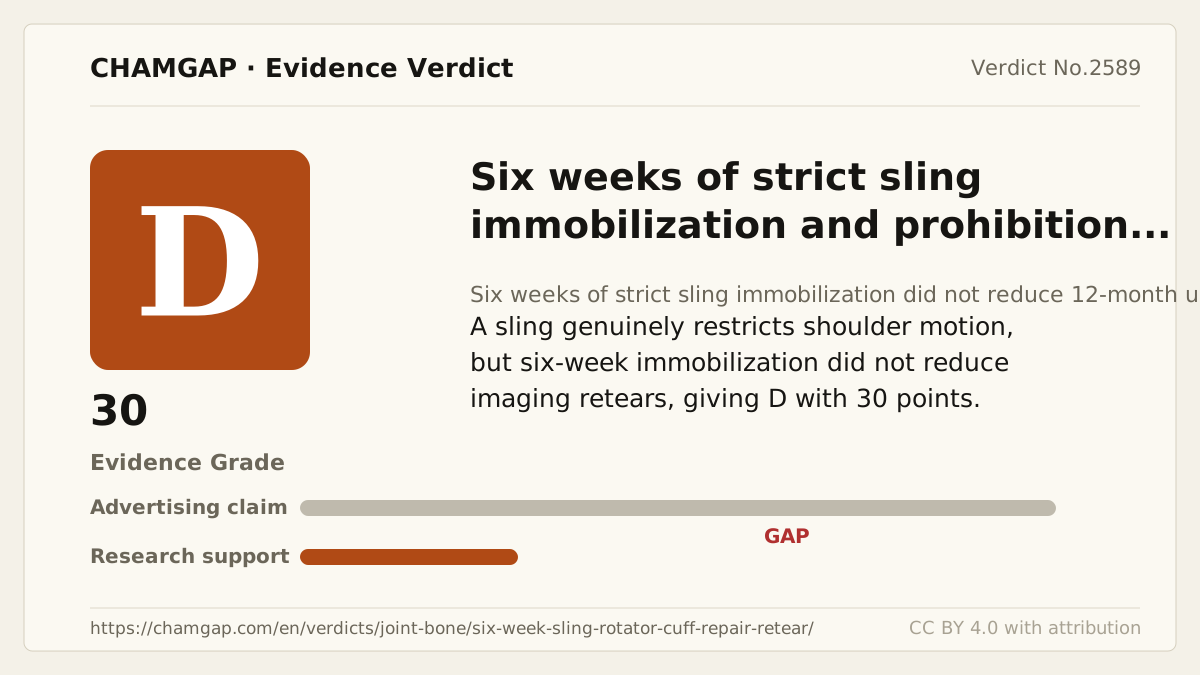
[Chamgap] Six-week sling immobilization x retear after rotator cuff repair — Evidence Grade D·30. 1 cited sources checked. Source: https://chamgap.com/en/verdicts/joint-bone/six-week-sling-rotator-cuff-repair-retear/ · CC BY 4.0CC BY 4.0 — free to use with attribution; do not distort grades, numbers, or verdict meaning.
What this document does and does not do
Chamgap is an information source. It reports what research has and has not confirmed; it does not tell readers what to take or buy. That decision belongs to readers and, when needed, medical or legal professionals. This verdict reflects literature available up to the search date and may change as new research appears. Nothing here is medical advice.