
Separated split keyboard,
does it really help with Reduced wrist ulnar deviation while typing?
research showsThe grade is C. In 11 experienced typists who used the same keyboard in a joined layout and three separated layouts, separation reduced mean ulnar deviation in both wrists by about 10 degrees. This was an immediate wrist angle, not reduced pain, tenosynovitis, or carpal tunnel syndrome. The tiny sample and lack of long-term testing give C with 50 points.
ads claimAn immediate reduction in wrist angle is not the same claim as long-term prevention of wrist pain, tenosynovitis, or carpal tunnel syndrome. The former was observed; the latter was not measured in this experiment.
Useful facts when choosing a product
- The same adjustable keyboard was used while separation distance and opening angle were changed within participants.
- Separated configurations reduced mean ulnar deviation by about 10 degrees, with no significant difference among separation distances.
- Pain, tenosynovitis, carpal tunnel syndrome, and long-term adaptation were not measured.
What the research actually shows
Eleven experienced typists used the same adjustable keyboard in a joined conventional layout and at 20-cm, half-shoulder-width, and full-shoulder-width separation. Each separated setup reduced mean ulnar deviation in both wrists by about 10 degrees, with no differences among the three separated setups. At half shoulder width, means were 7.0 degrees (SD 5.5) left and 2.7 (SD 8.3) right; at full shoulder width, 8.5 (SD 6.2) and 3.5 (SD 6.9). The paper stated that presentation order was balanced and randomized with a Latin square. However, the visible keyboard configuration made participant masking impossible, leaving conscious posture adjustment as a potential bias. The absence of a registration number is normal for a 1991-2001 ergonomics experiment.
Why this is classified as C (50)
A large immediate angle change was observed, but it was a biomechanical surrogate from one repeated-measures experiment in which participants could see the keyboard condition. The axis-1 surrogate cap gives C with 50 points.
Counterpoint. C does not deny the angle change. It separates a measured posture effect from an unmeasured long-term disease-prevention claim.
Rejudgment record. Cross-check applied — The four configurations, Latin-square randomized order, participant awareness of condition, participant count, means, standard deviations, and measured endpoint were checked against Marklin and Simoneau
| Endpoint | S | Surrogate marker - laboratory or imaging measures |
| Replication | R1 | Single confirmatory trial |
| Independence | I1 | Mixed funding sources |
| Effect size | E+ | Meets the clinically important threshold |
The scoring table and the verdict agree (C).
Sub-claim grades by effect
This ingredient is marketed for several effects. A single overall grade blends strong and weak claims together, so each effect is graded separately here. The overall grade reflects the strongest disconfirming or core claim.
| Effect (sub-claim) | Grade | Basis |
|---|---|---|
| Reduced ulnar deviation during typing | C | A reduction of about 10 degrees was observed in 11 typists. |
| Prevention of wrist pain or upper-limb musculoskeletal disorders | ? | The experiment did not measure long-term symptoms or disorder incidence. |
| Greater angle benefit from full- versus half-shoulder-width separation | D | Ulnar deviation did not differ significantly among the three separated configurations. |
Cross-check — Codex and Claude
Evidence Table
| Study | Design | Sample | Funding | Endpoint | Result | Weight |
|---|---|---|---|---|---|---|
| Marklin RW, Simoneau GG. 2001 | Repeated-measures keyboard-configuration experiment in 11 typists | 11 | Indexed by PubMed as non-US government research support; exact source wording not confirmed | Mean left and right wrist ulnar-deviation angle during typing | All three separated configurations reduced mean ulnar deviation by about 10 degrees versus the conventional layout, with no differences among separated setups. | Large biomechanical change from a tiny, brief surrogate-outcome experiment |
Receipt — 1 References
All 1 cited sources were verified for existence at the original page (as of 2026-08-15).
Reviewed and approved: Chamgap Editorial Team · Approval date: 2026-08-15 · Corrections: none
Cite this verdict
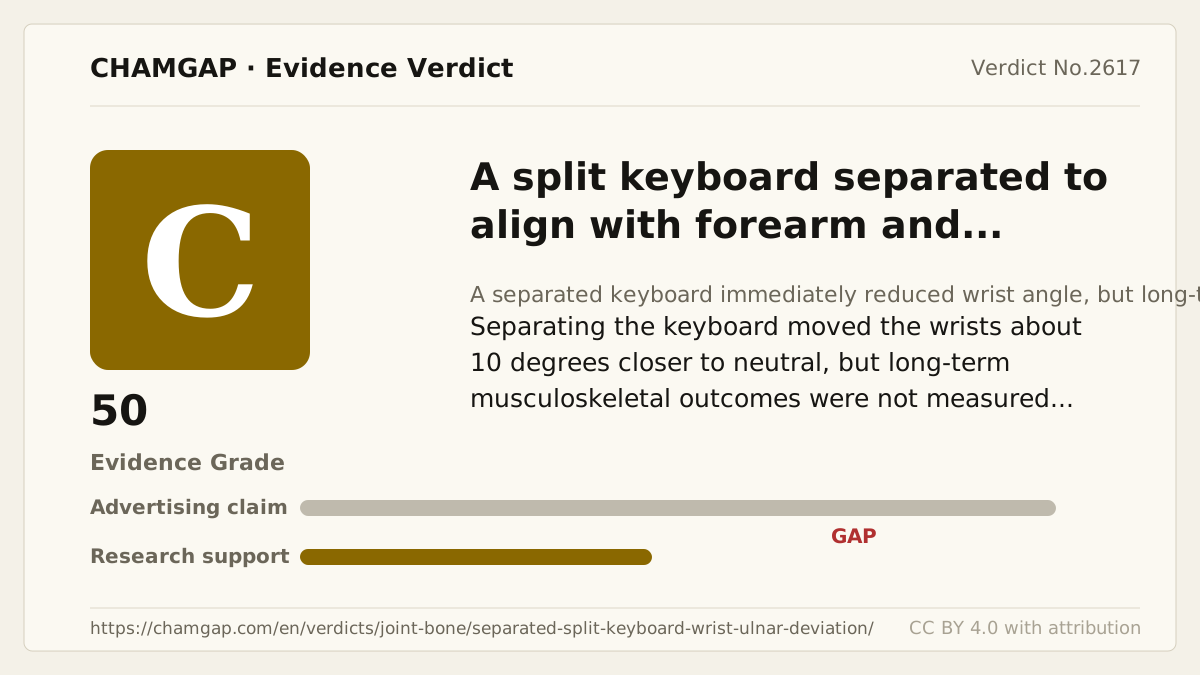
[Chamgap] Separated split keyboard x reduced wrist ulnar deviation during typing — Evidence Grade C·50. 1 cited sources checked. Source: https://chamgap.com/en/verdicts/joint-bone/separated-split-keyboard-wrist-ulnar-deviation/ · CC BY 4.0CC BY 4.0 — free to use with attribution; do not distort grades, numbers, or verdict meaning.
What this document does and does not do
Chamgap is an information source. It reports what research has and has not confirmed; it does not tell readers what to take or buy. That decision belongs to readers and, when needed, medical or legal professionals. This verdict reflects literature available up to the search date and may change as new research appears. Nothing here is medical advice.