
Posture-correcting shirt and tension bands,
does it really help with Posture and neck-pain improvement?
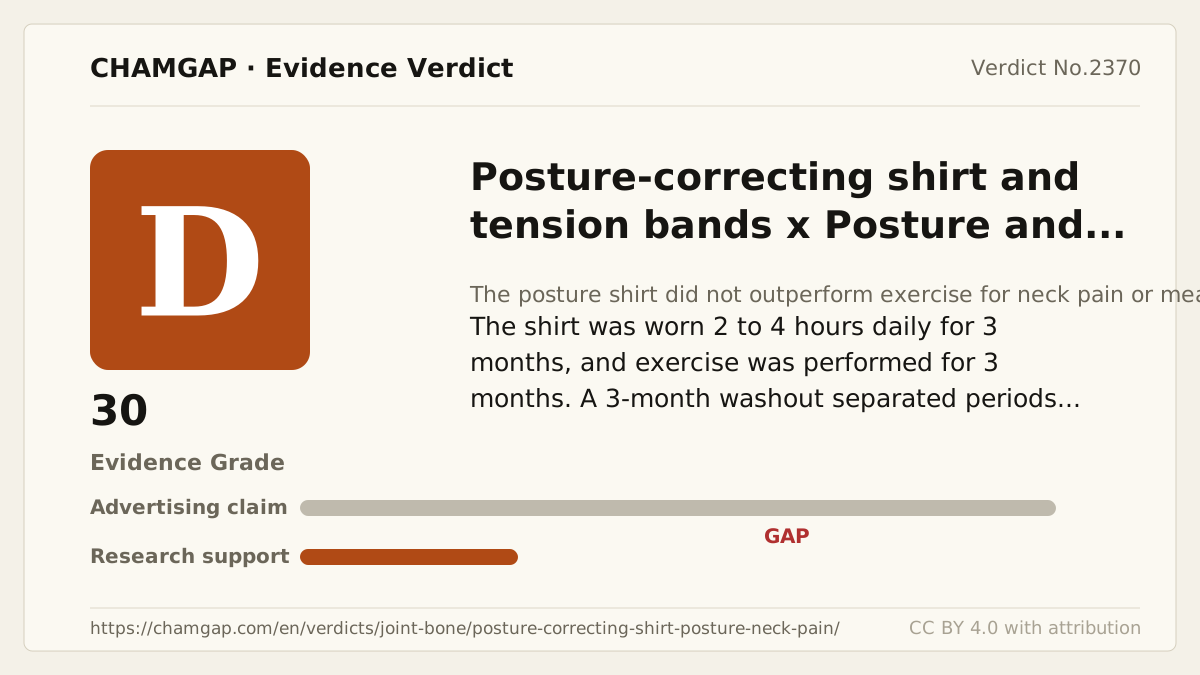
research showsIn a randomized crossover trial of 32 female health professionals, the percentage change in pain from baseline was a 33% reduction with both the shirt and exercise, with no between-treatment difference. The 33% versus 33% values were not event rates. Spinal angles also did not improve more with the shirt.
ads claimElastic fabric and inelastic tension bands do exert physical traction. That property alone does not establish durable posture, pain, or functional improvement.
Useful facts when choosing a product
- PosturePlusForce uses elastane, cotton, polyamide, and inelastic tension bands.
- The shirt was worn 2 to 4 hours in daytime every day for 3 months. Exercise included five weekly 20-minute teaching sessions followed by daily home exercise for 3 months.
- A blinded assessor measured spinal angles with Spinal Mouse. Participants necessarily knew the intervention when reporting VAS pain.
- The results paper stated that no funds supported the work and no relevant outside financial activities existed. The protocol stated that Medi supplied logbooks and postural garments for all participants.
What the research actually shows
Thirty-two participants were randomized and 29 completed both periods. Sequence was randomized, and treatment differences within each person were compared across sequences using mixed models. Baselines were similar after washout, but no explicit sequence-by-treatment test was reported and residual effects remained possible.
Why this is classified as D (30)
A randomized human crossover trial exists, so judgment is not deferred. The shirt was not superior to active exercise for pain or measured angles, while the study was small, subjective pain could not be blinded, and there was no inactive control.
Counterpoint. The 2-point or 30% pain value informed sample size and individual change, so it was not used as a boundary excluding a between-group benefit. The 33% versus 33% values were percentage changes from baseline. The source did not report the within-person correlation, paired variance, or covariance matrix needed to calculate a crossover standardized effect, so no standardized effect was claimed. The official posture comparison was also null.
Rejudgment record. Cross-check applied — The source was checked for randomized sequence, 3-month washout, primary pain and posture outcomes, mixed-model comparison, and funding disclosures.
| Endpoint | S | Surrogate marker - laboratory or imaging measures |
| Replication | R1 | Single confirmatory trial |
| Independence | I2 | Decisive evidence is publicly or non-profit funded |
| Effect size | E0 | Null |
| Precision | C0 | The confidence interval leaves room for benefit |
The scoring table and the verdict agree (D).
Sub-claim grades by effect
This ingredient is marketed for several effects. A single overall grade blends strong and weak claims together, so each effect is graded separately here. The overall grade reflects the strongest disconfirming or core claim.
| Effect (sub-claim) | Grade | Basis |
|---|---|---|
| Improved spinal posture angles | D | There was no between-treatment difference versus exercise. |
| Improved neck pain | D | Percentage pain change from baseline was -33% for both interventions, with P=.90 between treatments; these were not event rates. |
| Improved neck-related function or disability | D | NDI was secondary and showed no established overall superiority. |
Cross-check — Codex and Claude
Evidence Table
| Study | Design | Sample | Funding | Endpoint | Result | Weight |
|---|---|---|---|---|---|---|
| Study 1 | Randomized crossover trial with active exercise control | 29 | Results paper reported no external funding; protocol reported that Medi supplied logbooks and postural garments | Primary VAS pain and Spinal Mouse posture angles | Percentage pain change from baseline was -33% vs -33%, P=.90; no between-treatment posture difference | Decisive direct evidence |
| Study 2 | Prospectively registered randomized crossover protocol | 32 | Andorran institutional support; commercial funding not reported; Medi supplied logbooks and postural garments | Pain, posture, and a 3-month washout | Planned wear 2 to 4 hours daily for 90 days | Prospective confirmation of intervention, sequence, and duration |
Receipt — 2 References
All 2 cited sources were verified for existence at the original page (as of 2026-08-07).
Reviewed and approved: Chamgap Editorial Team · Approval date: 2026-08-07 · Corrections: none
Cite this verdict
[Chamgap] Does a posture-correcting shirt improve posture and neck pain more than exercise? — Evidence Grade D·30. 2 cited sources checked. Source: https://chamgap.com/en/verdicts/joint-bone/posture-correcting-shirt-posture-neck-pain/ · CC BY 4.0CC BY 4.0 — free to use with attribution; do not distort grades, numbers, or verdict meaning.
What this document does and does not do
Chamgap is an information source. It reports what research has and has not confirmed; it does not tell readers what to take or buy. That decision belongs to readers and, when needed, medical or legal professionals. This verdict reflects literature available up to the search date and may change as new research appears. Nothing here is medical advice.