
Multifactorial fall prevention,
does it really help with Reduced falls and recurrent falls over one year in community-dwelling older adults?
research showsThe grade is B with 76 points. Tinetti reduced the proportion falling from 47% to 35% and the fall rate from 1.37 to 0.84 per person-year. Tinetti's main estimand was the fall-event rate, whereas Wagner's was the proportion of fallers, so they did not repeat the same question.
ads claimA checklist or exercise-only service is not equivalent to the tested tailored program, and fewer self-reported falls does not establish fewer fractures or deaths.
Useful facts when choosing a product
- The intervention included medication, orthostasis, gait, balance, strength, footwear, and home hazards.
- Falls were recorded on monthly calendars and confirmed by blinded telephone interviewers.
- Wagner enrolled a general ambulatory older population.
- Author lists did not overlap, but Wagner's exact funding statement was not confirmed.
What the research actually shows
Tinetti tested medication reduction, postural-hypotension management, gait, balance and strength training, safer transfer and footwear instruction, and home-hazard and lighting modifications. The full Tinetti author list was Mary E. Tinetti, Dorothy I. Baker, Gail McAvay, Elizabeth B. Claus, Patricia Garrett, Margaret Gottschalk, Marie L. Koch, Kathryn Trainor, and Ralph I. Horwitz. Wagner's was Edward H. Wagner, Andrea Z. LaCroix, Louis Grothaus, Suzanne G. Leveille, JA Hecht, K Artz, K Odle, and David M. Buchner. No names overlap. Tinetti states funding as “a grant (UO1 AG09087) from the National Institute on Aging.” The exact original funding wording for Wagner could not be confirmed in the accessible source, so funding independence was not claimed.
Why this is classified as B (76)
A direct positive hard-outcome trial used monthly calendars plus blinded telephone confirmation. Wagner measured a different estimand, giving B with 76 points.
Counterpoint. Exercise-only programs and fracture prevention are separate questions.
Rejudgment record. Cross-check applied — Tinetti used fall-event rate and blinded telephone confirmation of calendar reports, whereas Wagner used proportion of fallers and therefore did not repeat the same question
| Endpoint | H | Hard endpoint - actual events such as death |
| Replication | R1 | Single confirmatory trial |
| Independence | I2 | Decisive evidence is publicly or non-profit funded |
| Effect size | E+ | Meets the clinically important threshold |
The scoring table and the verdict agree (B).
Sub-claim grades by effect
This ingredient is marketed for several effects. A single overall grade blends strong and weak claims together, so each effect is graded separately here. The overall grade reflects the strongest disconfirming or core claim.
| Effect (sub-claim) | Grade | Basis |
|---|---|---|
| Reduced one-year fall count | B | Tinetti reported 94 versus 164 falls. |
| Reduced proportion of fallers | B | Tinetti reported 35% versus 47%. |
Cross-check — Codex and Claude
Evidence Table
| Study | Design | Sample | Funding | Endpoint | Result | Weight |
|---|---|---|---|---|---|---|
| Study 1 | Community cluster-randomized usual-care controlled trial | 291 | Original wording: a grant (UO1 AG09087) from the National Institute on Aging | One-year incidence of falls; stated primary outcome | 94 versus 164 falls; 52/147 (35%) versus 68/144 (47%) fallers; incidence-rate ratio 0.64 (0.49 to 0.83) | Pivotal direct positive trial |
| Study 2 | Three-arm population-based randomized trial | 607 | Exact original funding wording not confirmed | One-year proportion of fallers among multiple disability and fall outcomes | 175/635 (27.6%) versus 223/607 (36.7%) | Not counted as direct replication because population and estimand differed |
Receipt — 2 References
All 2 cited sources were verified for existence at the original page (as of 2026-08-07).
Reviewed and approved: Chamgap Editorial Team · Approval date: 2026-08-07 · Corrections: none
Cite this verdict
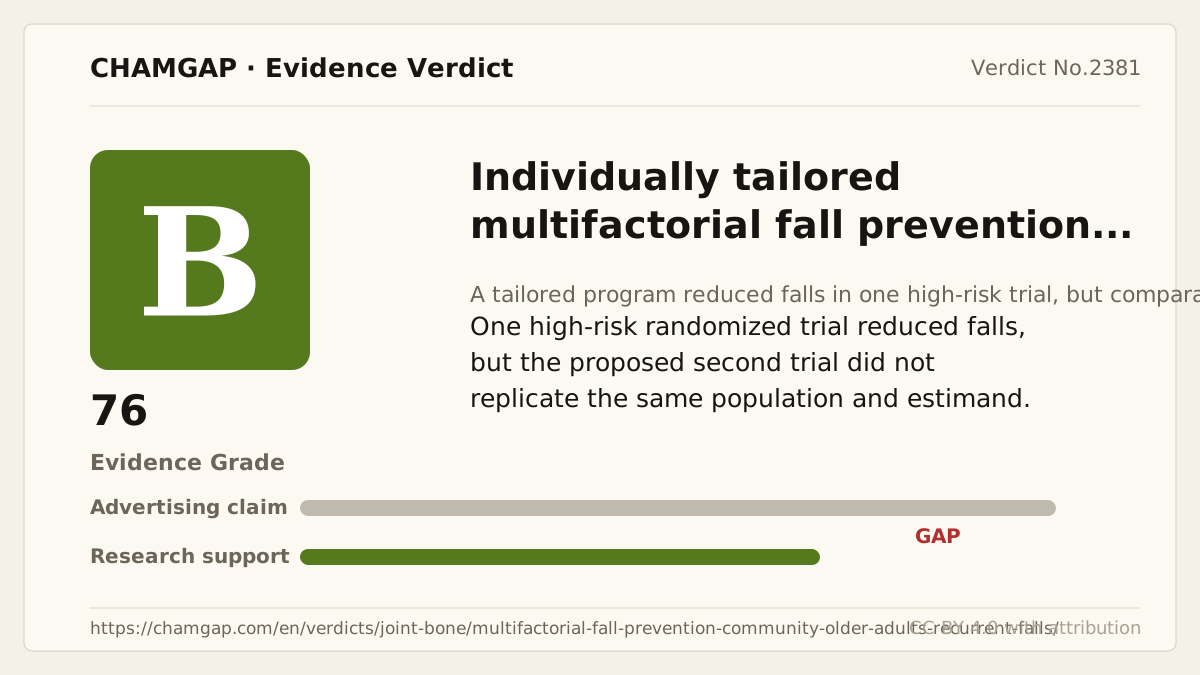
[Chamgap] Multifactorial fall prevention x recurrent falls in community-dwelling older adults — Evidence Grade B·76. 2 cited sources checked. Source: https://chamgap.com/en/verdicts/joint-bone/multifactorial-fall-prevention-community-older-adults-recurrent-falls/ · CC BY 4.0CC BY 4.0 — free to use with attribution; do not distort grades, numbers, or verdict meaning.
What this document does and does not do
Chamgap is an information source. It reports what research has and has not confirmed; it does not tell readers what to take or buy. That decision belongs to readers and, when needed, medical or legal professionals. This verdict reflects literature available up to the search date and may change as new research appears. Nothing here is medical advice.