
Wearing non-slip socks in hospital,
does it really help with Reduced inpatient falls?
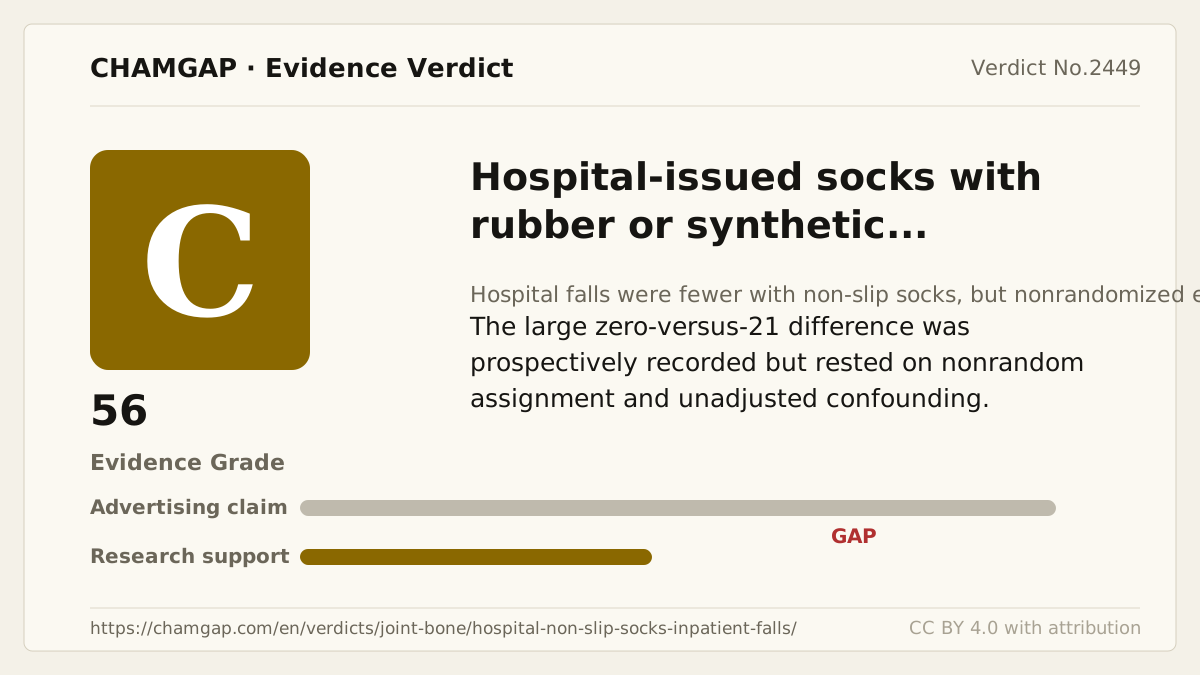
research showsThe grade is C. The data had only two groups: 77 patients with non-slip socks and 81 with adequate footwear. Falls were 0/77 versus 21/81 (25.9%). The regression model adjusted only for footwear type and age; it did not adjust Downton fall-risk score, confusion, gait, drugs, diagnosis, or length of stay, leaving confounding by the indication of unsuitable footwear.
ads claimKorean hospitals may issue grip socks as patient-safety equipment. This cohort is not a randomized demonstration that socks outperform well-fitting closed shoes, and socks do not replace assistance, medication review, environmental cleanup, or toileting support.
Useful facts when choosing a product
- Only non-slip socks and adequate footwear were compared; barefoot, ordinary socks, and slippers were not separate groups.
- Verdict 2450 is C with 56 points for ordinary socks, stockings, or bare feet in community settings. The exposure and setting differ from hospital-issued grip socks, so the verdicts do not conflict.
- Socks were assigned for unsuitable footwear; assignment was not randomized.
What the research actually shows
Hospital Clínico Universitario San Carlos prospectively observed 158 adults in geriatric and internal-medicine units from March through June 2022. The dataset had only two groups: 77 patients with unsuitable footwear who received non-slip socks and 81 wearing adequate footwear. Barefoot, ordinary socks, and slippers were not separate groups. Falls were 0/77 versus 21/81, risk difference -25.9 points (calculated Newcombe 95% CI -36.4 to -16.4), P<.0001. The regression model adjusted only footwear type and age. It did not adjust Downton fall-risk score, confusion, gait, drugs, diagnosis, or length of stay, and group patient-days were not reported. Mean age was 76.39±17.55 versus 84.45±10.75, P<.001, while confusion occurred in 12 versus four, P<.027; 61.9% overall had Downton scores above three. Near-total nonadjustment of major confounders and absent exposure-time adjustment are the two avoidable observational flaws counted. Assignment for unsuitable footwear also leaves confounding by indication. The funding statement reads: “This research was no funded and the APC was funded by Fundación Investigación Biomédica Hospital Clínico San Carlos/Instituto de Investigación Sanitaria Hospital Clínico San Carlos (IdISSC) provided economic support to publish this article.”
Why this is classified as C (56)
The strength-axis count for the same profile as verdict 2450 gives C with 58 points, while confounding beyond footwear type and age and absent patient-days change the evidentiary narrative.
Counterpoint. A zero-event arm in minimally adjusted observational data cannot establish a causal effect size, and confounding by indication remains.
Rejudgment record. Cross-check applied — Applied the strength-axis count for the same axis profile as verdict 2450 while distinguishing nonrandom assignment and unadjusted confounding
| Endpoint | H | Hard endpoint - actual events such as death |
| Replication | R1 | Single confirmatory trial |
| Independence | I2 | Decisive evidence is publicly or non-profit funded |
| Effect size | E+ | Meets the clinically important threshold |
The scoring table and the verdict agree (C).
Sub-claim grades by effect
This ingredient is marketed for several effects. A single overall grade blends strong and weak claims together, so each effect is graded separately here. The overall grade reflects the strongest disconfirming or core claim.
| Effect (sub-claim) | Grade | Basis |
|---|---|---|
| Reduced risk of at least one inpatient fall | C | The result was 0/77 versus 21/81 but was nonrandomized and unadjusted. |
| Reduced fall injuries | ? | Injuries occurred only in the footwear group, but there were only six events and no independent injury-endpoint analysis. |
Cross-check — Codex and Claude
Evidence Table
| Study | Design | Sample | Funding | Endpoint | Result | Weight |
|---|---|---|---|---|---|---|
| Study 1 | Single-hospital prospective observational cohort | 81 | This research was no funded and the APC was funded by Fundación Investigación Biomédica Hospital Clínico San Carlos/Instituto de Investigación Sanitaria Hospital Clínico San Carlos (IdISSC) provided economic support to publish this article. | Number and consequences of inpatient falls; no single primary endpoint was clearly designated | 0/77 versus 21/81 (25.9%); risk difference -25.9 points, calculated Newcombe 95% CI -36.4 to -16.4; P<.0001 | Pivotal observational evidence |
Receipt — 2 References
All 2 cited sources were verified for existence at the original page (as of 2026-08-08).
Reviewed and approved: Chamgap Editorial Team · Approval date: 2026-08-08 · Corrections: none
Cite this verdict
[Chamgap] Wearing non-slip socks in hospital x reduced falls — Evidence Grade C·56. 2 cited sources checked. Source: https://chamgap.com/en/verdicts/joint-bone/hospital-non-slip-socks-inpatient-falls/ · CC BY 4.0CC BY 4.0 — free to use with attribution; do not distort grades, numbers, or verdict meaning.
What this document does and does not do
Chamgap is an information source. It reports what research has and has not confirmed; it does not tell readers what to take or buy. That decision belongs to readers and, when needed, medical or legal professionals. This verdict reflects literature available up to the search date and may change as new research appears. Nothing here is medical advice.