
Home TENS,
does it really help with Reduced movement-evoked pain in fibromyalgia?
research showsThe grade is C. FAST randomized 301 women to active TENS (103), sensory placebo TENS (99), or no TENS (99). Four-week adjusted movement-pain changes were -1.8, -0.8, and approximately 0 points. The active-placebo difference of -1.0 on a 0-10 scale (95% CI -1.8 to -0.2) was statistically significant. Reconstructing within-arm dispersion from the confidence intervals and sample sizes gives Cohen d of about 0.35, below Cohen's 0.5 medium-effect convention. One short trial gives C with 50 points.
ads claimHome low-frequency devices are widely sold in Korea, but FAST tested strong-but-tolerable stimulation at two trunk sites for two hours during activity. Verdict 1338 is D with 30 points for the same device class in chronic nonspecific low-back pain; this verdict concerns a different indication and endpoint, movement pain in women with fibromyalgia.
Useful facts when choosing a product
- Active TENS used modulated 2-125 Hz, 200-microsecond pulses at maximal tolerable intensity for two hours daily.
- Placebo TENS produced initial sensation before ramping to zero.
- NIH funded the study and DJO Global supplied the units.
What the research actually shows
Women continued stable treatment and placed electrodes at the lumbar and cervicothoracic regions. They used modulated 2-125 Hz, 200-microsecond pulses at the highest tolerable intensity during activity for two hours daily over four weeks. Active, placebo, and no-TENS changes were -1.8 (95% CI -2.3 to -1.2), -0.8 (-1.4 to -0.2), and -0.006 (-0.5 to 0.6). The identical placebo delivered sensation for 45 seconds and ramped to zero over the final 15 seconds. The no-TENS group used no home device but wore an inactive device on test days to blind assessors. Assessors guessed active, placebo, and no TENS correctly 45%, 13%, and 20%; participants guessed placebo at chance but active TENS correctly 70%. Withdrawals were 15, 11, and 4. Funding came from NIH grants, while EMPI Select units were 'generously provided by DJO Global.' Sluka disclosed consulting and research relationships with several companies.
Why this is classified as C (50)
A publicly funded 301-participant trial met its registered primary endpoint, but approximate d was 0.35, below Cohen's medium-effect statistical convention, and follow-up was four weeks, giving C with 50 points.
Counterpoint. Some patients achieved 30% improvement, but average device-specific benefit and functional gains were limited.
Rejudgment record. Cross-check applied — Registry-concordant movement-pain primary endpoint with a small mean between-group difference, E~ retained under Cohen's statistical convention rather than a clinical threshold, and four-week follow-up
| Endpoint | P | Patient-reported treatment goal - the symptom is the goal |
| Replication | R1 | Single confirmatory trial |
| Independence | I2 | Decisive evidence is publicly or non-profit funded |
| Effect size | E~ | Statistically positive but below the threshold |
The scoring table and the verdict agree (C).
Sub-claim grades by effect
This ingredient is marketed for several effects. A single overall grade blends strong and weak claims together, so each effect is graded separately here. The overall grade reflects the strongest disconfirming or core claim.
| Effect (sub-claim) | Grade | Basis |
|---|---|---|
| Reduced movement-evoked pain | C | The -1.0-point placebo-controlled difference was statistically positive, but approximate d was 0.35, below Cohen's medium-effect convention. |
| Reduced resting pain | C | A statistical difference was reported, but all absolute values and intervals could not be verified in the accessible table. |
| Improved function | D | FIQR function and performance or activity measures did not improve versus sensory placebo. |
Cross-check — Codex and Claude
Evidence Table
| Study | Design | Sample | Funding | Endpoint | Result | Weight |
|---|---|---|---|---|---|---|
| Study 1 | Two-site double-blind three-arm randomized trial | 99 | NIH grants; EMPI Select units provided by DJO Global | Primary: four-week change in 0-10 movement pain during a six-minute walk | Active -1.8 (95% CI -2.3 to -1.2), placebo -0.8 (-1.4 to -0.2), no TENS -0.006 (-0.5 to 0.6); active-placebo -1.0 (-1.8 to -0.2) | Pivotal publicly funded short-term confirmatory trial |
Receipt — 3 References
All 3 cited sources were verified for existence at the original page (as of 2026-08-08).
Reviewed and approved: Chamgap Editorial Team · Approval date: 2026-08-08 · Corrections: none
Cite this verdict
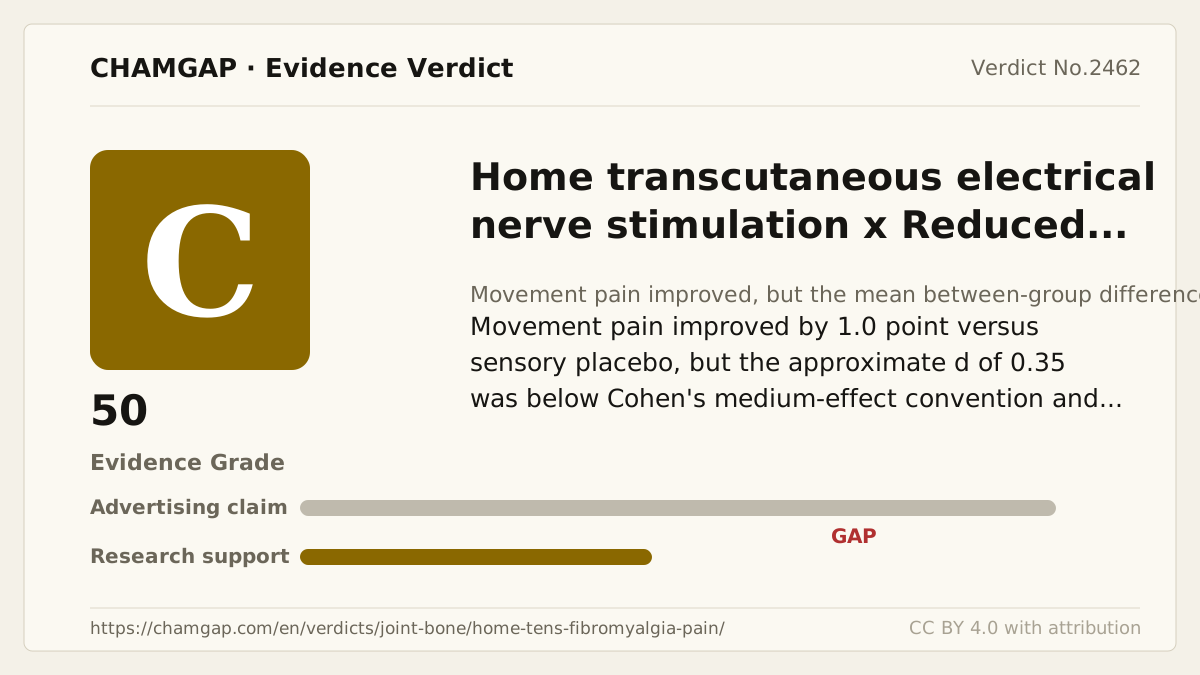
[Chamgap] Home TENS x reduced fibromyalgia pain — Evidence Grade C·50. 3 cited sources checked. Source: https://chamgap.com/en/verdicts/joint-bone/home-tens-fibromyalgia-pain/ · CC BY 4.0CC BY 4.0 — free to use with attribution; do not distort grades, numbers, or verdict meaning.
What this document does and does not do
Chamgap is an information source. It reports what research has and has not confirmed; it does not tell readers what to take or buy. That decision belongs to readers and, when needed, medical or legal professionals. This verdict reflects literature available up to the search date and may change as new research appears. Nothing here is medical advice.