
Fracture liaison service,
does it really help with Reduced subsequent distal-forearm, proximal-humerus, or hip fragility fractures?
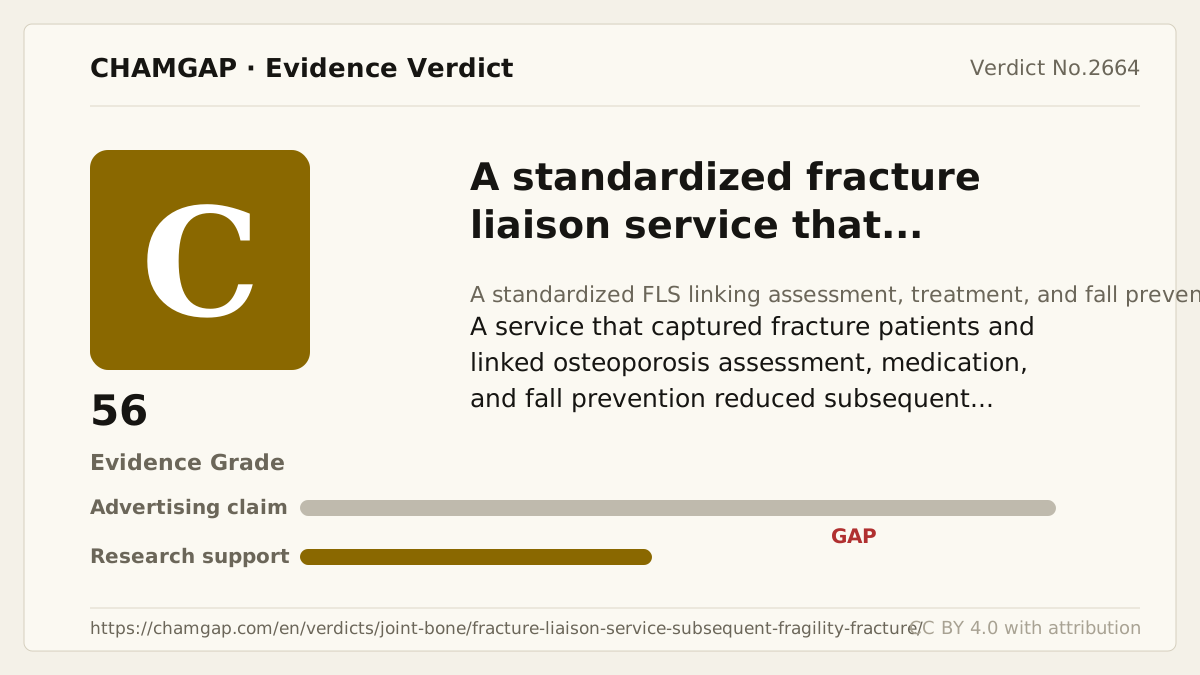
research showsThe grade is C with 56 points. NoFRACT randomized the implementation order of seven Norwegian hospitals, while a separate 2025 observational analysis used national registries for 104,257 index-fracture episodes among 100,198 unique patients. Adjusted hazard ratios were 0.87 (95% CI 0.83 to 0.92) in women and 0.90 (0.81 to 0.99) in men. Patients were classified ‘solely based on the time of index fracture,’ so actual FLS participation was unknown, and absent BMD and osteoporosis-medication data led the authors to note ‘limited information about confounding factors.’ Randomized stepped implementation and calendar-time adjustment do not remove these two defects.
ads claimThe service was linked to fracture events, not merely higher DXA or prescribing rates. But any program labeled FLS cannot claim this effect unless it implements systematic identification, risk assessment, treatment initiation, and fall-prevention referral.
Useful facts when choosing a product
- The 2018 protocol randomized implementation order across seven hospitals, with every hospital eventually adopting FLS.
- There were 100,198 unique patients and 104,257 index-fracture episodes; 4,059 patients appeared in both periods.
- The 2025 Osteoporosis International paper is a separate observational analysis, not an independent replication trial.
What the research actually shows
The 2025 report by Andreasen C, Dahl C, Frihagen F, Borgen TT, Basso T, Gjertsen JE, Figved W, Wisløff T, Hagen G, Apalset EM, Stutzer JM, Lund I, Hansen AK, Nissen FI, Joakimsen RM, Syversen U, Eriksen EF, Nordsletten L, Omsland TK, Bjørnerem Å, and Solberg LB was an observational national-registry analysis before and after NoFRACT implementation. It analyzed 104,257 fracture episodes in 100,198 unique patients: 57,186 control-period and 47,071 FLS-period episodes, with 4,059 patients appearing in both periods, and maximum follow-up of 4.7 years. Subsequent-fracture HRs were 0.87 (0.83 to 0.92) in women and 0.90 (0.81 to 0.99) in men. Patients were classified ‘solely based on the time of index fracture,’ so actual participation was unknown; BMD and osteoporosis-medication data were unavailable, and the report stated ‘limited information about confounding factors.’ The 2018 NCT02536898 protocol cluster-randomized implementation order across seven hospitals, and the analysis adjusted for calendar time, but neither measure removes exposure misclassification or unmeasured and residual confounding. The two reports are not independent replications.
Why this is classified as C (56)
A large publicly funded registry analysis found fewer prespecified actual refracture events in women and men. Time-defined exposure misclassification and unmeasured or residual confounding from missing BMD and medication data are two independent defects; the observational-study ceiling therefore gives C with 56 points.
Counterpoint. Linked medications require individualized review of renal function, hypocalcemia, dental status, and other contraindications; the service verdict does not establish safety or efficacy of one specific drug.
Rejudgment record. Cross-check applied — Cross-checked the 2025 report, 2018 protocol, and NCT02536898 for randomization unit, prespecified primary endpoint, patient and episode counts, sex-specific hazard ratios, time-defined exposure, absent BMD and medication data, period differences, and public funding
| Endpoint | H | Hard endpoint - actual events such as death |
| Replication | R1 | Single confirmatory trial |
| Independence | I2 | Decisive evidence is publicly or non-profit funded |
| Effect size | E+ | Meets the clinically important threshold |
The scoring table and the verdict agree (C).
Sub-claim grades by effect
This ingredient is marketed for several effects. A single overall grade blends strong and weak claims together, so each effect is graded separately here. The overall grade reflects the strongest disconfirming or core claim.
| Effect (sub-claim) | Grade | Basis |
|---|---|---|
| Reduced subsequent fragility fracture in women | C | Adjusted HR 0.87 (0.83 to 0.92), with exposure misclassification and residual confounding. |
| Reduced subsequent fragility fracture in men | C | Adjusted HR 0.90 (0.81 to 0.99), with exposure misclassification and residual confounding. |
Cross-check — Codex and Claude
Evidence Table
| Study | Design | Sample | Funding | Endpoint | Result | Weight |
|---|---|---|---|---|---|---|
| Andreasen C, Dahl C, Frihagen F, Borgen TT, Basso T, Gjertsen JE, Figved W, Wisløff T, Hagen G, Apalset EM, Stutzer JM, Lund I, Hansen AK, Nissen FI, Joakimsen RM, Syversen U, Eriksen EF, Nordsletten L, Omsland TK, Bjørnerem Å, Solberg LB. 2025 | Observational national-registry analysis before and after NoFRACT implementation | 47,071 | Norwegian regional health authorities, hospital trusts, and university-hospital public funding | Registry-recorded subsequent distal-forearm, proximal-humerus, or hip fragility fracture | Women HR 0.87 (0.83 to 0.92); men HR 0.90 (0.81 to 0.99); time-defined exposure misclassification and residual confounding from absent BMD and medication data | Large hard-outcome observational analysis with two independent defects, rated B2 |
Receipt — 2 References
All 2 cited sources were verified for existence at the original page (as of 2026-08-15).
Reviewed and approved: Chamgap Editorial Team · Approval date: 2026-08-15 · Corrections: none
Cite this verdict
[Chamgap] Fracture liaison service x prevention of subsequent fragility fracture — Evidence Grade C·56. 2 cited sources checked. Source: https://chamgap.com/en/verdicts/joint-bone/fracture-liaison-service-subsequent-fragility-fracture/ · CC BY 4.0CC BY 4.0 — free to use with attribution; do not distort grades, numbers, or verdict meaning.
What this document does and does not do
Chamgap is an information source. It reports what research has and has not confirmed; it does not tell readers what to take or buy. That decision belongs to readers and, when needed, medical or legal professionals. This verdict reflects literature available up to the search date and may change as new research appears. Nothing here is medical advice.