
Early weight-bearing after ankle-fracture fixation,
does it really help with Improved four-month ankle function versus six-week delayed weight-bearing without a clear complication increase?
research showsThe grade is C. In the 561-participant WAX trial across 23 UK hospitals, four-month OMAS was 65.9 with early and 61.2 with delayed weight-bearing; the adjusted superiority difference was 4.42 points (95% CI 0.53-8.32). The result was statistically positive but only about 0.21 standardized units, and a noninferiority design without independent replication of the same estimate gives C with 50 points.
ads claimThis does not mean every postoperative patient should walk at two weeks. WAX excluded hindfoot nails, loss of protective sensation, and patients explicitly instructed to remain non-weight-bearing; treatment occurred under surgical review of fixation, wound, and neurovascular status.
Useful facts when choosing a product
- Even the WAX early group remained non-weight-bearing for the first two postoperative weeks, then began weight-bearing as tolerated.
- WAX had UK public NIHR funding and prospectively registered four-month OMAS, comparator, and noninferiority/superiority analyses as ISRCTN12883981.
- Existing verdicts 917, 1009, 1560, 1717, and 2000 address adjacent fracture, loading, or rehabilitation questions, not this two-versus-six-week postoperative strategy; the pivotal PMID and DOI were not duplicated.
What the research actually shows
WAX was a pragmatic multicenter noninferiority RCT at 23 NHS hospitals. Participants and clinicians knew the instruction, but patients entered primary OMAS data directly into the central database without clinical-team influence. Four-month data were obtained from 480/561 (86%); the primary noninferiority analysis was per protocol and the prespecified superiority analysis was intention-to-treat. Dehghan 2016 randomized 110 and reported six-week OMAS 45 versus 32 and ROM 41 versus 29 degrees, but the primary outcome was return to work and was null. Different timing, primary outcome, and estimates meant it was not counted as independent replication of WAX's four-month superiority result.
Why this is classified as C (50)
A large publicly funded multicenter trial established noninferiority and planned superiority on the prespecified four-month functional outcome, but the average difference was small by statistical convention. Noninferiority design and lack of independent same-question replication give C with 50 points.
Counterpoint. A smaller trial showed larger six-week functional differences, but its primary return-to-work outcome was null and it did not estimate the same four-month effect. No significant complication increase is not proof of safety equivalence.
Rejudgment record. Cross-check applied — We cross-checked allocation, analyzed population, registered primary outcome, noninferiority and superiority estimates, complications, and funding against the Lancet paper, WAX protocol, ISRCTN, and Dehghan paper.
| Endpoint | P | Patient-reported treatment goal - the symptom is the goal |
| Replication | R1 | Single confirmatory trial |
| Independence | I2 | Decisive evidence is publicly or non-profit funded |
| Effect size | E~ | Statistically positive but below the threshold |
The scoring table and the verdict agree (C).
Sub-claim grades by effect
This ingredient is marketed for several effects. A single overall grade blends strong and weak claims together, so each effect is graded separately here. The overall grade reflects the strongest disconfirming or core claim.
| Effect (sub-claim) | Grade | Basis |
|---|---|---|
| Weight-bearing from two weeks after ankle-fracture fixation improves four-month function versus six-week delay. | C | A large public trial was statistically positive, but the standardized effect was small. |
| Two-week early weight-bearing does not increase complications. | D | OR 1.18 (0.80-1.75) was not significant but did not exclude a meaningful increase. |
Cross-check — Codex and Claude
Evidence Table
| Study | Design | Sample | Funding | Endpoint | Result | Weight |
|---|---|---|---|---|---|---|
| Study 1 | Pragmatic 23-hospital multicenter randomized noninferiority trial | 237 | NIHR, NIHR Barts Biomedical Research Centre, and NIHR Applied Research Collaboration Oxford and Thames Valley | Four-month Olerud-Molander Ankle Score and complications | OMAS 65.9 versus 61.2; adjusted superiority difference 4.42 (95% CI 0.53-8.32). Complications 46/280 versus 39/281, OR 1.18 (0.80-1.75) | Large pivotal publicly funded trial |
| Study 2 | Two-trauma-center multicenter randomized comparative trial | 110 | Original full-text funding statement not verified | Primary return to work; secondary six-week OMAS, ROM, SF-36, and complications | No return-to-work difference. Six-week OMAS 45 versus 32 and ROM 41 versus 29 degrees; no wound or infection difference | Supportive trial with different timing and primary endpoint |
Receipt — 3 References
All 3 cited sources were verified for existence at the original page (as of 2026-08-14).
Reviewed and approved: Chamgap Editorial Team · Approval date: 2026-08-14 · Corrections: none
Cite this verdict
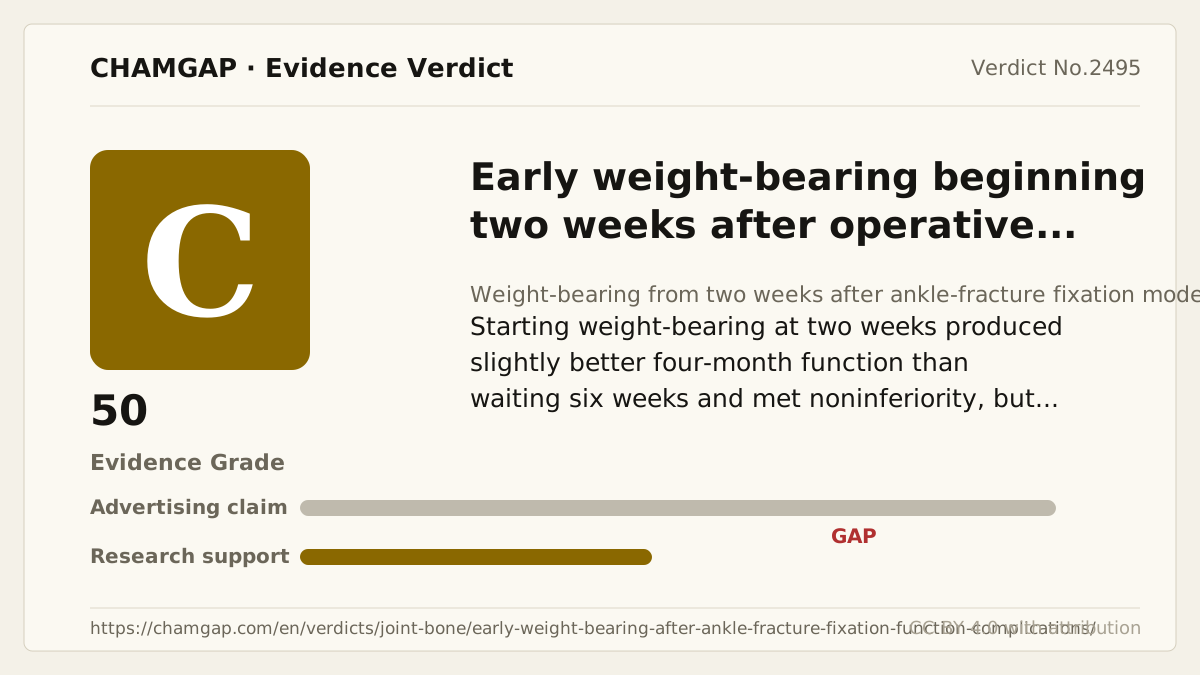
[Chamgap] Early weight-bearing after ankle-fracture fixation x four-month function — Evidence Grade C·50. 3 cited sources checked. Source: https://chamgap.com/en/verdicts/joint-bone/early-weight-bearing-after-ankle-fracture-fixation-function-complications/ · CC BY 4.0CC BY 4.0 — free to use with attribution; do not distort grades, numbers, or verdict meaning.
What this document does and does not do
Chamgap is an information source. It reports what research has and has not confirmed; it does not tell readers what to take or buy. That decision belongs to readers and, when needed, medical or legal professionals. This verdict reflects literature available up to the search date and may change as new research appears. Nothing here is medical advice.