
Continuous low-level heat wrap,
does it really help with Reduced short-term pain and disability in acute nonspecific low-back pain?
research showsThe grade is C. In acute and subacute low-back-pain trials, heat wraps improved pain relief over oral placebo by 1.06 points on a 0-5 scale (95% CI 0.68-1.45) and disability by 2.10 points on a 0-24 scale (95% CI 1.01-3.19) within five days. These are roughly moderate standardized effects, but the evidence is concentrated in the same product, investigator network, and manufacturer program with weak masking, giving C with 50 points.
ads claimThese results cannot be transferred to ordinary hot packs or high-temperature heating. The trial device was designed to maintain about 40 C for a specified wear period; hotter or longer use has not been shown to improve outcomes.
Useful facts when choosing a product
- The ThermaCare trial wrap was designed to reach about 40 C within 30 minutes and maintain low-level heat for about eight hours.
- The 2002 trial was funded by Procter & Gamble; six of eight authors were company research employees and one was a paid consultant.
- Verdict 1833 concerns abdominal heat for primary dysmenorrhea, a different site and indication; the pivotal PMIDs and DOIs were absent from existing verdicts.
What the research actually shows
The 2002 trial used eight-hour wear for two days and measured pain relief and Roland-Morris disability. The systematic review found that sequence generation and allocation concealment were not described and judged participant masking at high risk, while attrition and analysis were low risk. The 2003 study was investigator-single-blind; participants knew whether the wrap heated. No validated between-group minimum difference was verified, so public means and standard deviations, approximately 0.5-0.7 standardized units, were classified as moderate by Cohen's statistical convention. This is not a patient-anchored clinical threshold.
Why this is classified as C (50)
Pain and function are directly meaningful patient outcomes, and earlier pooled placebo differences were moderate by statistical convention. A nonmanufacturer independent trial exists but its one-week ODI result was null and did not reproduce the earlier Roland-Morris estimand. Overlapping earlier investigators, inability to mask participants, and unreported allocation concealment give C with 50 points.
Counterpoint. Several days of relief do not establish prevention of recurrence, earlier return to work, treatment of chronic pain, or replacement of analgesics. Patients with neurologic deficits or red flags were excluded.
Rejudgment record. Cross-check applied — We cross-checked group counts, pain and disability results, placebo-group size, masking, allocation reporting, and manufacturer support against both Nadler papers, Cochrane, and AHRQ tables.
| Endpoint | P | Patient-reported treatment goal - the symptom is the goal |
| Replication | R1 | Single confirmatory trial |
| Independence | I1 | Mixed funding sources |
| Effect size | E+ | Meets the clinically important threshold |
The scoring table and the verdict agree (C).
Sub-claim grades by effect
This ingredient is marketed for several effects. A single overall grade blends strong and weak claims together, so each effect is graded separately here. The overall grade reflects the strongest disconfirming or core claim.
| Effect (sub-claim) | Grade | Basis |
|---|---|---|
| Continuous low-level heat wraps reduce short-term pain and disability in acute nonspecific low-back pain. | C | Results were positive versus placebo and some analgesics but depend on manufacturer trials with weak masking. |
Cross-check — Codex and Claude
Evidence Table
| Study | Design | Sample | Funding | Endpoint | Result | Weight |
|---|---|---|---|---|---|---|
| Study 1 | Multicenter randomized investigator-single-blind multiarm comparative trial | 19 | Funded by Procter & Gamble Company; most authors were company employees | Day-one pain relief and Roland-Morris disability | Pain relief 2.00 versus ibuprofen 1.51 and acetaminophen 1.32; MD 0.65 (0.25-1.05) and 0.90 (0.50-1.30). Disability MD -2.20 (-3.29 to -1.11) and -2.00 (-3.14 to -0.86) | Pivotal analgesic-comparator trial |
| Study 2 | Multicenter randomized investigator-single-blind placebo-controlled trial | 34 | Indexed as non-government research support; original full-text funding statement not verified | Morning pain relief over three days as primary, with disability | Morning pain relief P=0.00005, daytime pain relief P<0.001, and day-four disability P=0.005; group final means and CIs were not verified from the public abstract | Supportive placebo trial from the same investigator network |
| Study 3 | Independent randomized sham-controlled trial | 32 | Funded by the Quebec Pain Research Network | One-week Oswestry Disability Index | Between-group mean difference 1.2 points (95% CI -3.4 to 5.8), null | Independent nonmanufacturer counterevidence using a different disability scale |
Receipt — 4 References
All 4 cited sources were verified for existence at the original page (as of 2026-08-14).
Reviewed and approved: Chamgap Editorial Team · Approval date: 2026-08-14 · Corrections: none
Cite this verdict
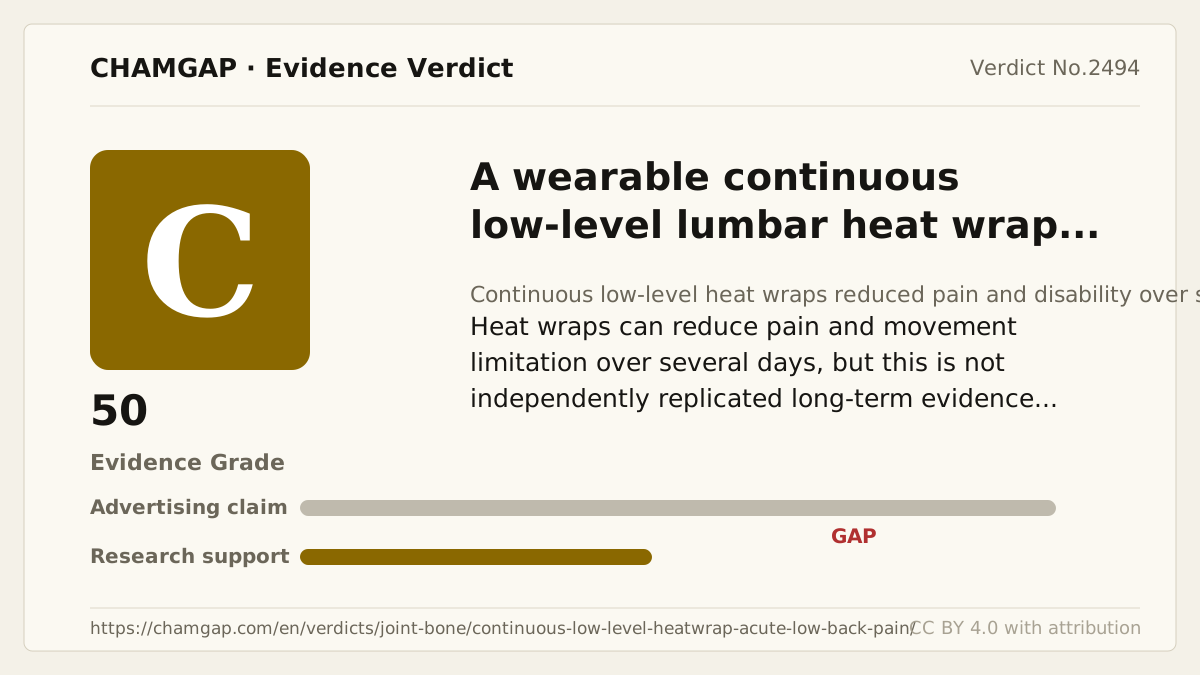
[Chamgap] Continuous low-level heat wrap x acute low-back pain and disability — Evidence Grade C·50. 4 cited sources checked. Source: https://chamgap.com/en/verdicts/joint-bone/continuous-low-level-heatwrap-acute-low-back-pain/ · CC BY 4.0CC BY 4.0 — free to use with attribution; do not distort grades, numbers, or verdict meaning.
What this document does and does not do
Chamgap is an information source. It reports what research has and has not confirmed; it does not tell readers what to take or buy. That decision belongs to readers and, when needed, medical or legal professionals. This verdict reflects literature available up to the search date and may change as new research appears. Nothing here is medical advice.