
Going barefoot or wearing socks alone indoors,
does it really help with Increased falls during everyday activity and indoor walking in older adults?
research showsThe grade is C. In a nested case-control study within a two-year prospective cohort of 1,371 adults aged 65 or older, 24/327 fall cases versus 4/327 matched control reference occasions involved bare or stocking feet. Compared with athletic or canvas shoes, the conditional OR was 11.2 (95% CI 2.4 to 51.8) after gait-abnormality adjustment; the indoor-walking stratum had OR 12.7 (2.8 to 56.1). This is neither a risk ratio nor absolute risk, and situational confounding and self-reported falls remain.
ads claimKorean fall-prevention advice should favor indoor footwear that fits, holds the heel, and has a slip-resistant sole. This does not mean any slipper is safe; lighting, clear paths, toileting plans, walking aids, and medication review remain important.
Useful facts when choosing a product
- Barefoot exposure was 12 versus one, stocking feet 12 versus three, slippers 29 versus 29, and athletic shoes 97 versus 125 among 327 cases and 327 controls.
- Verdict 2449 is C with 56 points for hospital-issued grip socks versus adequate footwear. Ordinary community socks or stockings are a different exposure.
- Controls were different people at their most recent similar activity, not the same person at another time.
What the research actually shows
Within the Group Health Cooperative ACT cohort, 1,371 ambulatory, noninstitutionalized adults aged 65 or older were prospectively monitored from July 1998 through June 2000 using a fall hotline, monthly mailed calendars, and calls for missing returns. There were 327 qualifying first falls over 1,900.6 person-years. For each case, a different person still under surveillance and not falling at that time was randomly selected, matched on sex and age within three years. This was not self-controlled. Controls recalled their most recent occasion in the broad activity category of the case: indoor walking, outdoor walking, stairs, moderate, or vigorous activity; that occasion defined the control date, time, place, and footwear. Case visits occurred a median 22 days after the fall and control visits eight days after the reference time. Exposures were athletic shoes 97/327 versus 125/327, canvas shoes 13/327 versus 19/327, slippers 29/327 versus 29/327, stocking feet 12/327 versus 3/327, and barefoot 12/327 versus 1/327. Combined shoeless exposure was 24/327 versus 4/327. These are exposure counts among cases and controls, not absolute fall risks. Conditional logistic regression matched age, sex, and activity category and separately added grip strength, difficulty rising, or gait abnormality. With gait abnormality, shoeless OR was 11.2 (95% CI 2.4 to 51.8) and other-shoe OR 1.3 (0.9 to 1.9). In 102 indoor-walking pairs, shoeless OR was 12.7 (2.8 to 56.1), but only matching factors were adjusted because numbers were small. Broad activity was therefore considered, but time of day was not adjusted or stratified, and nighttime toileting, sudden bed exit, wet floors, and lighting were not matched within indoor walking. These circumstances could jointly cause shoelessness and falls. Falls were self-reported and footwear reconstructed afterward. Unadjusted major situational confounding and self-reported outcome were counted as two avoidable observational flaws; retrospective exposure reconstruction itself was unavoidable and not counted again. The paper states: “Supported by Grants AG13793 and AG06781 from the National Institute on Aging and CCR002570 from the National Center for Injury Prevention and Control.”
Why this is classified as C (56)
A large harmful association in an activity-matched nested case-control study is capped at C with 56 points by self-reported falls and residual situational confounding.
Counterpoint. The conditional OR of 11.2 is not an incidence ratio or eleven-fold absolute risk, and its 2.4-to-51.8 interval is very wide.
Rejudgment record. Cross-check applied — Large conditional odds ratio in an activity-matched nested case-control study with self-report and situational confounding limitations
| Endpoint | H | Hard endpoint - actual events such as death |
| Replication | R1 | Single confirmatory trial |
| Independence | I2 | Decisive evidence is publicly or non-profit funded |
| Effect size | E+ | Meets the clinically important threshold |
The scoring table and the verdict agree (C).
Sub-claim grades by effect
This ingredient is marketed for several effects. A single overall grade blends strong and weak claims together, so each effect is graded separately here. The overall grade reflects the strongest disconfirming or core claim.
| Effect (sub-claim) | Grade | Basis |
|---|---|---|
| Increased overall falls with bare or stocking feet | C | Conditional OR was 11.2, with observational limitations and a wide interval. |
| Increased falls during indoor walking | C | The 102-pair activity stratum had OR 12.7 without additional health-variable adjustment. |
| Increased falls with slippers | D | Exposure was 29 versus 29, OR 1.3 (0.7 to 2.4), which did not support an increase. |
Cross-check — Codex and Claude
Evidence Table
| Study | Design | Sample | Funding | Endpoint | Result | Weight |
|---|---|---|---|---|---|---|
| Study 1 | Nested case-control study within a prospective cohort | 327 | Supported by Grants AG13793 and AG06781 from the National Institute on Aging and CCR002570 from the National Center for Injury Prevention and Control. | Footwear at the reference occasion and occurrence of an actual fall | Shoeless 24/327 versus 4/327; conditional OR 11.2 (95% CI 2.4 to 51.8) adjusted for gait abnormality; indoor walking OR 12.7 (2.8 to 56.1) | Pivotal evidence for the harmful association |
Receipt — 2 References
All 2 cited sources were verified for existence at the original page (as of 2026-08-08).
Reviewed and approved: Chamgap Editorial Team · Approval date: 2026-08-08 · Corrections: none
Cite this verdict
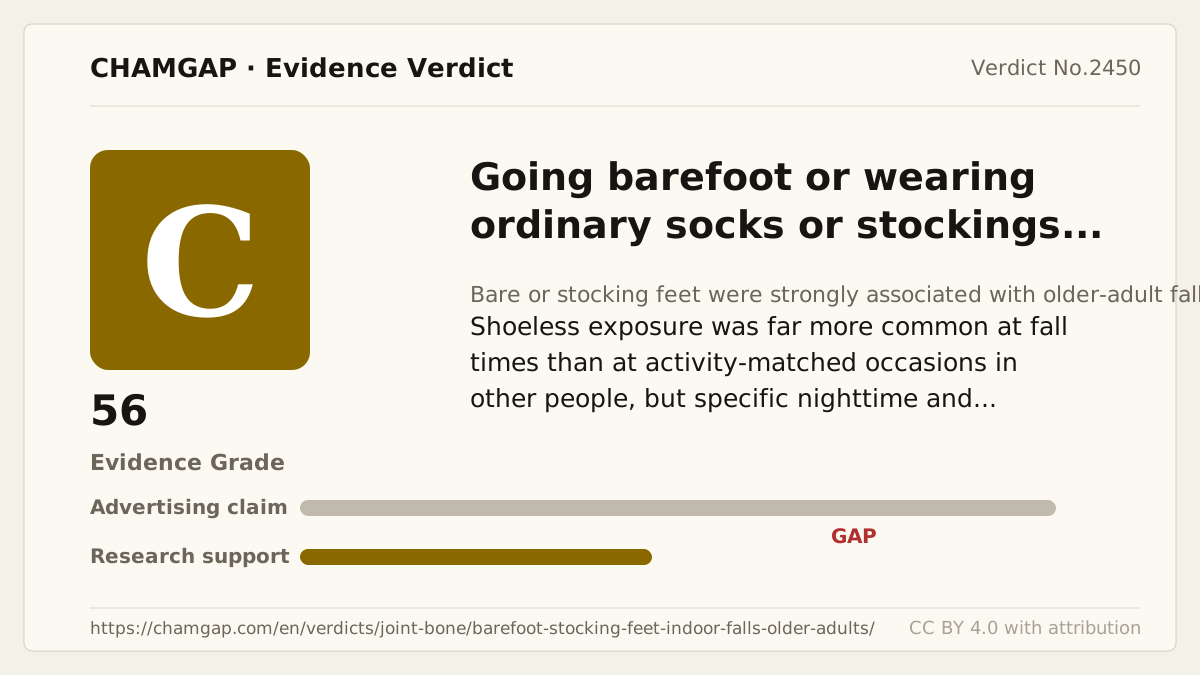
[Chamgap] Going barefoot or wearing socks alone indoors x increased falls — Evidence Grade C·56. 2 cited sources checked. Source: https://chamgap.com/en/verdicts/joint-bone/barefoot-stocking-feet-indoor-falls-older-adults/ · CC BY 4.0CC BY 4.0 — free to use with attribution; do not distort grades, numbers, or verdict meaning.
What this document does and does not do
Chamgap is an information source. It reports what research has and has not confirmed; it does not tell readers what to take or buy. That decision belongs to readers and, when needed, medical or legal professionals. This verdict reflects literature available up to the search date and may change as new research appears. Nothing here is medical advice.