
Triclosan-coated sutures,
does it really help with Reduction of surgical-site infection versus otherwise equivalent uncoated sutures?
research showsThe grade is D. FALCON, the largest independent trial, randomized 5,788 patients and analyzed 30-day infection in 5,284. Rates were 14.7% versus 16.3% in clean-contaminated wounds, RR 0.90 (95% CI 0.77-1.06), and 29.4% versus 30.7% in contaminated or dirty wounds, RR 0.98 (0.87-1.10). Neither comparison showed a significant reduction. No validated minimum-benefit boundary was confirmed, so possible benefit was not fully excluded; this is D with 34 points, not F.
ads claimThe suture is genuinely coated with triclosan. That physical product fact does not itself establish fewer clinical infections, and the largest independent trial did not confirm such a reduction.
Useful facts when choosing a product
- PLUS sutures have the antibacterial agent triclosan applied to the suture surface.
- FALCON allowed Ethicon PDS Plus in adults and Vicryl Plus in children and compared them with uncoated sutures.
- FALCON states: “Funding: National Institute for Health Research (NIHR) Global Health Research Unit Grant, BD.”
What the research actually shows
Sprowson AP, Jensen C, Parsons N et al. quasi-randomized 2,546 arthroplasty patients by odd or even hospital number. Ichida K, Noda H, Kikugawa R, Hasegawa et al. analyzed 1,013 patients by modified intention to treat with 30-day superficial or deep infection as primary outcome. The corporate author NIHR Global Research Health Unit on Global Surgery conducted FALCON in 54 hospitals across seven countries: 5,788 were computer randomized, patients and outcome assessors were masked, intention-to-treat analysis was stated, and the registered NCT03700749 30-day infection outcome was reported. The publicly available article did not let us verify the implementation of allocation concealment, so the trial was not described as free of avoidable limitations.
Why this is classified as D (34)
The largest publicly funded randomized trial, another randomized trial, and Sprowson's quasi-randomized odd/even hospital-number trial did not confirm fewer infections. FALCON RRs of 0.90 (95% CI 0.77-1.06) and 0.98 (0.87-1.10) did not exclude meaningful benefit, and the 2025 all-trial synthesis was positive, so this is D with 34 points rather than F.
Counterpoint. D does not mean benefit has been completely excluded. It reflects a null pivotal direct trial while preserving uncertainty raised by a positive synthesis of smaller studies.
Rejudgment record. Cross-check applied — We cross-checked analysis denominators, event counts, confidence intervals, funding, and the 2025 synthesis of all randomized trials against primary reports.
| Endpoint | H | Hard endpoint - actual events such as death |
| Replication | R1 | Single confirmatory trial |
| Independence | I2 | Decisive evidence is publicly or non-profit funded |
| Effect size | E0 | Null |
| Precision | C0 | The confidence interval leaves room for benefit |
The scoring table and the verdict agree (D).
Sub-claim grades by effect
This ingredient is marketed for several effects. A single overall grade blends strong and weak claims together, so each effect is graded separately here. The overall grade reflects the strongest disconfirming or core claim.
| Effect (sub-claim) | Grade | Basis |
|---|---|---|
| Reduced 30-day surgical-site infection versus uncoated sutures | D | Neither FALCON wound stratum showed a significant reduction. |
Cross-check — Codex and Claude
Evidence Table
| Study | Design | Sample | Funding | Endpoint | Result | Weight |
|---|---|---|---|---|---|---|
| Study 1 | Multicenter double-blind quasi-randomized controlled trial | 1,223 | Funding statement not verified in the primary report | Surgical-site infection after hip or knee arthroplasty | 33/1,323 (2.5%) versus 22/1,223 (1.8%), P=.266 | Quasi-randomized null evidence |
| Study 2 | Single-center double-blind randomized controlled trial | 505 | Funding statement not verified in the primary report | Superficial or deep surgical-site infection within 30 days | 35/508 (6.9%) versus 30/505 (5.9%), 95% CI 0.686-2.010, P=.609 | Randomized null evidence |
| NIHR Global Research Health Unit on Global Surgery, 2021 FALCON | Two-by-two factorial randomized trial at 54 hospitals in seven countries | 5,284 | NIHR Global Health Research Unit Grant, BD | Surgical-site infection within 30 days | Clean-contaminated: 215/1,459 vs 239/1,464, RR 0.90 (0.77-1.06); contaminated/dirty: 347/1,181 vs 362/1,180, RR 0.98 (0.87-1.10) | Largest independent direct trial |
Receipt — 4 References
All 4 cited sources were verified for existence at the original page (as of 2026-08-14).
Reviewed and approved: Chamgap Editorial Team · Approval date: 2026-08-14 · Corrections: none
Cite this verdict
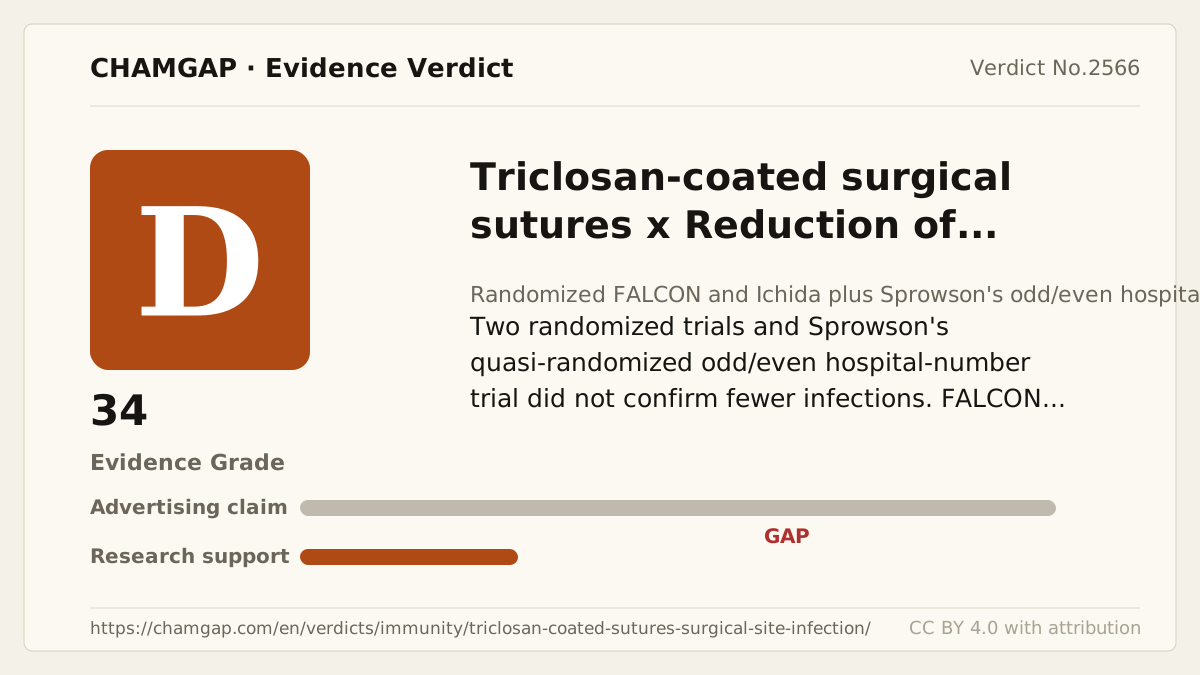
[Chamgap] Triclosan-coated sutures x reduced surgical-site infection — Evidence Grade D·34. 4 cited sources checked. Source: https://chamgap.com/en/verdicts/immunity/triclosan-coated-sutures-surgical-site-infection/ · CC BY 4.0CC BY 4.0 — free to use with attribution; do not distort grades, numbers, or verdict meaning.
What this document does and does not do
Chamgap is an information source. It reports what research has and has not confirmed; it does not tell readers what to take or buy. That decision belongs to readers and, when needed, medical or legal professionals. This verdict reflects literature available up to the search date and may change as new research appears. Nothing here is medical advice.