
Taurolidine-heparin catheter lock,
does it really help with Prevention of catheter-related bloodstream infection in hemodialysis through a central venous catheter?
research showsThe grade is B. In the 795-participant full analysis of LOCK IT-100, blinded-adjudicated catheter-related bloodstream infection occurred in 9/397 (2.3%) with taurolidine-heparin versus 32/398 (8.0%) with heparin, HR 0.29 (95% CI 0.14-0.62). A separately funded RCT also reduced infections with a different formulation, while LOCK IT-100 was manufacturer-sponsored and stopped early for efficacy, giving B with 72 points.
ads claimThe decisive point is fewer culture-confirmed bloodstream infections, not merely an antimicrobial mechanism. An independent trial exists, but its formulation differed, so it is not exact replication of the same product.
Useful facts when choosing a product
- The study formulation contained taurolidine 13.5 mg/mL, citrate 3.5%, and heparin 1,000 U/mL; the control contained heparin 1,000 U/mL.
- The lock was instilled after dialysis and withdrawn before the next dialysis session.
- The target brief's NCT03595514 was corrected to NCT02651428 after checking the paper and ClinicalTrials.gov.
- No duplicate verdict for this formulation and dialysis-catheter infection claim, PMID 37678222, or DOI 10.2215/CJN.0000000000000278 was found in the existing list.
What the research actually shows
LOCK IT-100 was a randomized, double-blind, active-controlled phase 3 trial at 70 US sites, with 795 participants in the full efficacy population. Its paper states, "This study was sponsored by CorMedix Inc." and three company employees were coauthors. Winnicki et al. 2018 independently randomized 106 patients in NCT02789501 to a different taurolidine regimen, TauroLock-Hep500 twice weekly plus TauroLock-U25,000 once weekly, or 4% citrate. Infection occurred as 6 events in 6/52 patients versus 18 events in 13/54, 0.67 versus 2.7 per 1,000 catheter-days, IRR 0.25 (95% CI 0.09-0.63), and dysfunction also favored taurolidine. Exit-site and tunnel infections and cardiovascular hospitalization were neutral; deaths were numerically unfavorable at 4 versus 2, though adjudicated unrelated to the lock regimen. The funding statement was, "This research did not receive any specific grant from funding agencies in the public, commercial, or not-for-profit sectors." Study solutions were purchased from TauroPharm.
Why this is classified as B (72)
A 795-participant phase 3 trial showed a large reduction in blinded-adjudicated bloodstream infection, and an independently funded RCT of a different formulation also reduced infection. Lack of exact product replication and early stopping limit the result to B with 72 points.
Counterpoint. B does not mean infection prevention failed. An independent trial was favorable, but its different formulation was not exact replication of LOCK IT-100.
Rejudgment record. Cross-check applied — We cross-checked outcomes, formulations, registrations, funding, and early stopping against LOCK IT-100 with NCT02651428 and Winnicki with NCT02789501.
| Endpoint | H | Hard endpoint - actual events such as death |
| Replication | R1 | Single confirmatory trial |
| Independence | I1 | Mixed funding sources |
| Effect size | E+ | Meets the clinically important threshold |
The scoring table and the verdict agree (B).
Sub-claim grades by effect
This ingredient is marketed for several effects. A single overall grade blends strong and weak claims together, so each effect is graded separately here. The overall grade reflects the strongest disconfirming or core claim.
| Effect (sub-claim) | Grade | Basis |
|---|---|---|
| Taurolidine-heparin lock reduces dialysis catheter-related bloodstream infection. | B | In 795 participants, rates were 2.3% versus 8.0%, HR 0.29. |
| Taurolidine-heparin lock reduces catheter removal for any reason. | D | This secondary outcome did not differ significantly between groups. |
Cross-check — Codex and Claude
Evidence Table
| Study | Design | Sample | Funding | Endpoint | Result | Weight |
|---|---|---|---|---|---|---|
| Study 1 | Randomized double-blind active-controlled phase 3 trial at 70 US sites | 398 | Original statement: "This study was sponsored by CorMedix Inc."; three company employees were coauthors | Time to catheter-related bloodstream infection confirmed by a blinded clinical adjudication committee | 9/397 (2.3%) versus 32/398 (8.0%); HR 0.29 (95% CI 0.14-0.62), P<0.001 | Large registered hard-outcome trial, but manufacturer-only and stopped early for efficacy |
| Study 2 | Prospective multicenter randomized trial versus 4% citrate | 54 | Original statement: "This research did not receive any specific grant from funding agencies in the public, commercial, or not-for-profit sectors." Study solutions were purchased from TauroPharm. | Catheter-related infection, dysfunction, and cost | Six infections in 6/52 versus 18 in 13/54; 0.67 versus 2.7 per 1,000 catheter-days, IRR 0.25 (95% CI 0.09-0.63). Dysfunction favored taurolidine; exit-site and tunnel infections and cardiovascular hospitalization were neutral, while deaths were numerically unfavorable at 4 versus 2 but adjudicated unrelated to the lock regimen. | Independently funded RCT, but with a formulation different from LOCK IT-100 |
Receipt — 3 References
All 3 cited sources were verified for existence at the original page (as of 2026-08-14).
Reviewed and approved: Chamgap Editorial Team · Approval date: 2026-08-14 · Corrections: none
Cite this verdict
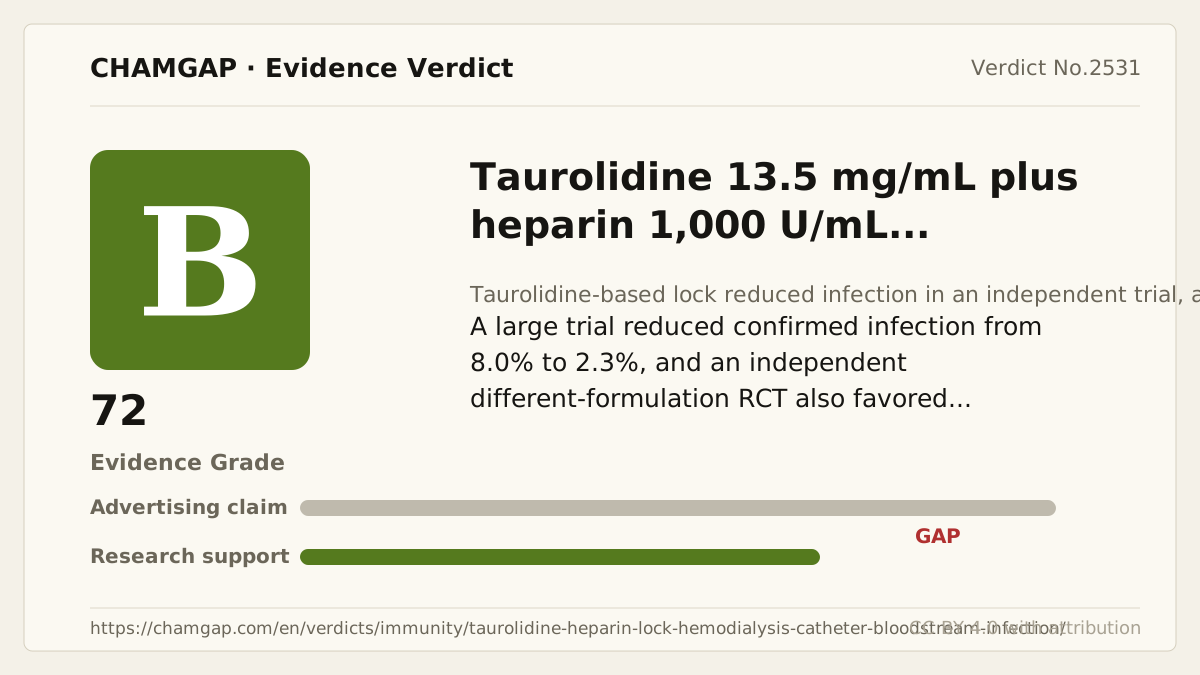
[Chamgap] Taurolidine-heparin catheter lock x prevention of bloodstream infection in hemodialysis — Evidence Grade B·72. 3 cited sources checked. Source: https://chamgap.com/en/verdicts/immunity/taurolidine-heparin-lock-hemodialysis-catheter-bloodstream-infection/ · CC BY 4.0CC BY 4.0 — free to use with attribution; do not distort grades, numbers, or verdict meaning.
What this document does and does not do
Chamgap is an information source. It reports what research has and has not confirmed; it does not tell readers what to take or buy. That decision belongs to readers and, when needed, medical or legal professionals. This verdict reflects literature available up to the search date and may change as new research appears. Nothing here is medical advice.