
Seed-oil intake,
does it really help with Increased blood inflammatory markers?
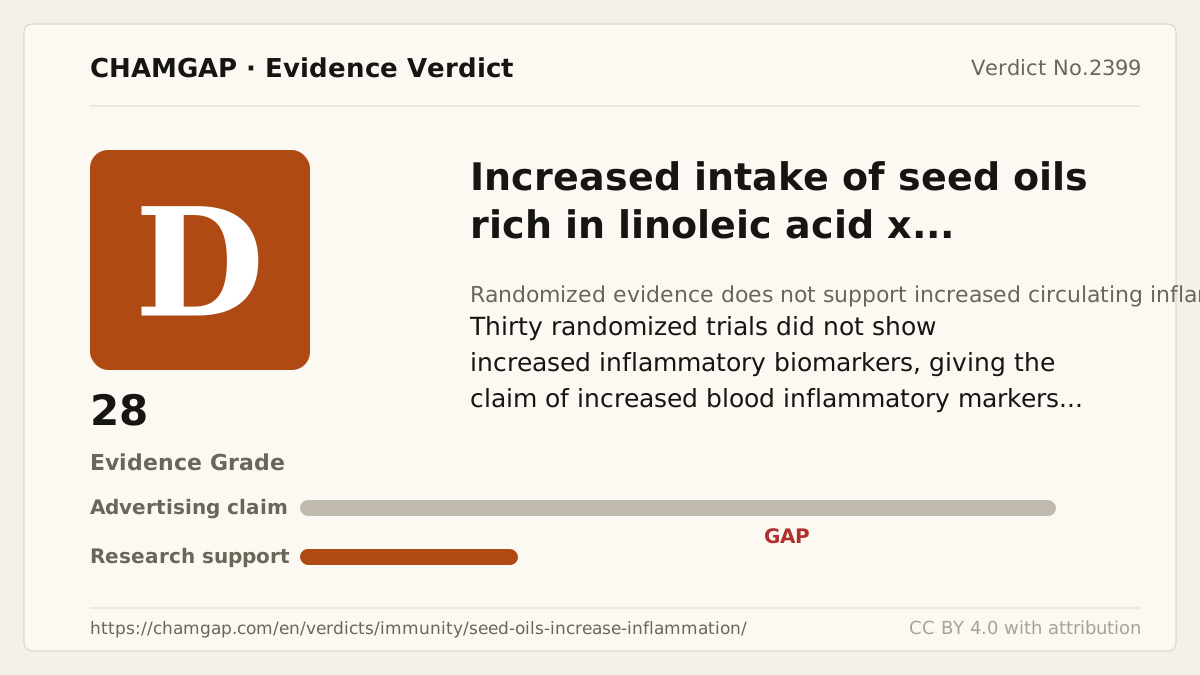
research showsThe grade is D with 28 points. A meta-analysis of 30 randomized trials with 1,377 adults found no significant increase in C-reactive protein when linoleic acid intake increased, SMD 0.09 (95% CI -0.05 to 0.24), and no consistent increase across other cytokines, acute-phase reactants, or adhesion molecules. These mostly short biomarker trials do not support the claim of increased blood inflammatory markers, but they were not long-term clinical-event trials capable of excluding every inflammatory disease outcome.
ads claimKorean social-media seed-oil avoidance often treats soybean, corn, sunflower, and grapeseed oils as one bad oil while marketing premium alternatives. Trials instead compare a specified oil with a specified replacement; cooking temperature, repeated heating, excess calories, and ultra-processed foods are separate exposures.
Useful facts when choosing a product
- Seed oil is a market category covering oils with different fatty-acid profiles, not one ingredient.
- Linoleic acid is an essential omega-6 fatty acid and was usually exchanged isocalorically with oleic acid or saturated fat in trials.
- Verdict 2087 is D with 30 points for perilla oil, verdict 2089 is D with 28 points for palm olein, and verdict 2090 is D with 30 points for grapeseed oil; each addresses a different intervention and outcome.
What the research actually shows
The 2017 systematic review and meta-analysis included 30 randomized controlled studies with 1,377 adults. Interventions generally increased linoleic acid through safflower, sunflower, corn, or soybean oils while replacing oleic-acid-rich oils or saturated fat isocalorically. Across 16 randomized CRP studies the pooled SMD was 0.09 (95% CI -0.05 to 0.24), with no confirmed increase. Fewer trials were pooled for IL-6, TNF-alpha, fibrinogen, and other markers, and endpoints differed. Exact trial counts for each of those markers could not be confirmed from the accessible text. The abstract reported no significant heterogeneity or publication bias, but exact marker-specific I-squared values were not available in the publicly verifiable text. A stricter 2012 review included 15 healthy-person trials, seven crossover and eight parallel, and likewise found virtually no evidence that adding linoleic acid increased inflammatory markers. The two reviews had independent authors but overlapping primary trials, so they were not counted as independent repeated refutations. The 2012 review states that it was funded through an unrestricted grant from the International Life Sciences Institute North America Technical Committee on Dietary Lipids; Guy H. Johnson disclosed consulting services to Monsanto Company and Bunge Limited during the preceding five years. These primary trials measured blood biomarkers; none measured clinical inflammatory-disease events as an endpoint.
Why this is classified as D (28)
The pooled CRP estimate did not increase, but other markers had fewer trials and varying endpoints; heterogeneous oils, comparators, and surrogate outcomes without clinical-event testing give D with 28 points.
Counterpoint. This verdict does not establish that every seed oil is beneficial under every use condition. Oxidation, repeated heating, allergy, caloric excess, and cardiovascular events are separate questions.
Rejudgment record. Cross-check applied — Thirty randomized studies did not consistently increase CRP or other inflammatory biomarkers, but oils, comparators, and endpoints varied and clinical events were not tested
| Endpoint | S | Surrogate marker - laboratory or imaging measures |
| Replication | R1 | Single confirmatory trial |
| Independence | I1 | Mixed funding sources |
| Effect size | E0 | Null |
| Precision | C0 | The confidence interval leaves room for benefit |
The scoring table and the verdict agree (D).
Sub-claim grades by effect
This ingredient is marketed for several effects. A single overall grade blends strong and weak claims together, so each effect is graded separately here. The overall grade reflects the strongest disconfirming or core claim.
| Effect (sub-claim) | Grade | Basis |
|---|---|---|
| Increased circulating CRP | D | Pooled SMD was 0.09 (-0.05 to 0.24). |
| Increased clinical inflammatory disease | ? | The pivotal trials did not use clinical inflammatory events as primary outcomes. |
Cross-check — Codex and Claude
Evidence Table
| Study | Design | Sample | Funding | Endpoint | Result | Weight |
|---|---|---|---|---|---|---|
| Study 1 | Systematic review and meta-analysis of randomized controlled trials | 16 | Mixed and partly unconfirmed funding across primary trials; overlap between the two reviews | CRP, cytokines, acute-phase reactants, and adhesion molecules | CRP SMD 0.09 (95% CI -0.05 to 0.24), no significant increase | Pivotal quantitative synthesis |
Receipt — 2 References
All 2 cited sources were verified for existence at the original page (as of 2026-08-07).
Reviewed and approved: Chamgap Editorial Team · Approval date: 2026-08-07 · Corrections: none
Cite this verdict
[Chamgap] Seed-oil intake x increased blood inflammatory markers — Evidence Grade D·28. 2 cited sources checked. Source: https://chamgap.com/en/verdicts/immunity/seed-oils-increase-inflammation/ · CC BY 4.0CC BY 4.0 — free to use with attribution; do not distort grades, numbers, or verdict meaning.
What this document does and does not do
Chamgap is an information source. It reports what research has and has not confirmed; it does not tell readers what to take or buy. That decision belongs to readers and, when needed, medical or legal professionals. This verdict reflects literature available up to the search date and may change as new research appears. Nothing here is medical advice.