
Romiplostim,
does it really help with Reduced treatment failure and splenectomy in adults with immune thrombocytopenia who had not undergone splenectomy?
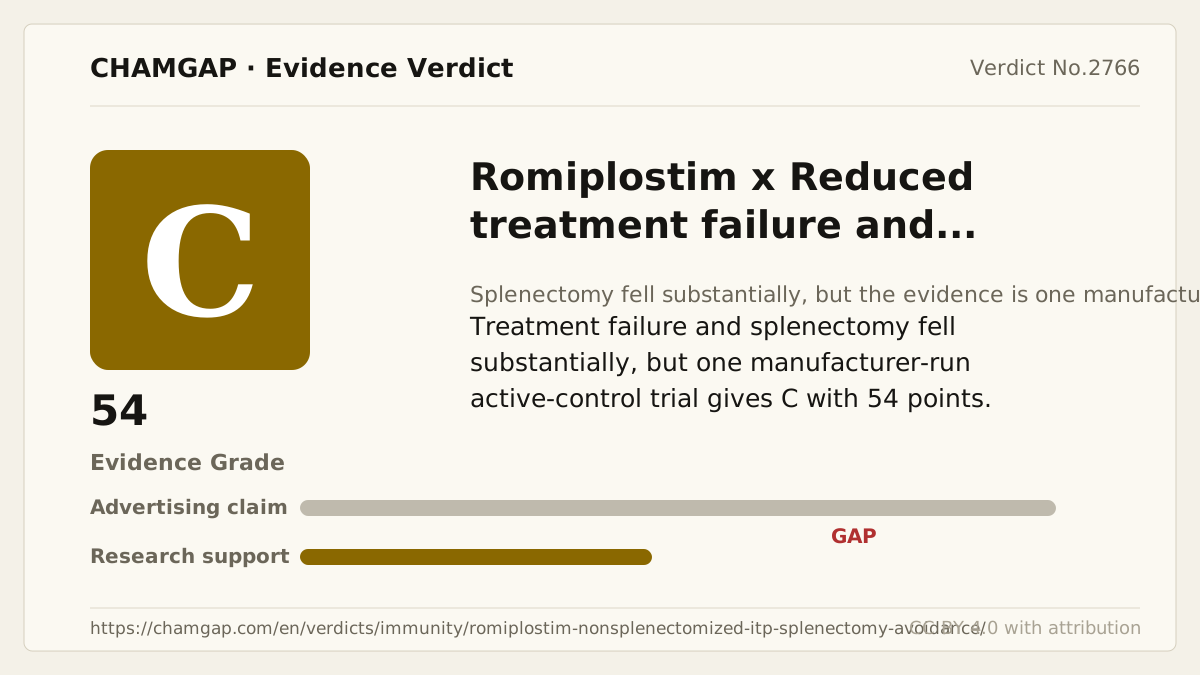
research showsThe grade is C. Over 52 weeks, treatment failure occurred in 18/157 (11%) with romiplostim versus 23/77 (30%) with standard care, and splenectomy in 14/157 (9%) versus 28/77 (36%). The absolute differences were -18.4 and -27.5 percentage points, and both coprimary endpoints had p<0.001. However, the evidence is one active-control trial for which Amgen handled design, data collection, analysis, and interpretation, giving C with 54 points.
ads claimA claim that the drug merely raises platelets misses the clinical question. The measured claim is that, among nonsplenectomized adults with ITP, romiplostim reduced treatment failure and splenectomy over 52 weeks versus standard care; the single manufacturer-run evidence base should also be disclosed.
Useful facts when choosing a product
- Romiplostim is a thrombopoietin-receptor agonist administered by weekly subcutaneous injection.
- The coprimary endpoints were treatment failure and splenectomy; platelet response was secondary.
- Unlike verdict 2726 on placebo-controlled eltrombopag platelet response, this trial asked about splenectomy avoidance versus standard care.
What the research actually shows
At 85 centers, 234 nonsplenectomized adults were randomized 2:1, and all 234 were included in the efficacy analysis. Treatment failure was 18/157 versus 23/77 and splenectomy 14/157 versus 28/77. Participants who discontinued were conservatively counted as having both coprimary events. Safety was analyzed in 229 treated participants, 154 versus 75. The article states, ‘Amgen (the sponsor) designed the study, gathered the data, conducted the statistical analyses, and interpreted the results,’ and Amgen also funded medical-writing support. Romiplostim was the trial intervention; no separate company-supplied assessment tool was identified. The active-control-only open design was counted as an avoidable limitation.
Why this is classified as C (54)
Splenectomy fell from 36% to 9%, but one manufacturer-run trial using only an active standard-care comparator gives C with 54 points.
Counterpoint. C does not mean the trial was null. It reflects the lack of independent replication and the restricted comparator design.
Rejudgment record. Cross-check applied — Centers the absolute differences in the coprimary treatment-failure and splenectomy endpoints while accounting for a single manufacturer-run trial and active-control-only design
| Endpoint | H | Hard endpoint - actual events such as death |
| Replication | R1 | Single confirmatory trial |
| Independence | I0 | Evidence comes only from manufacturer studies |
| Effect size | E+ | Meets the clinically important threshold |
The scoring table and the verdict agree (C).
Sub-claim grades by effect
This ingredient is marketed for several effects. A single overall grade blends strong and weak claims together, so each effect is graded separately here. The overall grade reflects the strongest disconfirming or core claim.
| Effect (sub-claim) | Grade | Basis |
|---|---|---|
| Reduced splenectomy over 52 weeks | C | Rates were 9% versus 36%, an absolute difference of -27.5 points. |
| Reduced treatment failure over 52 weeks | C | Rates were 11% versus 30%, an absolute difference of -18.4 points. |
Cross-check — Codex and Claude
Evidence Table
| Study | Design | Sample | Funding | Endpoint | Result | Weight |
|---|---|---|---|---|---|---|
| Study 1 | Open-label 2:1 randomized standard-care-controlled trial at 85 centers over 52 weeks | 75 | Funded by Amgen, which handled design, data collection, statistical analysis, interpretation, and medical-writing support; romiplostim was the trial drug | Coprimary endpoints: treatment failure and splenectomy over 52 weeks | Treatment failure 18/157 (11%) versus 23/77 (30%), absolute difference -18.4 points, OR 0.31 (95% CI 0.15 to 0.61); splenectomy 14/157 (9%) versus 28/77 (36%), absolute difference -27.5 points, OR 0.17 (0.08 to 0.35); both p<0.001 | Positive clinical-event coprimary endpoints in one manufacturer-run active-control trial |
Receipt — 1 References
All 1 cited sources were verified for existence at the original page (as of 2026-08-18).
Reviewed and approved: Chamgap Editorial Team · Approval date: 2026-08-18 · Corrections: none
Cite this verdict
[Chamgap] Romiplostim x avoidance of splenectomy in nonsplenectomized immune thrombocytopenia — Evidence Grade C·54. 1 cited sources checked. Source: https://chamgap.com/en/verdicts/immunity/romiplostim-nonsplenectomized-itp-splenectomy-avoidance/ · CC BY 4.0CC BY 4.0 — free to use with attribution; do not distort grades, numbers, or verdict meaning.
What this document does and does not do
Chamgap is an information source. It reports what research has and has not confirmed; it does not tell readers what to take or buy. That decision belongs to readers and, when needed, medical or legal professionals. This verdict reflects literature available up to the search date and may change as new research appears. Nothing here is medical advice.