
Rituximab plus short prednisone,
does it really help with Increased complete remission off therapy at 24 months in newly diagnosed moderate-to-severe pemphigus?
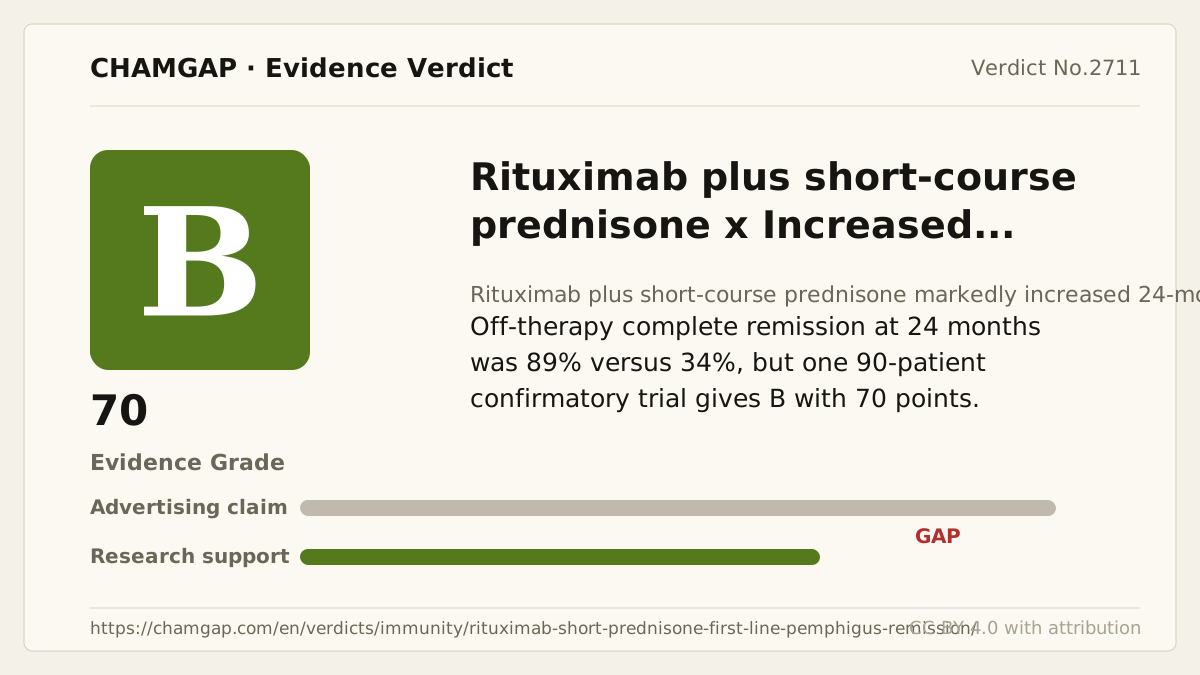
research showsThe grade is B with 70 points. In Ritux 3, 90 patients at 25 French dermatology departments were randomized. Complete remission off therapy at 24 months occurred in 41/46 (89%) with rituximab plus short-course prednisone versus 15/44 (34%) with prednisone alone: absolute difference 55 points (95% CI 38.4 to 71.7), RR 2.61 (1.71 to 3.99), P<.0001. The effect is large, but it comes from one confirmatory trial with fewer than 200 participants.
ads claimThis does not establish that rituximab alone permanently cures pemphigus. It shows that a specified rituximab schedule combined with a short prednisone taper increased 24-month complete remission off therapy in newly diagnosed moderate-to-severe disease.
Useful facts when choosing a product
- Rituximab is an intravenous monoclonal antibody targeting CD20-positive B cells.
- The combination arm received rituximab 1,000 mg on days 0 and 14 and 500 mg at months 12 and 18, with prednisone tapered over 3 to 6 months.
- There were 27 grade 3-4 serious adverse events in the combination arm and 53 in the prednisone-only arm.
What the research actually shows
Ritux 3 used central computer-generated randomization stratified by disease severity and analyzed all 46 versus 44 randomized patients as assigned. Complete remission off therapy at month 24 was the primary endpoint in both NCT00784589 and the paper. Participants and clinicians knew allocation, but the endpoint required complete remission while taking no therapy. Enrollment below 200 was counted as the main avoidable limitation. The article funding statement names the French Ministry of Health, French Society of Dermatology, and Roche, making the funding mixed.
Why this is classified as B (70)
A large clinical effect with central randomization and all-patient analysis is strong, but a single 90-person open-label confirmatory trial gives B with 70 points.
Counterpoint. Long-term relapse, repeat dosing, and rare serious harms are not settled by the 24-month remission rate alone.
Rejudgment record. Cross-check applied — Cross-checked the abstract and registry for central randomization, all-90 intention-to-treat analysis, the prespecified 24-month endpoint, effect estimates, and mixed public, nonprofit, and Roche funding
| Endpoint | H | Hard endpoint - actual events such as death |
| Replication | R1 | Single confirmatory trial |
| Independence | I1 | Mixed funding sources |
| Effect size | E+ | Meets the clinically important threshold |
The scoring table and the verdict agree (B).
Sub-claim grades by effect
This ingredient is marketed for several effects. A single overall grade blends strong and weak claims together, so each effect is graded separately here. The overall grade reflects the strongest disconfirming or core claim.
| Effect (sub-claim) | Grade | Basis |
|---|---|---|
| Increased complete remission off therapy at 24 months | B | Rates were 89% versus 34%, an absolute difference of 55 points. |
| Permanent cure | ? | The trial did not exclude all relapse beyond 24 months. |
Cross-check — Codex and Claude
Evidence Table
| Study | Design | Sample | Funding | Endpoint | Result | Weight |
|---|---|---|---|---|---|---|
| Study 1 | Open-label, centrally randomized parallel trial at 25 French centers | 44 | French Ministry of Health PHRC, French Society of Dermatology, and Roche | Complete remission off therapy at month 24 | 41/46 (89%) vs 15/44 (34%); absolute difference 55 points (95% CI 38.4 to 71.7), RR 2.61 (1.71 to 3.99), P<.0001 | Single confirmatory trial with a large clinical effect |
Receipt — 2 References
All 2 cited sources were verified for existence at the original page (as of 2026-08-18).
Reviewed and approved: Chamgap Editorial Team · Approval date: 2026-08-18 · Corrections: none
Cite this verdict
[Chamgap] Rituximab plus short prednisone x off-therapy remission in pemphigus — Evidence Grade B·70. 2 cited sources checked. Source: https://chamgap.com/en/verdicts/immunity/rituximab-short-prednisone-first-line-pemphigus-remission/ · CC BY 4.0CC BY 4.0 — free to use with attribution; do not distort grades, numbers, or verdict meaning.
What this document does and does not do
Chamgap is an information source. It reports what research has and has not confirmed; it does not tell readers what to take or buy. That decision belongs to readers and, when needed, medical or legal professionals. This verdict reflects literature available up to the search date and may change as new research appears. Nothing here is medical advice.