
Picaridin lotion plus insecticidal nets,
does it really help with Reduced PCR-confirmed malaria infection among residents of an endemic area?
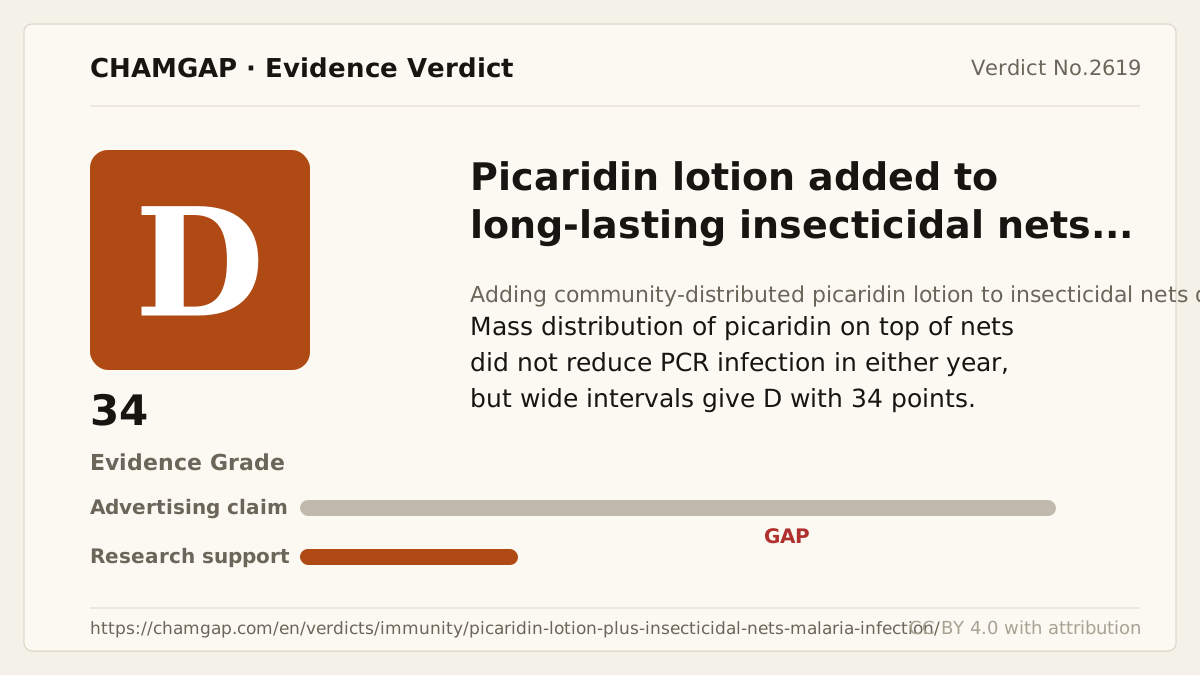
research showsThe grade is D. In a 98-cluster Cambodian trial, PCR positivity in 2012 was 4.86% with added picaridin versus 4.91% with nets alone, adjusted OR 1.01 (95% CI 0.60 to 1.70). In 2013 it was 3.85% versus 2.96%, OR 1.31 (0.81 to 2.11). Neither survey showed reduced infection, but they were repeated surveys within one trial and the intervals did not precisely exclude benefit, giving D with 34 points.
ads claimThe trial does not deny that picaridin repels mosquitoes on treated skin. It failed to show that a daily community distribution strategy reduced PCR prevalence beyond insecticidal nets. Short-term personal use by travelers and a two-year population rollout in Cambodia are different use conditions.
Useful facts when choosing a product
- The intervention supplied 20% picaridin lotion for adults and 10% for children, while every cluster received long-lasting insecticidal nets.
- PCR-confirmed infection did not decline in either survey year, and investigators identified poor daily adherence as a central obstacle.
- This verdict concerns added malaria prevention from community distribution, not every personal-repellency use of picaridin.
What the research actually shows
Investigators assessed 117 high-endemic villages in Ratanakiri, excluded four that were inaccessible, and grouped 25 nearby villages to form 98 clusters. Forty-nine clusters received one long-lasting insecticidal net per person plus picaridin, and 49 received nets alone. Cross-sectional surveys randomly selected 65 people per cluster around each transmission season, and real-time PCR determined infection. The trial used computer-based restricted randomization and intention-to-treat analysis, but no placebo lotion; masking of PCR personnel was not confirmed in the accessible report. The Bill & Melinda Gates Foundation funded the study and reportedly had no role in design, collection, analysis, interpretation, or writing.
Why this is classified as D (34)
A publicly funded cluster-randomized trial measured actual infection in two years and was null, but it remained one trial and confidence intervals allowed substantial benefit. Three strength features give D with 34 points.
Counterpoint. Low adherence prevents converting this result into proof that regularly applied picaridin lacks personal repellency. The target claim is effectiveness of the population rollout.
Rejudgment record. Cross-check applied — The Sluydts paper and NCT01663831 were checked for cluster count, registered primary endpoint, annual adjusted odds ratios, funding, and adherence
| Endpoint | H | Hard endpoint - actual events such as death |
| Replication | R1 | Single confirmatory trial |
| Independence | I2 | Decisive evidence is publicly or non-profit funded |
| Effect size | E0 | Null |
| Precision | C0 | The confidence interval leaves room for benefit |
The scoring table and the verdict agree (D).
Sub-claim grades by effect
This ingredient is marketed for several effects. A single overall grade blends strong and weak claims together, so each effect is graded separately here. The overall grade reflects the strongest disconfirming or core claim.
| Effect (sub-claim) | Grade | Basis |
|---|---|---|
| Reduced PCR-confirmed malaria infection in 2012 | D | The result was null, aOR 1.01 (0.60 to 1.70). |
| Reduced PCR-confirmed malaria infection in 2013 | D | The result was null, aOR 1.31 (0.81 to 2.11). |
| Reduced mosquito bites in a consistently treated individual | ? | This was not the target of the cluster trial and requires separate efficacy evidence. |
Cross-check — Codex and Claude
Evidence Table
| Study | Design | Sample | Funding | Endpoint | Result | Weight |
|---|---|---|---|---|---|---|
| Study 1 | Cluster-randomized controlled trial with 98 clusters | 65 | Bill & Melinda Gates Foundation | Real-time PCR-confirmed Plasmodium prevalence in 2012 and 2013 | 2012: 4.86% versus 4.91%, aOR 1.01 (0.60 to 1.70); 2013: 3.85% versus 2.96%, aOR 1.31 (0.81 to 2.11). | Direct infection endpoint with poor adherence and wide confidence intervals |
Receipt — 2 References
All 2 cited sources were verified for existence at the original page (as of 2026-08-15).
Reviewed and approved: Chamgap Editorial Team · Approval date: 2026-08-15 · Corrections: none
Cite this verdict
[Chamgap] Picaridin lotion plus insecticidal nets x reduced malaria infection — Evidence Grade D·34. 2 cited sources checked. Source: https://chamgap.com/en/verdicts/immunity/picaridin-lotion-plus-insecticidal-nets-malaria-infection/ · CC BY 4.0CC BY 4.0 — free to use with attribution; do not distort grades, numbers, or verdict meaning.
What this document does and does not do
Chamgap is an information source. It reports what research has and has not confirmed; it does not tell readers what to take or buy. That decision belongs to readers and, when needed, medical or legal professionals. This verdict reflects literature available up to the search date and may change as new research appears. Nothing here is medical advice.