
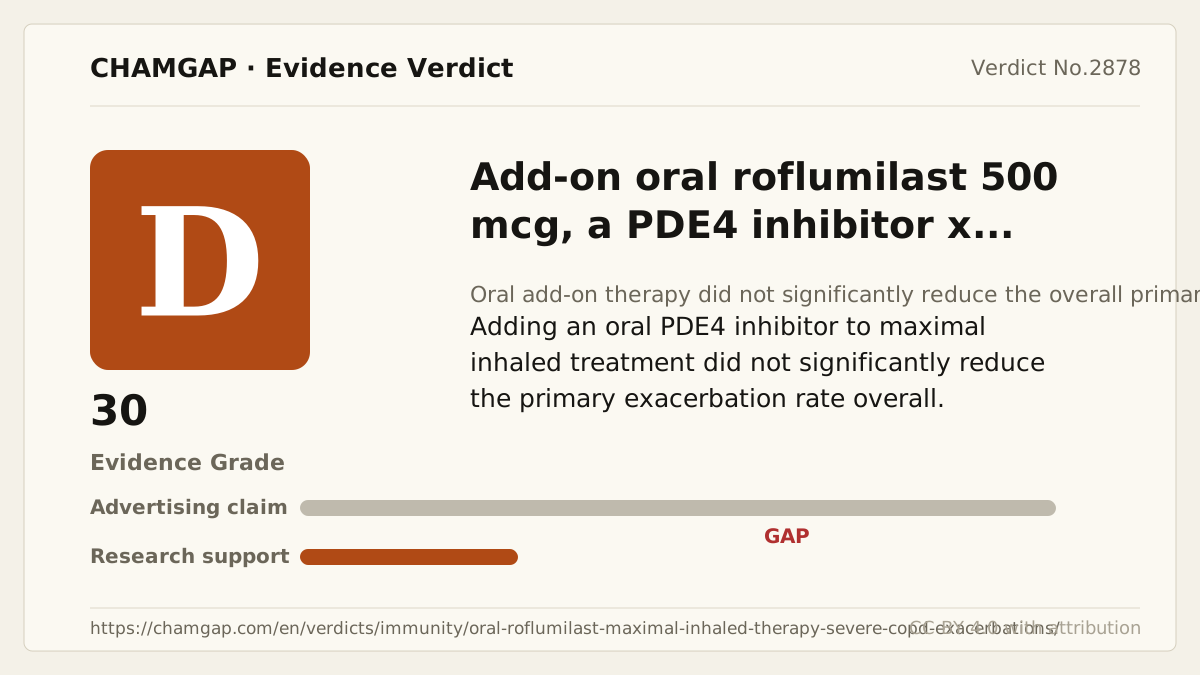
Add-on oral roflumilast 500 mcg, a PDE4 inhibitor,
does it really help with Reduced moderate or severe exacerbations in severe COPD on maximal inhaled therapy?
research showsThe grade is D. Primary annual moderate/severe exacerbation rates were 1.17 versus 1.27 per patient-year, absolute difference -0.10, rate ratio 0.92 (95% CI 0.81 to 1.04), P=0.163. The prespecified significance threshold was missed, while the interval still allowed a 19% relative rate reduction.
ads claimA post hoc high-risk subgroup and lung-function improvement cannot convert the overall primary P=0.163 result into success.
Useful facts when choosing a product
- Roflumilast is an oral selective PDE4 inhibitor.
- Background therapy was ICS/LABA, with LAMA allowed.
- Diarrhea, nausea, weight loss, and discontinuation require monitoring.
What the research actually shows
Moderate events required oral or parenteral glucocorticosteroids; severe events required hospitalization and/or led to death. Thus treatment decisions and hospitalization were combined.
Axis 6 B0 evidence ① Allocation concealment: randomized 1:1 through an interactive voice/web response system, stratified by LAMA use. ② Blinding: 'double-blind, placebo-controlled, parallel-group trial' with matching placebo. ③ Analysis set and missingness: 'Intent-to-Treat Study Population' analyzed by negative binomial regression with exposure time. ④ Prespecified primary endpoint: 'The primary efficacy measure is the rate of moderate or severe COPD exacerbations per participant per year' - consistent with NCT01443845.
Dropout candidate gates ① Defect: substantial attrition. ② Listed item: substantial attrition (at least 15%). ③ Evidence: 591/2,354=25.1% did not complete treatment. ④ Avoidability: not applicable; this was an ITT event-rate analysis using observed time, so fixed-time missingness requirements were not met.
Why this is classified as D (30)
P, R1, I0, E0, B0, and C0 yield D with 30 points.
Counterpoint. The post hoc very-frequent-exacerbator signal requires confirmation.
Rejudgment record. Cross-check applied — Used the null overall ITT event-rate analysis while preserving benefit allowed by the confidence interval and manufacturer-only evidence
| Endpoint | P | Patient-reported treatment goal - the symptom is the goal |
| Replication | R1 | Single confirmatory trial |
| Independence | I0 | Evidence comes only from manufacturer studies |
| Effect size | E0 | Null |
| Precision | C0 | The confidence interval leaves room for benefit |
The scoring table and the verdict agree (D).
Sub-claim grades by effect
This ingredient is marketed for several effects. A single overall grade blends strong and weak claims together, so each effect is graded separately here. The overall grade reflects the strongest disconfirming or core claim.
| Effect (sub-claim) | Grade | Basis |
|---|---|---|
| Reduced exacerbations overall | D | Rate ratio was 0.92 (0.81 to 1.04), P=0.163. |
| Improved lung function | C | The prespecified secondary result was favorable, but the primary exacerbation rate failed. |
Cross-check — Codex and Claude
Evidence Table
| Study | Design | Sample | Funding | Endpoint | Result | Weight |
|---|---|---|---|---|---|---|
| Study 1 | 52-week phase 4 multicenter randomized double-blind placebo-controlled add-on trial | 1,174 | Manufacturer support related to Takeda and AstraZeneca with company authors disclosed | Annual rate of moderate or severe COPD exacerbations | 1.17 versus 1.27 per patient-year; rate ratio 0.92 (95% CI 0.81 to 1.04), absolute difference -0.10, P=0.163. | Pivotal manufacturer-funded null trial |
Receipt — 1 References
All 1 cited sources were verified for existence at the original page (as of 2026-08-18).
Reviewed and approved: Chamgap Editorial Team · Approval date: 2026-08-18 · Corrections: none
Cite this verdict
[Chamgap] No Benefit of Adding Oral Roflumilast for Exacerbations in Severe COPD on Maximal Inhaled Therapy — Evidence Grade D·30. 1 cited sources checked. Source: https://chamgap.com/en/verdicts/immunity/oral-roflumilast-maximal-inhaled-therapy-severe-copd-exacerbations/ · CC BY 4.0CC BY 4.0 — free to use with attribution; do not distort grades, numbers, or verdict meaning.
What this document does and does not do
Chamgap is an information source. It reports what research has and has not confirmed; it does not tell readers what to take or buy. That decision belongs to readers and, when needed, medical or legal professionals. This verdict reflects literature available up to the search date and may change as new research appears. Nothing here is medical advice.