
On-site nursing-home pneumonia pathway,
does it really help with Reduced hospital admission for nursing-home residents with pneumonia or lower respiratory infection?
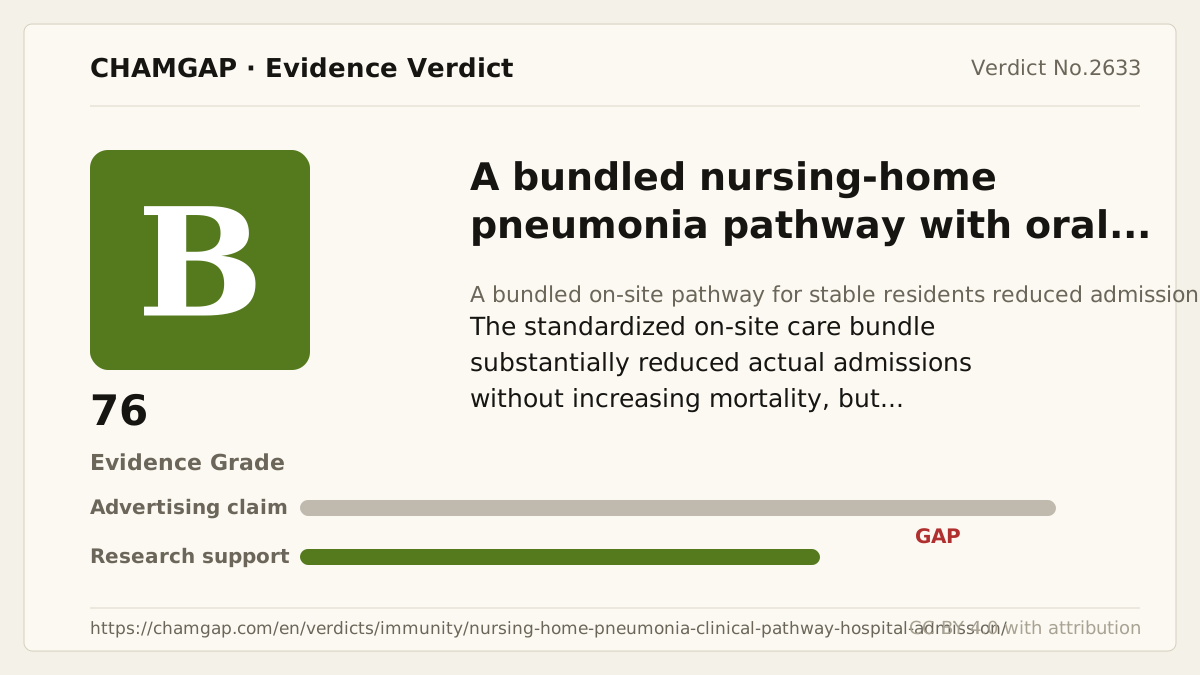
research showsThe grade is B. Twenty-two nursing homes were randomized, two withdrew before enrolling residents, and 680 residents entered across the remaining 20 homes. Admission occurred in 34/327 (10%) with the pathway and 76/353 (22%) with usual care; the cluster-adjusted absolute reduction was 12 percentage points (95% CI 5-18). This is roughly one admission prevented per eight residents managed, but evidence comes from one cluster trial and complete 30-day data were available for 661/680, giving B with 76 points.
ads claimSimply saying care occurred in a nursing home does not reproduce the intervention. The trial tested the entire pathway: explicit stability criteria, treatment resources, monitoring, and transfer on deterioration.
Useful facts when choosing a product
- On-site criteria included pulse at most 100/min, respiratory rate below 30/min, systolic pressure at least 90 mm Hg, oxygen saturation at least 92%, and ability to eat and drink.
- Residents who deteriorated beyond pathway criteria were transferred.
- The bundle cannot identify separate effects of antibiotic, oxygen, radiography, fluids, or nurse monitoring.
What the research actually shows
Homes were paired by bed count and a statistician independent of the study team used a random-number table to allocate one member of each pair. The paper states that allocation was concealed, but nurses and residents could not be blinded; investigators did not participate in hospital-admission decisions. The trial enrolled 680 residents, while complete 30-day admission follow-up was available for 314/327 (96%) and 347/353 (98%), 661 total. The authors reported intention-to-treat analysis. NCT00157612 links to the paper's admission endpoint, but its public registration followed study initiation. CIHR and the Physicians' Services Incorporated Foundation funded the trial. Loeb, Simor, and Marrie disclosed outside industry relationships, while the funders had no study role.
Why this is classified as B (76)
A publicly and noncommercially funded cluster trial reduced a hard admission outcome by 12 points, but one trial and complete data for 661/680 limit it to B with 76 points.
Counterpoint. The result applies to stable residents meeting pathway criteria and is not evidence to avoid transfer for severe illness.
Rejudgment record. Cross-check applied — The JAMA report, PubMed, and NCT00157612 were checked for cluster allocation, primary endpoint, 680 enrolled and 661 with complete follow-up, funding and disclosures, and bundle components
| Endpoint | H | Hard endpoint - actual events such as death |
| Replication | R1 | Single confirmatory trial |
| Independence | I2 | Decisive evidence is publicly or non-profit funded |
| Effect size | E+ | Meets the clinically important threshold |
The scoring table and the verdict agree (B).
Sub-claim grades by effect
This ingredient is marketed for several effects. A single overall grade blends strong and weak claims together, so each effect is graded separately here. The overall grade reflects the strongest disconfirming or core claim.
| Effect (sub-claim) | Grade | Basis |
|---|---|---|
| Reduced hospital admission | B | The cluster-adjusted absolute difference was 12 percentage points. |
| No increase in mortality | D | Rates were 24/327 versus 32/353 without significance; the trial did not establish equivalence. |
Cross-check — Codex and Claude
Evidence Table
| Study | Design | Sample | Funding | Endpoint | Result | Weight |
|---|---|---|---|---|---|---|
| Loeb M, Carusone SC, Goeree R, Walter SD, Brazil K, Krueger P, Simor A, Moss L, Marrie T. 2006 | Nursing-home cluster-randomized usual-care-controlled trial | 347 | Canadian Institutes of Health Research and Physicians' Services Incorporated Foundation of Ontario | Primary hospital admission | 34/327 (10%) versus 76/353 (22%); cluster-adjusted absolute difference 12 points (95% CI 5-18). | Only direct cluster-randomized trial |
Receipt — 1 References
All 1 cited sources were verified for existence at the original page (as of 2026-08-15).
Reviewed and approved: Chamgap Editorial Team · Approval date: 2026-08-15 · Corrections: none
Cite this verdict
[Chamgap] On-site nursing-home pneumonia pathway x fewer hospital admissions — Evidence Grade B·76. 1 cited sources checked. Source: https://chamgap.com/en/verdicts/immunity/nursing-home-pneumonia-clinical-pathway-hospital-admission/ · CC BY 4.0CC BY 4.0 — free to use with attribution; do not distort grades, numbers, or verdict meaning.
What this document does and does not do
Chamgap is an information source. It reports what research has and has not confirmed; it does not tell readers what to take or buy. That decision belongs to readers and, when needed, medical or legal professionals. This verdict reflects literature available up to the search date and may change as new research appears. Nothing here is medical advice.