
Otovent nasal balloon autoinflation,
does it really help with Tympanometric resolution of otitis media with effusion in children?
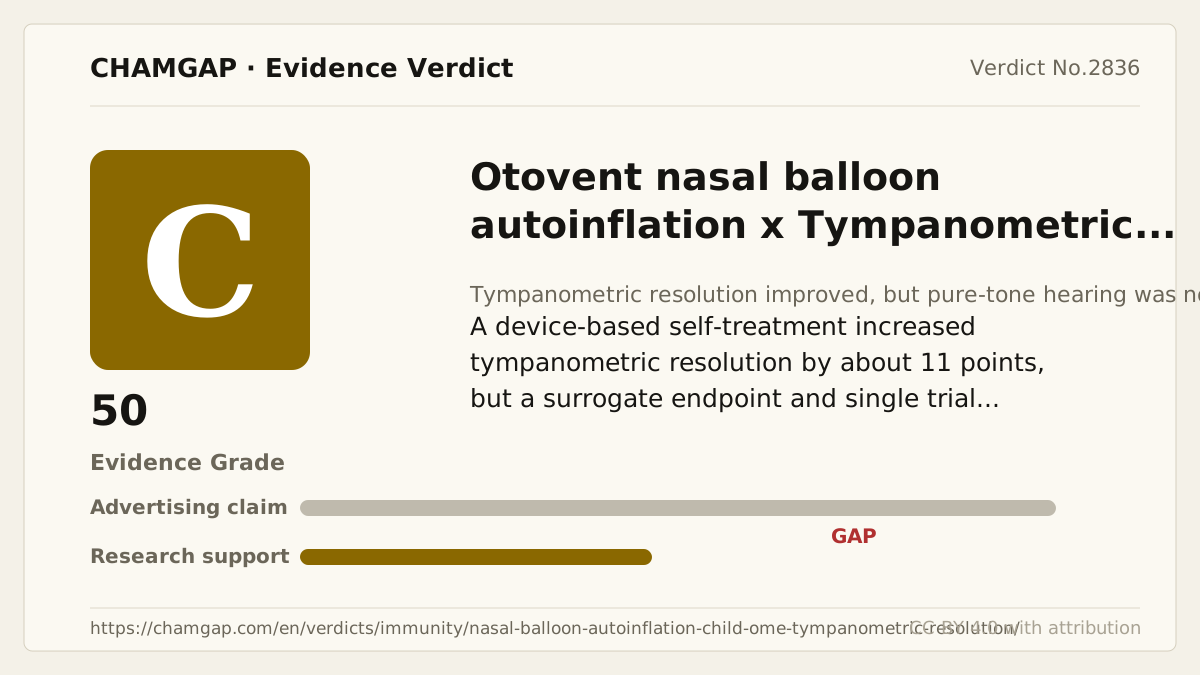
research showsThe grade is C with 50 points. At three months, tympanometric resolution occurred in 62/125 children (49.6%) with autoinflation and 46/120 (38.3%) with usual care, an absolute difference of 11.3 points; adjusted RR 1.37 (95% CI 1.03 to 1.83), NNT 9. Tympanometry is a surrogate rather than hearing itself, capping the grade at C.
ads claimVerdict 2828 is D with 34 points for oral prednisolone and hearing in persistent OME. Verdict 1757 is D with 28 points for tubes in recurrent acute otitis, verdict 1923 is B with 72 points for amoxicillin-clavulanate in acute otitis, verdict 2544 is B with 70 points for drops in acute tube otorrhea, and verdict 2550 is D with 30 points for water precautions after tubes. This intervention occupies the non-drug, non-surgical self-device niche during watchful waiting.
Useful facts when choosing a product
- Otovent-type nasal balloons are sold in South Korea.
- Use required three sessions daily for one to three months; reported adherence was 89% at one month and 80% at three months.
- Nosebleed rates were similar, but otalgia was reported in 7 versus 2 children and one autoinflation child recovered after admission for mild early mastoiditis.
What the research actually shows
The UK trial randomized 320 children aged 4 to 11 in 43 primary-care practices. Allocation used "An independent external agency provided a centralized Web-based computer-generated randomization system". Families and nurses were unmasked, but primary endpoint review was blinded: "Two members of the trial team, trained in tympanometry and masked to allocation, independently reviewed anonymized tympanometry printouts." Limitation name: substantial attrition (>=15%). Listed item: the one-month modified intention-to-treat analysis included 263/320, leaving 57/320 (17.8%) without a valid primary result. Avoidability: possible - valid tympanograms could have been obtained for every randomized child or an imputed analysis could have been primary; multiple-imputation sensitivity analysis was similar. Completer analysis was not counted again because it is the same missing-data fact. Unblinded subjective endpoint does not apply because the primary printouts were reviewed blind. Short duration (<12 weeks) does not apply because three months is 12 weeks and fits watchful waiting. NIHR HTA funded the trial, while the registry says Kestrel Medical supplied the Otovent devices, making support mixed.
Why this is classified as C (50)
The primary endpoint was tympanometric normalization, a surrogate that caps the grade at C. A single trial, device supply from Kestrel, and 17.8% missing valid one-month outcomes are balanced against blinded endpoint review and a positive 11.3-point three-month difference, giving C with 50 points.
Counterpoint. The trial supports tympanometric and ear-related quality-of-life improvement, not direct pure-tone hearing gain or long-term avoidance of surgery.
Rejudgment record. New verdict — Blinded tympanogram review, an 11.3-point three-month difference, surrogate cap, single trial, device supply, and 17.8% missing valid one-month outcomes
| Endpoint | S | Surrogate marker - laboratory or imaging measures |
| Replication | R1 | Single confirmatory trial |
| Independence | I1 | Mixed funding sources |
| Effect size | E+ | Meets the clinically important threshold |
The scoring table and the verdict agree (C).
Sub-claim grades by effect
This ingredient is marketed for several effects. A single overall grade blends strong and weak claims together, so each effect is graded separately here. The overall grade reflects the strongest disconfirming or core claim.
| Effect (sub-claim) | Grade | Basis |
|---|---|---|
| Three-month tympanometric resolution | C | The absolute difference was 11.3 points, NNT 9. |
| Pure-tone hearing improvement | ? | This trial did not perform pure-tone audiometry. |
Cross-check — Codex and Claude
Evidence Table
| Study | Design | Sample | Funding | Endpoint | Result | Weight |
|---|---|---|---|---|---|---|
| Study 1 | UK multicenter open randomized usual-care-controlled trial | 245 | NIHR HTA 09/01/27; Otovent devices supplied by Kestrel Medical | Conversion of at least one affected ear from type B to type A or C1 tympanometry | At three months, 62/125 (49.6%) versus 46/120 (38.3%); absolute difference 11.3 points; adjusted RR 1.37 (95% CI 1.03 to 1.83); NNT 9 | Pivotal single surrogate-endpoint trial |
Receipt — 1 References
All 1 cited sources were verified for existence at the original page (as of 2026-08-18).
Reviewed and approved: Chamgap Editorial Team · Approval date: 2026-08-18 · Corrections: none
Cite this verdict
[Chamgap] Nasal Balloon Autoinflation Benefits Tympanometric Resolution in Children with Otitis Media with Effusion — Evidence Grade C·50. 1 cited sources checked. Source: https://chamgap.com/en/verdicts/immunity/nasal-balloon-autoinflation-child-ome-tympanometric-resolution/ · CC BY 4.0CC BY 4.0 — free to use with attribution; do not distort grades, numbers, or verdict meaning.
What this document does and does not do
Chamgap is an information source. It reports what research has and has not confirmed; it does not tell readers what to take or buy. That decision belongs to readers and, when needed, medical or legal professionals. This verdict reflects literature available up to the search date and may change as new research appears. Nothing here is medical advice.