
Luspatercept,
does it really help with Reducing transfusion burden in transfusion-dependent beta-thalassemia?
research showsLuspatercept increased the proportion achieving at least a 33% reduction in transfusion burden plus at least two fewer red-cell units during weeks 13–24 from 4.5% with placebo to 21.4%. The absolute difference was 16.9 percentage points, but the evidence comes from one trial whose manufacturers participated in design, analysis, and manuscript preparation.
ads claimIt is an overstatement to say that luspatercept removes the need for transfusion. Although the primary response was more common than with placebo, only about one in five treated patients met the prespecified threshold.
Useful facts when choosing a product
- Luspatercept and placebo were the tested trial materials.
- Celgene funded the study in collaboration with Acceleron Pharma, and the two sponsors participated with the independent steering committee in design, conduct, data collection and management, analysis, interpretation, and manuscript preparation and review.
What the research actually shows
BELIEVE was an international multicenter, 2:1 randomized, double-blind, placebo-controlled phase 3 trial. All 336 randomized patients were included in the prespecified intention-to-treat efficacy analysis, and discontinuers were treated as nonresponders for the relevant 12-week interval. The safety analysis included 332 treated patients (223 versus 109). Central Interactive Response Technology was used for randomization. The paper reported double masking, but did not report a test showing that participant masking remained intact despite repeated transfusion monitoring and dose adjustment; the highest design rating was therefore not assigned. The targeted 20% difference was a 90%-power assumption, not a declared minimum clinically important difference. Verdict 2769 is C with 54 points and concerns chelation of transfusional iron overload rather than treatment of the anemia itself. This verdict asks whether promoting erythroid maturation reduces the need for transfusion, so the therapeutic questions differ.
Why this is classified as C (54)
A patient-relevant transfusion-burden response improved in a placebo-controlled randomized trial, but there is no independent replication, the evidence is manufacturer-only, and maintenance of masking was not fully demonstrated. The manufacturer-only evidence ceiling supports grade C.
Counterpoint. Many authors disclosed Celgene or Acceleron research funding and consulting fees, and some were company employees. More importantly, both sponsors directly participated throughout the trial rather than merely appearing in author disclosures.
Rejudgment record. New verdict
| Endpoint | H | Hard endpoint - actual events such as death |
| Replication | R1 | Single confirmatory trial |
| Independence | I0 | Evidence comes only from manufacturer studies |
| Effect size | E+ | Meets the clinically important threshold |
The scoring table and the verdict agree (C).
Sub-claim grades by effect
This ingredient is marketed for several effects. A single overall grade blends strong and weak claims together, so each effect is graded separately here. The overall grade reflects the strongest disconfirming or core claim.
| Effect (sub-claim) | Grade | Basis |
|---|---|---|
| Luspatercept increases transfusion-burden response during weeks 13–24. | C | The primary endpoint succeeded at 21.4% versus 4.5%, an absolute difference of 16.9 percentage points. |
| Luspatercept frees most patients from transfusion. | D | Only 21.4% of treated patients met the primary response threshold. |
Cross-check — Codex and Claude
Evidence Table
| Study | Design | Sample | Funding | Endpoint | Result | Weight |
|---|---|---|---|---|---|---|
| BELIEVE | International multicenter 2:1 randomized, double-blind, placebo-controlled phase 3 trial | 336 randomized and included in the prespecified intention-to-treat efficacy analysis (224 luspatercept, 112 placebo); 332 treated in the safety analysis (223, 109) | Celgene in collaboration with Acceleron Pharma. Both sponsors participated in study design, conduct, data collection and management, analysis, interpretation, and manuscript preparation and review; luspatercept and placebo were the tested trial materials. | Primary transfusion-burden response during weeks 13–24: 21.4% vs 4.5%; absolute difference 16.9 percentage points, p<.001. |
Receipt — 2 References
All 2 cited sources were verified for existence at the original page (as of 2026-08-18).
Reviewed and approved: Chamgap Editorial Team · Approval date: 2026-08-18 · Corrections: none
Cite this verdict
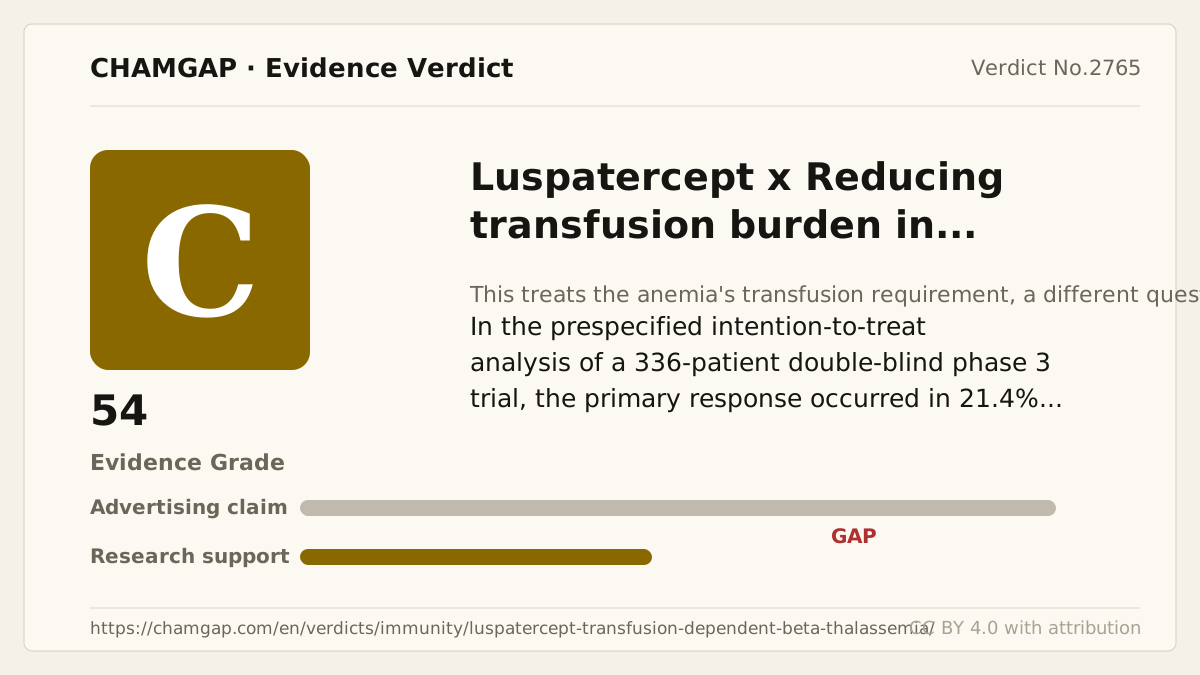
[Chamgap] Luspatercept × transfusion-dependent beta-thalassemia — Evidence Grade C·54. 2 cited sources checked. Source: https://chamgap.com/en/verdicts/immunity/luspatercept-transfusion-dependent-beta-thalassemia/ · CC BY 4.0CC BY 4.0 — free to use with attribution; do not distort grades, numbers, or verdict meaning.
What this document does and does not do
Chamgap is an information source. It reports what research has and has not confirmed; it does not tell readers what to take or buy. That decision belongs to readers and, when needed, medical or legal professionals. This verdict reflects literature available up to the search date and may change as new research appears. Nothing here is medical advice.